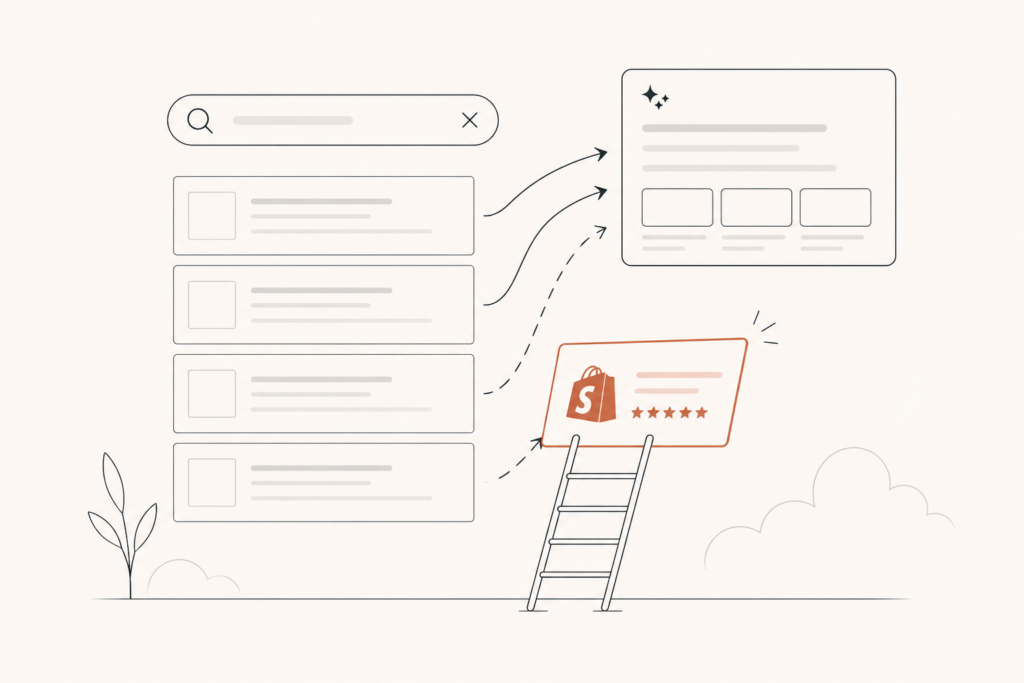
Your Shopify store is probably leaking organic traffic right now, and the scary part is you cannot feel it happening. Rankings look stable. The store loads. Yet fewer of those impressions turn into clicks than they did a year ago. That gap is the story of Shopify SEO in 2026, and if you ignore it, your cheapest channel quietly stops paying you.
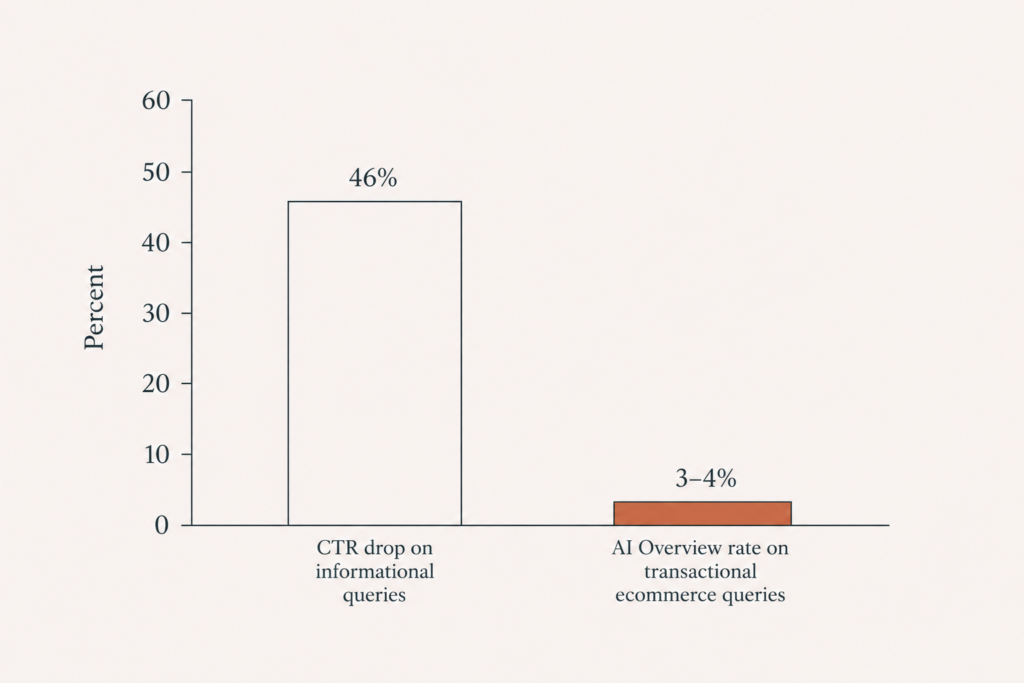
Here is the uncomfortable truth. Google AI Overviews now appear in roughly 13% of all queries, up from under 5% during the limited 2025 rollout, and they cut organic click-through by anywhere from 15% to 46% depending on the query. Position one used to feel safe. Not anymore.
But here is the good news I keep proving on real stores: transactional ecommerce queries are far more insulated than informational ones. AI Overviews show on only 3% to 4% of “buy X,” “best X for Y,” and “price of X” searches. So the money keywords are still very winnable. You just have to play sharper. Let me show you how.
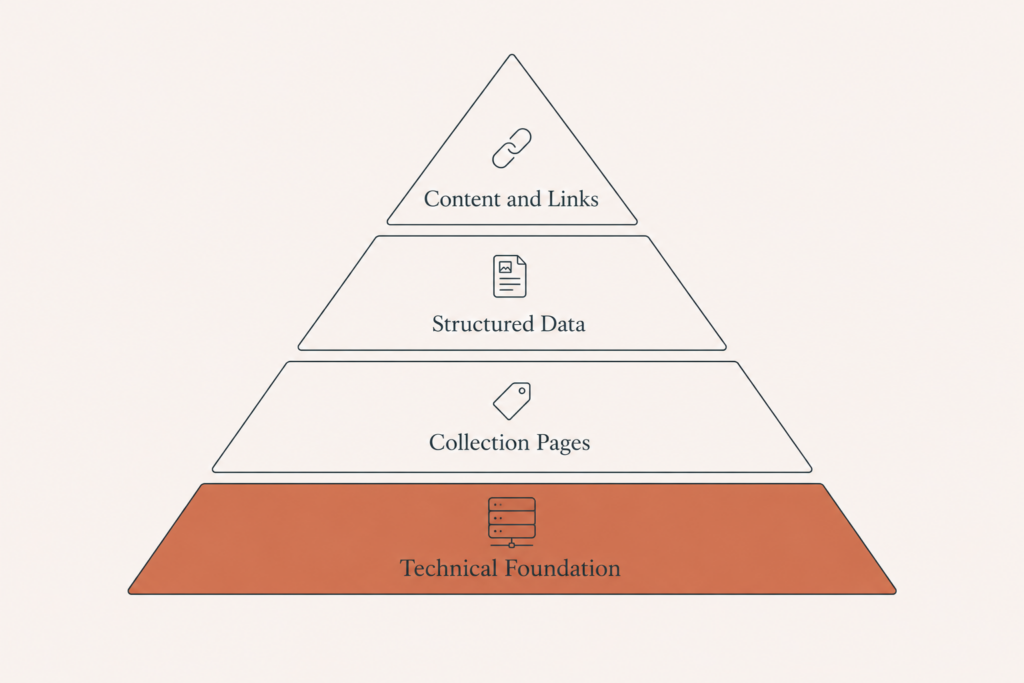
Shopify SEO starts with the technical foundation
Most Shopify SEO problems are not content problems. They are plumbing problems baked into the platform, and they silently cap your ceiling.
The big one is duplicate URLs. Shopify can serve the same product at /products/handle and /collections/name/products/handle, which splits ranking signals across two addresses. Check that your product canonical tags always point to the clean /products/ URL. Most modern themes do this correctly, but I still find broken canonicals on roughly a third of the stores I audit.
Next, fix your crawl basics:
- Keep your collection architecture to three levels maximum so crawl depth stays shallow.
- Submit your
sitemap.xmlin Google Search Console and confirm it is not blocked inrobots.txt. - Set descriptive image filenames and alt text before upload, since many stores ship images named
IMG_4821.jpgand forfeit image search. - Audit redirects after any migration so you do not bleed authority through 404s.
Key takeaway: you cannot out-content a broken technical base. Fix the plumbing first, then optimize. If you came from Magento, my Magento to Shopify SEO redirects checklist will save you a painful traffic dip.
Win collection pages, not just product pages
If you only optimize product pages, you are fighting on the hardest ground and ignoring the easiest. Collection pages out-rank product pages across nearly every key SEO metric, because they target broader category keywords that buyers actually search.
Think about it. Nobody searches for your exact SKU. They search “rose gold engagement rings” or “men’s leather chukka boots.” Those are collection queries, and your collection page is the natural answer.
Here is the pattern I use on every store:
- Map one primary keyword per collection. Use Ahrefs or Semrush and target terms with 500+ monthly searches.
- Write 150 to 300 words of genuinely unique copy above the product grid. Empty collection pages cannot rank for category keywords, full stop.
- Work the keyword into the H1, the intro sentence, and the meta title naturally, without stuffing.
- Link each collection to two or three related collections and a few featured products.
That last step is the one everyone skips. Your collection pages are your most powerful internal-linking hubs, so treat them like the homepages of each category. Pass authority deliberately instead of letting it pool on your homepage and die there.
Make structured data load-bearing, not optional
In 2026, schema stopped being a nice-to-have. Pages with complete product schema are 2.5x more likely to be cited in AI Overviews, and stores with proper schema see 20% to 40% higher click-through than plain blue links.
For Shopify, you want two things working together. Add Product schema on product pages so Google reads price, availability, and reviews instantly. Add ItemList schema on collection pages so it understands the grid as a structured set. Both feed not just Google but the shopping agents inside ChatGPT, Perplexity, and Copilot that now pull answers straight from your markup.
One warning from the trenches: most themes already inject basic schema. Before you bolt on an app or custom snippet, check your theme code. Duplicate or conflicting schema confuses crawlers and can wipe out your rich results entirely. Validate every template in Google’s Rich Results Test before you ship.
If you sell jewelry or anything with deep attributes, my structured product data guide for jewelry goes deeper on getting individual gemstones and SKUs recommended by AI.
Speed is still a ranking factor, and now it is INP
Google has confirmed site speed as a ranking factor, and Core Web Vitals directly influence position, especially on mobile. In 2026 the metric that bites hardest is INP (Interaction to Next Paint), which measures how fast your store responds when someone taps.
Shopify stores fail INP for predictable reasons: too many apps injecting scripts, bloated theme JavaScript, and third-party tag managers firing on load. Each one adds main-thread work that makes taps feel laggy, and laggy stores both convert worse and rank lower.
Audit your app stack ruthlessly. I have cut entire seconds off load time just by removing three apps a store no longer used. For the full method, see how to get your Shopify store under 3 seconds in 2026 and my Core Web Vitals checklist.
Earn links and brand signals, because authority still breaks ties
When two stores match on technical SEO and content, links break the tie. Backlinks from trusted sites remain one of the strongest ranking factors in 2026, and they are the hardest thing for a competitor to copy.
You do not need hundreds of links. You need a handful of relevant ones. Here is what consistently moves the needle for the stores I work on:
- Get listed in genuine industry roundups and “best of” guides in your niche, not spammy directories.
- Pitch one or two original data points or expert quotes to bloggers and journalists covering your category.
- Turn your best-selling products into linkable assets, like a sizing guide or a materials comparison that other sites want to reference.
- Reclaim unlinked brand mentions by asking sites that already name you to add a link.
Brand signals matter too. Google and the AI engines reward stores people search for by name, click through, and trust, so your reviews and repeat traffic feed back into visibility. Treat reputation as an SEO input, not a separate silo. And do not chase volume: three editorial links beat twenty low-quality ones, every time.
Build content that answers, not content that pads
With 58.5% of US Google searches ending without a click, you cannot rely on rankings alone. You have to be the answer that gets cited, quoted, and remembered.
Write supporting content of at least 1,000 words that answers real buyer questions: sizing, materials, comparisons, care, returns. Use question-style H2s and put the direct answer in the first sentence, because that is the format AI Overviews and Perplexity lift. This is where classic SEO and AI optimization merge.
Then link that content back into your collections and products. A “how to choose” guide that funnels readers into the right collection page beats ten thin product descriptions. To extend this into AI-specific tactics, my GEO for product pages guide covers getting recommended by shopping agents.
FAQ
Is Shopify good for SEO in 2026?
Yes. Shopify gives you fast hosting, clean URLs, automatic sitemaps, and easy schema support. Its main weaknesses are duplicate collection URLs and limited control over URL structure, both of which you can manage with correct canonicals and disciplined internal linking.
How long does Shopify SEO take to work?
Plan on 3 to 6 months for meaningful movement on competitive category keywords, and sometimes 6 to 12 for high-competition niches. Technical fixes and schema can show results faster, often within a few weeks of being crawled.
Do AI Overviews hurt Shopify store traffic?
They reduce clicks on informational queries by 15% to 46%, but transactional ecommerce searches like “buy” and “price of” trigger AI Overviews only 3% to 4% of the time. Your money keywords stay largely protected, which is why product and collection optimization still pays.
Should I focus on collection pages or product pages for Shopify SEO?
Lead with collection pages. They target broader category keywords buyers actually search and out-rank product pages on most metrics. Optimize products second, mainly for long-tail and branded queries.
Do I need an SEO app for Shopify?
Not usually. Most ranking gains come from technical hygiene, collection content, schema, and speed, none of which require a paid app. Apps help with bulk meta editing or redirects, but they are conveniences, not the strategy.
Conclusion
Shopify SEO in 2026 is not dead, it is just less forgiving. The stores that win fix their technical base, treat collection pages as the main event, make schema load-bearing, keep INP fast, earn a few real links, and write content built to be the answer. Do those things well and you compound traffic while competitors panic about AI.
If your Shopify store feels stuck, slow, or invisible in search, I can find exactly where the leaks are. Book a free audit at javaid.dev/contact and let us get your store ranking and converting again.
SEO is one piece of a bigger picture. The rest of it, from build costs to checkout and speed, lives in my Shopify archive.

Comments are reviewed before they appear, so yours will not show up straight away. Your email is never published.