
You want an AI-powered store. The question is which platform gives you more without making you wrangle a dozen plugins or write a dozen prompts a day.
In 2026 both Shopify and WordPress put AI at the center of their pitch. But they took very different roads to get there, and that difference decides which one fits your store.
Let me break down what each actually does, where each wins, and how to pick.
The short version
Shopify built AI features that run your store. WordPress built an AI framework that other tools plug into.
Shopify hands you a working assistant. WordPress hands you the wiring and lets you choose the assistant. That single distinction explains almost every trade-off below.
What Shopify gives you: Sidekick and Magic
Shopify’s AI comes in two named pieces that work out of the box.
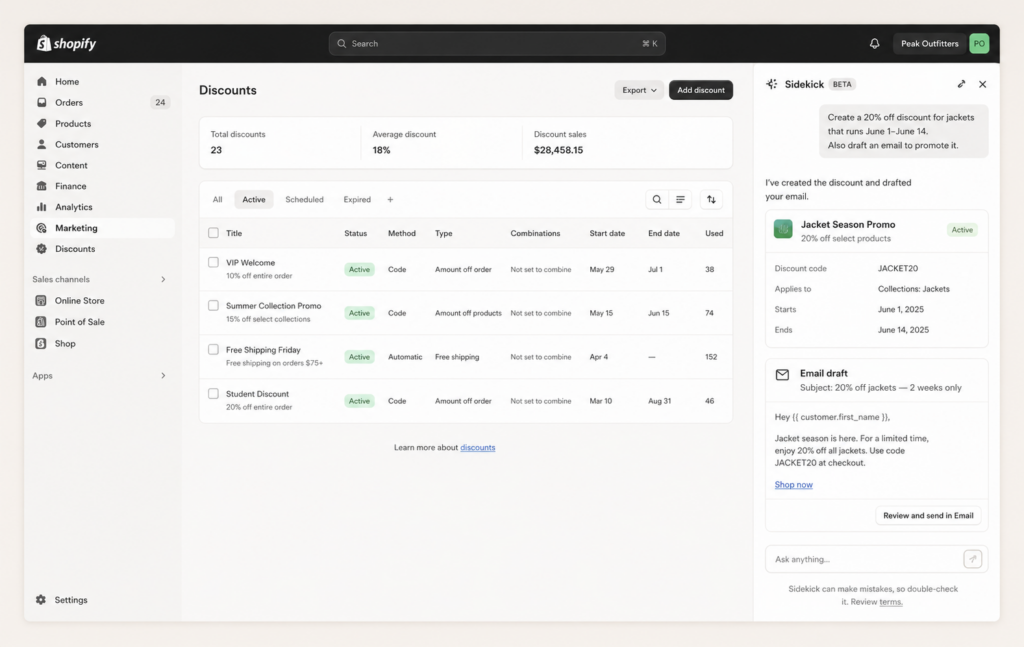
Sidekick started as a help chatbot. By 2026 it became an operational assistant. You can ask it questions in plain language, like “what were my top sellers last month,” and get an answer with a chart instead of clicking through five analytics screens.
The bigger jump is action. Sidekick now runs multi-step tasks. A single prompt like “create a 15 percent discount for the summer collection for two weeks and draft an announcement email” triggers a coordinated sequence across discounts, collections, and email. It is available on all plans through the admin search bar, with deeper organization-level analysis for Plus merchants.
Magic is the creative side. Automatic product descriptions, AI image editing, background removal and replacement, image enhancement, and brand voice tools that keep your copy consistent. The multi-variant image generation is a quiet winner: make product photos for color variants without shooting each one.
The point is, you do not assemble any of this. You turn it on.
What WordPress 7.0 gives you: a framework, not an assistant
WordPress 7.0, the Armstrong release from May 2026, took the opposite approach.
It does not ship a built-in store assistant. Instead it ships the AI Client, the Connectors screen, and the Abilities API. Together they let you enter one API key per provider, with OpenAI, Anthropic, and Google supported out of the box, and let any compatible plugin use that connection safely.
In the editor you get practical core AI tasks like adjusting text tone, summarizing content, and generating block patterns, without a heavy external plugin. But for actual ecommerce AI, like product recommendations or merchandising, you rely on WooCommerce and plugins built on top of that AI framework.
So WordPress gives you flexibility and no lock-in. You pick your model and your tools. The cost is that you assemble the experience yourself.
Head to head for ecommerce
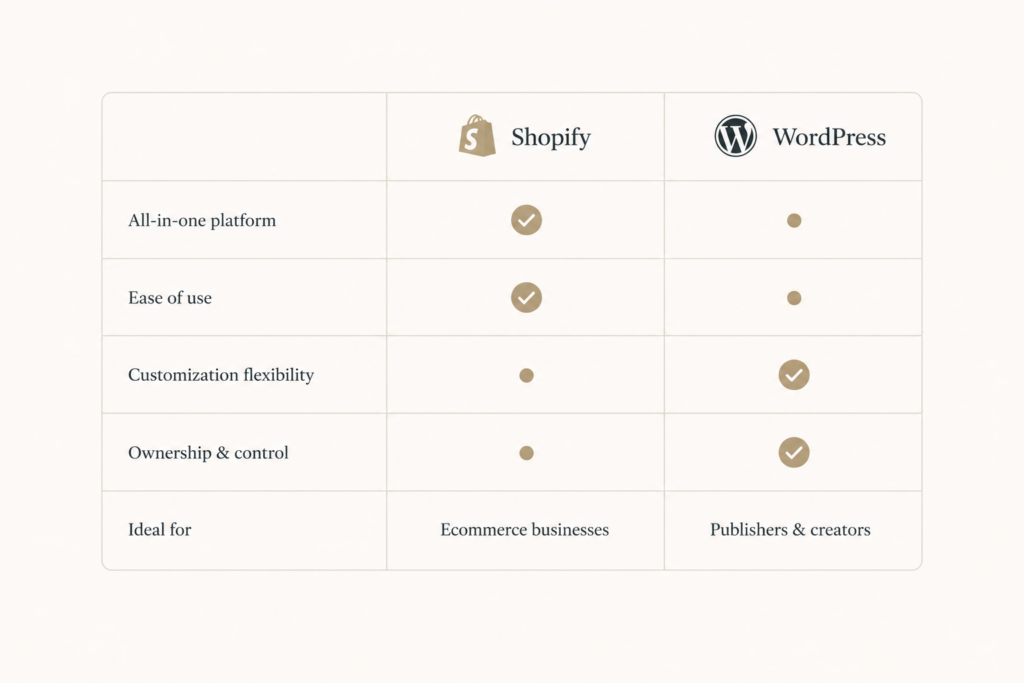
Setup effort. Shopify wins. The AI is there when you open the admin. WordPress needs you to add WooCommerce, pick AI plugins, and configure providers.
Merchandising and operations. Shopify wins clearly. Sidekick handling discounts, pricing, and analytics in one prompt is purpose-built for store operations. WordPress has no native equivalent.
Content and flexibility. WordPress wins. If your store is content-heavy, with guides, reviews, and large catalogs of editorial, the WordPress editor plus your choice of AI model is hard to beat. You also avoid being locked to one vendor’s AI.
Cost control. This is a real split. Shopify bundles much of its AI into your plan, so costs are predictable. WordPress AI runs on your own provider API keys, which means you pay per token and must set hard spending limits to avoid a runaway bill from plugins looping in the background.
Security and control. WordPress gives you more control through the Abilities API, which defines exactly what each tool may do. That control is also a responsibility: you have to audit plugin permissions yourself. Shopify makes those calls for you.
So which should you pick?
Match the platform to the kind of store you run.
Pick Shopify if selling is the main event. You want merchandising, discounts, inventory, and store operations handled with as little setup as possible, and you would rather pay a predictable plan price than manage AI infrastructure. Most product-first stores land here.
Pick WordPress 7.0 if content drives your sales. You run a large editorial operation around your products, you want to choose your own AI provider, and you have the technical comfort to wire plugins together and watch your token spend.
The hybrid play more teams are using
You do not always have to choose.
A growing pattern in 2026 is running the storefront and operations on Shopify for the merchandising muscle, while running a content hub on WordPress for guides, SEO, and editorial. The WordPress side feeds traffic, the Shopify side closes the sale.
It is more to maintain, but for content-heavy brands that also sell hard, it gets you the best of both. Shopify’s operational AI plus WordPress’s flexible content AI, each doing what it is best at.
The takeaway
Shopify gives you AI that runs the store today, with little setup and predictable cost. WordPress 7.0 gives you an AI framework you control, with no vendor lock-in but more assembly and per-token billing to watch.
Product-first store? Lean Shopify. Content-first brand? Lean WordPress. Doing both at scale? The hybrid is worth the extra upkeep.

Comments are reviewed before they appear, so yours will not show up straight away. Your email is never published.