
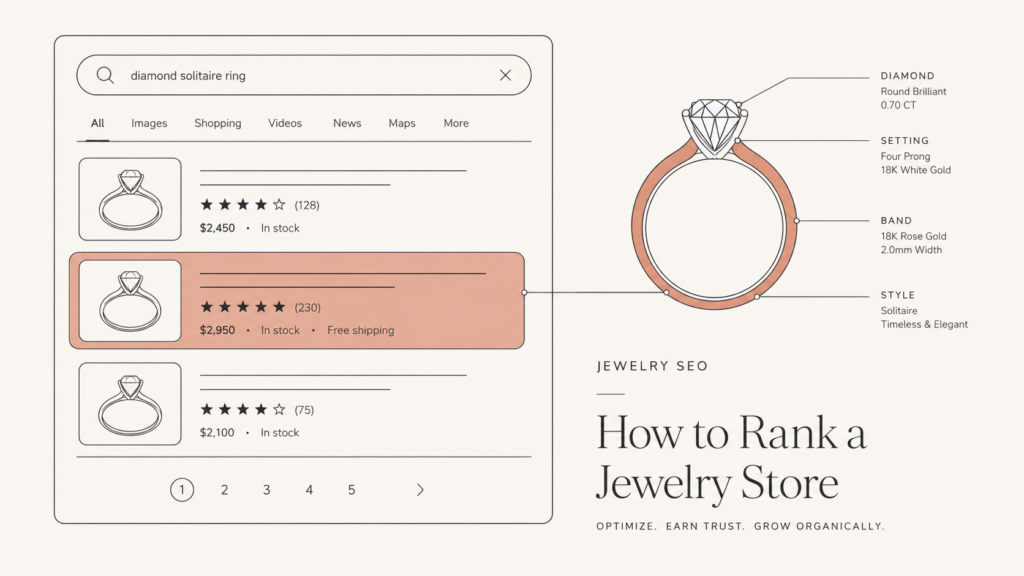
Picture this: a jeweler with forty years of trade knowledge, a beautiful showroom, and a Shopify store that gets 900 organic visits a month. Meanwhile a drop-shipper with stock photos and no inventory outranks him for “diamond tennis bracelet”. He has better product, better service, better everything. And he’s invisible.
That gap isn’t a mystery. It’s structural. Search engines can’t see craftsmanship, they see markup, page structure, and evidence of relevance, and most jewelry sites hand them almost none of it.
Jewelry SEO has also gotten harder for a reason that has nothing to do with jewelry. Google zero-click searches reached roughly 65% in early 2026, and Seer Interactive’s analysis of billions of impressions found organic click-through rate dropping around 61% on queries where AI Overviews appear. Fewer clicks are available. The ones that remain go to sites that answer cleanly and prove themselves fast.
This article covers the full picture: why jewelry converts worse than almost any other category and what that means for your keyword choices, how to build collection pages that actually rank, the schema layer most jewelry stores skip, the local signals that still win high-intent buyers, and the technical work that makes all of it stick.
Why jewelry SEO is a different problem than general ecommerce SEO
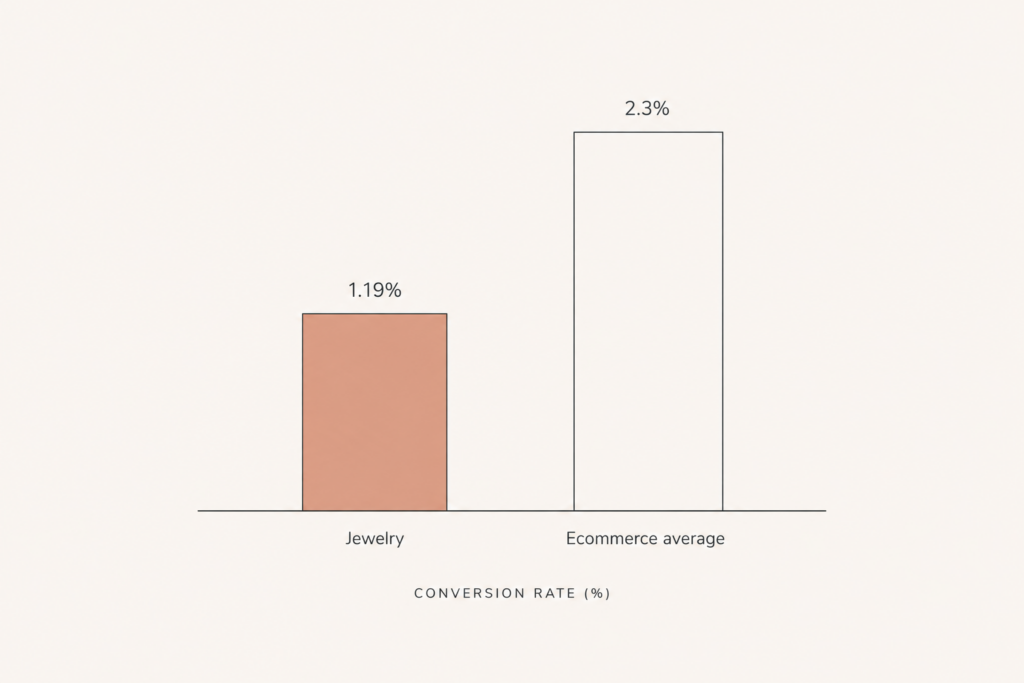
Start with the number that should shape your entire strategy. Jewelry sits at roughly a 1.19% ecommerce conversion rate, the lowest of any retail category tracked, against a general ecommerce average closer to 2.3%.
That’s not a failure of your store. It’s the nature of considered, high-AOV, emotionally loaded purchases. People research for weeks. They compare four stones across three sites. They ask a partner. Then they buy.
So the traffic you chase matters more than the traffic you get. Ten thousand visits on “gold jewelry” is worth less than four hundred on “1.5 carat oval lab grown engagement ring”. One is a browse. The other is a buyer with a budget.
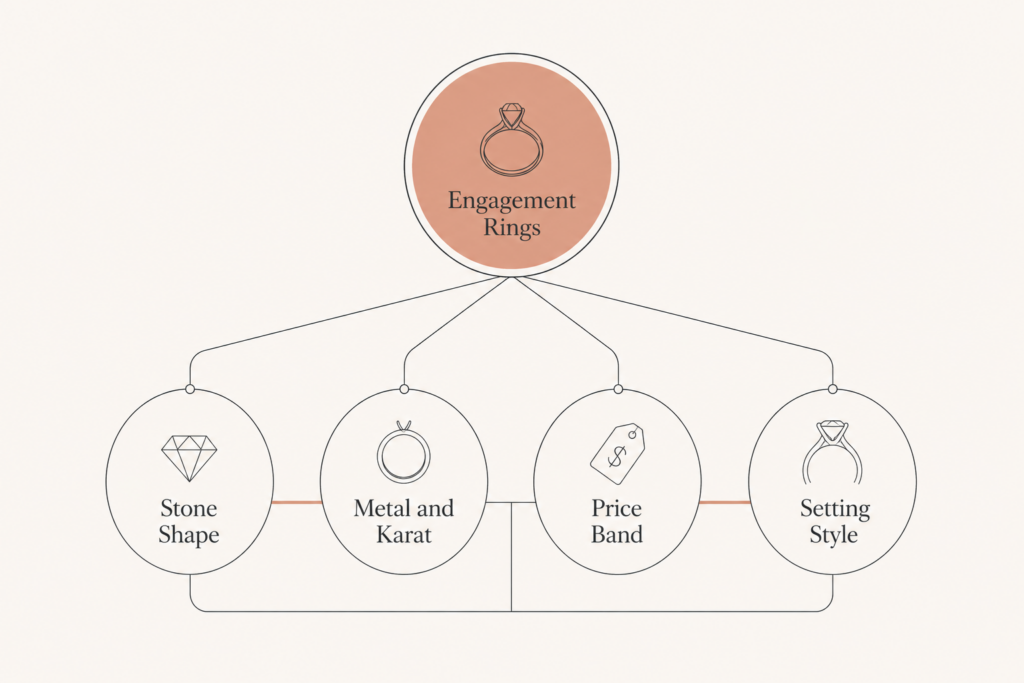
Here’s the thing: the jewelry sites that win organically aren’t the ones with the most content. They’re the ones whose page inventory maps onto how buyers actually narrow down. Metal. Stone. Shape. Carat range. Setting style. Price band.
Most jewelry stores publish a blog instead. That’s backwards.
Build collection pages around how buyers narrow, not how you merchandise
Your highest-value SEO assets are collection pages, not product pages and not blog posts. A product page targets one SKU. A collection page targets a whole buying decision.
The mistake is inheriting your collection structure from your POS categories. “Rings”, “Necklaces”, “Earrings” is an inventory taxonomy, not a search taxonomy. Nobody searches “rings”.
Map instead to the modifiers buyers actually type:
- Stone and shape combinations. Oval, emerald, pear, radiant, each crossed with lab-grown or natural. These are separate pages with separate demand.
- Metal and karat. 14k vs 18k, yellow vs white vs rose. Buyers filter on this constantly and search on it directly.
- Price bands. “Engagement rings under $3000” is a real query with real intent, and almost no independent jeweler has a page for it.
- Occasion and recipient. Anniversary, push present, graduation, milestone birthday. Seasonal, but reliable.
- Setting and style. Halo, solitaire, three-stone, bezel, vintage-inspired.
Each of those pages needs more than a filtered product grid. It needs 200 to 400 words of genuinely useful copy above or below the grid, written by someone who knows the trade, covering what the buyer should consider, what the tradeoffs are, and what price ranges mean at that spec. Not keyword filler. Actual guidance.
Then link them to each other. An oval lab-grown page should link to the oval natural page, the 1.5 carat page, and the setting styles that suit oval stones. That internal mesh is what tells search engines these pages are a coherent, authoritative cluster rather than thin variations.
The schema layer almost every jewelry store gets wrong
Structured data is where jewelry sites leak the most easy ground. Schema markup is what decides whether your listing carries price, availability and star ratings, or shows up as a bare blue link next to competitors that have all three.
For a jewelry store you want three layers working together:
Product schema on every product page, with the specifics that matter in this category: material, gemstone, carat weight, ring size as a variant, and accurate price and availability. Generic Product markup with just a name and price is table stakes and won’t differentiate you.
LocalBusiness or JewelryStore schema if you have a showroom, with exact name, address, phone, hours and service categories. This is the layer that connects your website to your map presence.
Review and aggregate rating schema, tied to real, verifiable reviews. In a category where trust is the whole purchase, star ratings in a listing do double duty.
The variant problem is the one that catches most jewelry stores. A ring available in three metals across six sizes at four different prices is not one product to a search engine unless you tell it so, correctly. Get this wrong and you either publish inaccurate pricing or fragment your own authority across near-duplicate pages. Javaid Ahmad builds jewelry storefronts where the variant, metal and stone data feeds the schema layer directly from the product data model, so pricing in search results stays accurate when gold moves. If you want the deeper version of this, structured product data for jewelry covers the markup patterns in detail, and GEO for product pages covers how the same data feeds AI answer engines.
The result? Your products become machine-readable at the level of detail buyers actually filter on. That matters more every quarter, because AI shopping surfaces read structured data, not your brand story.
Local signals still decide the highest-intent jewelry searches
Here’s what gets missed in ecommerce-first thinking: a huge share of jewelry buying is still local, or hybrid. Someone researches online for three weeks, then searches “engagement rings near me” and drives to a showroom.
If you have a physical location, the map pack is the highest-intent real estate available to you, and it’s less crowded than organic.
The work is unglamorous. Your business name, address and phone need to match exactly across your site footer, Google Business Profile, Yelp, Facebook, and trade directories. One inconsistent suite number can suppress you. Fill the profile completely, and load it with real photography of actual pieces, not stock images.
Then build location pages that earn their place. “Custom Engagement Rings in [City]” only works if it contains something real, your process, your turnaround, local pieces you’ve made, actual reviews from local customers. A templated city page with the name swapped is worse than no page.
The technical work that makes ranking stick
You can do all the keyword and schema work above and still lose on execution. Jewelry sites are unusually vulnerable to technical problems, because they’re image-heavy by nature.
High-resolution stone photography, 360-degree spins, video, and configurators all add weight. Over 60% of online jewelry transactions happen on mobile, based on current industry benchmark reporting, which means your slowest visitor is your most likely buyer.
The fixes are known:
- Serve properly sized, modern-format images with correct lazy loading below the fold, and never lazy-load your hero image.
- Preload the LCP image, and keep the largest above-fold element predictable across templates.
- Defer or remove third-party scripts. A jewelry store running six review apps, a chat widget, three pixels and a wishlist app is paying for that in interaction delay.
- Watch INP, not just LCP. Filtering a collection of 400 rings by four facets is exactly the interaction that exposes a slow store.
The Core Web Vitals checklist covers the working version of this, and why jewelry wishlists need bespoke logic covers one of the apps most worth replacing. The short form: a sub-3-second budget is achievable on an image-heavy jewelry store, but only if app bloat is treated as a performance decision rather than a feature decision.
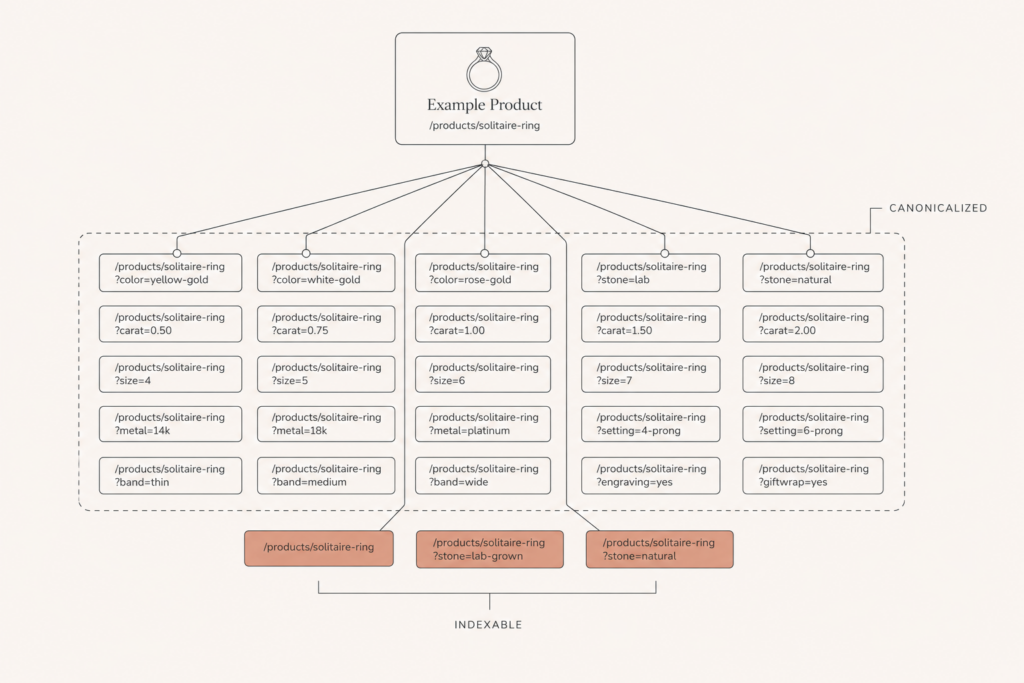
Crawl hygiene matters too. Faceted navigation on a jewelry catalog can generate tens of thousands of near-duplicate URLs from metal, size and stone combinations. Left unmanaged, that swallows your crawl budget and buries the pages you actually want indexed. Decide deliberately which facet combinations deserve an indexable URL, and canonical or block the rest.
What to fix first, in order
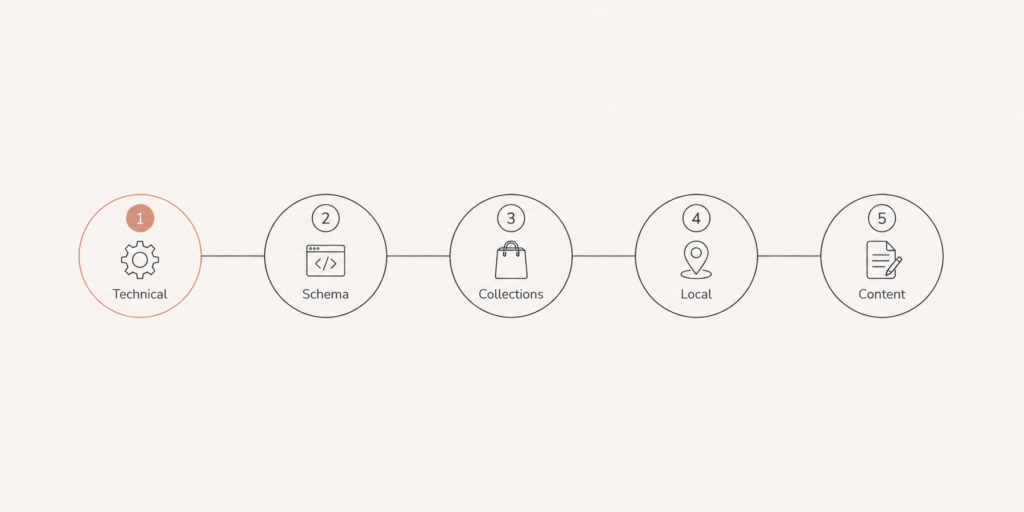
Most jewelers try to do everything and finish nothing. The sequence that works:
- Fix technical foundations. Speed, crawlability, indexation. Nothing else compounds until this is clean.
- Ship complete product and local schema. Fastest visible return of anything on this list.
- Build the top eight to twelve collection pages mapped to real buyer modifiers, with genuine copy.
- Complete and photograph the Google Business Profile, if you have a showroom.
- Then, and only then, publish content. Buying guides that support your collection pages, not generic blog posts.
Skipping to step five is the single most common mistake, and it’s why so many jewelers have thirty blog posts and no rankings.
The bottom line on jewelry SEO
Jewelry SEO isn’t a content problem. It’s an architecture problem. The stores that rank aren’t out-writing you, they’re out-structuring you, with page inventory that matches how buyers narrow and markup that makes every product legible to machines.
If your catalog is small and your business is mostly local, start with Google Business Profile, schema, and eight strong collection pages. That’s a few weeks of focused work and it’s usually enough. If you’re running thousands of SKUs across multiple suppliers with dynamic metal pricing and faceted navigation, the problem is genuinely technical, and patching it at the theme level will keep failing until the data model underneath is right.
Either way, the compounding part is the structure, not the blog. Get it right once and it keeps working while you sleep.
If you want a straightforward read on which of those two situations you’re in, reach out to Javaid Ahmad at javaid.dev/contact. No lengthy discovery calls, no vague proposals, just a clear answer on what to fix first and what it takes.
FAQ
Q: How long does jewelry SEO take to show results? A: Technical fixes and schema often show movement within four to eight weeks, because you’re removing friction rather than building authority. New collection pages targeting competitive stone and carat terms typically take three to six months to settle. Local map pack improvements can move fastest of all, sometimes within weeks of a fully completed and correctly cited profile.
Q: Do I need a blog to rank a jewelry store? A: Not to start. Collection pages and product pages carry most commercial intent, and they’re where your ranking effort pays back fastest. Content earns its place later, as buying guides that support and internally link to those collection pages, not as a standalone publishing habit.
Q: What’s the most important schema for a jewelry website? A: Product schema with accurate variant-level pricing and availability, because that’s what drives rich results and what AI shopping surfaces read. If you have a showroom, add LocalBusiness or JewelryStore markup, and add review markup wherever you have genuine verifiable reviews.
Q: Should I target “engagement rings” or long-tail keywords? A: Long-tail, almost always. Head terms in jewelry are dominated by national retailers with enormous domain authority and ad budgets. Specific queries combining stone shape, carat, metal and price band carry higher purchase intent and are realistically winnable for an independent jeweler.
Q: Does jewelry SEO still work now that AI Overviews reduce clicks? A: It works differently. Fewer clicks are available on informational queries, so the value shifts toward transactional and local searches, and toward being the structured, citable source AI answers pull from. Clean product data and schema now serve both traditional rankings and AI visibility, which makes that work more valuable, not less.
Q: How does site speed affect jewelry rankings specifically? A: More than in most categories, because jewelry sites are image-heavy and the majority of jewelry transactions happen on mobile. Heavy photography, 360 spins and stacked apps degrade interaction responsiveness exactly where buyers filter and compare, which costs you both rankings and conversions on the same visit.

Comments are reviewed before they appear, so yours will not show up straight away. Your email is never published.