
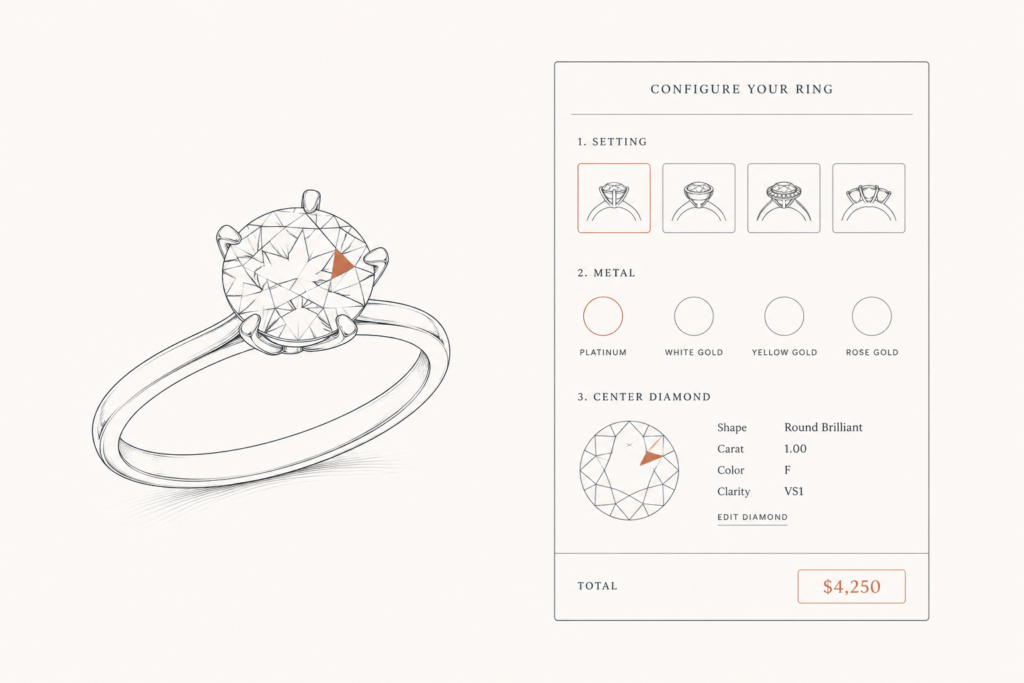
If you sell engagement rings online, the ring builder is the most important tool on your site. It is where a shopper turns a vague idea into a specific, high-value order. Most builders on Shopify are either a monthly app or an iframe bolted onto a brochure site, and both fight you on the two things that matter most: brand and truth. Here is how a real one gets built, and when it is worth doing custom.
I build these for high-AOV jewelry brands, so this is written from real work, including the configurator behind GemFind RingBuilder. Let me start with what a ring builder actually has to do, because that is where most options fall short.
What a real ring builder must do
A ring builder has one job that everything else depends on: tell the customer the truth. The truth about price, and the truth about what they can actually buy. Get those two right and the rest is detail.
- Live inventory. The diamond on screen is a diamond you can actually source and ship, pulled from a current supplier feed.
- A true price that updates as the shopper picks setting, center stone, metal, and size, with your markup applied correctly.
- Buyable-only results, so the builder never shows a stone that just sold or a combination you cannot fulfill.
- Native theme integration, so it looks and loads like the rest of your store instead of a boxed-in iframe.
- Margin control, 4Cs filters, and international ring sizes, because jewelry buyers expect to filter the way they think.
The diamond feeds, and how they work
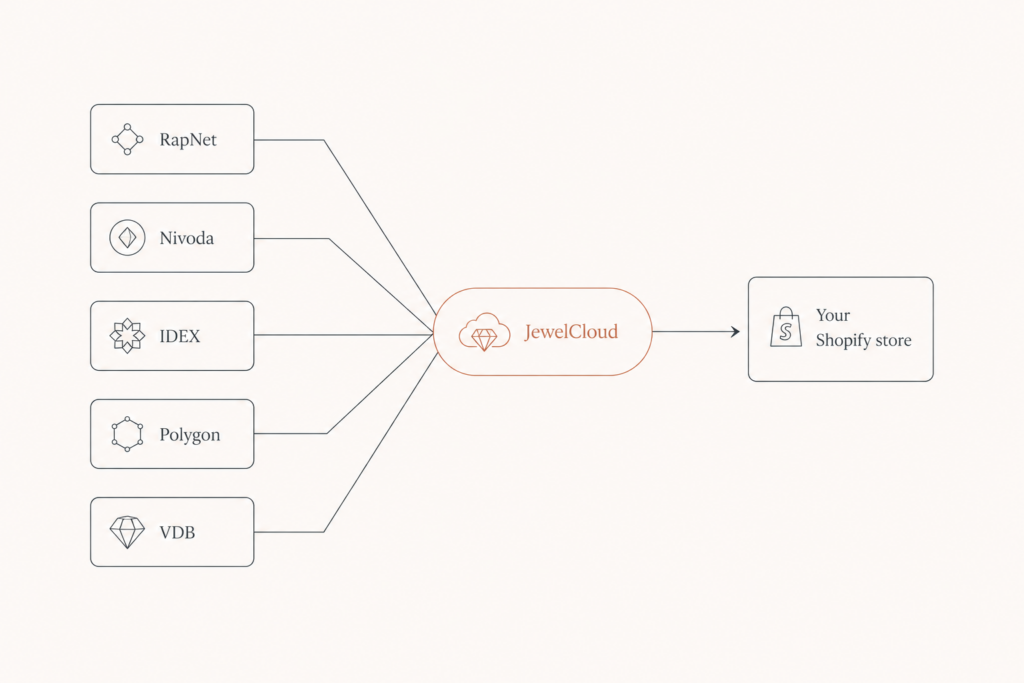
Real-time inventory comes from the big diamond aggregators. The common feeds are RapNet, Nivoda, IDEX, Polygon, and VDB, usually connected through a service like JewelCloud or directly through each supplier API. A single feed can expose hundreds of thousands of stones, including natural, lab-grown, colored diamonds, and gemstones.
Your own in-house stones sit alongside the feed inventory, so the builder shows both your physical stock and the virtual supply you can drop-ship. The shopper does not see the difference. They just see stones you can deliver.
The hard parts most builds get wrong
Two problems make ring builders genuinely difficult. Both are about truth.
Price truth
The feed gives you a cost, not your retail price. Your real price is cost plus a markup that can vary by stone type, carat band, or supplier. The builder has to apply your markup rules correctly and instantly as the shopper changes options. Get this wrong and you either lose margin or scare the customer with a number that jumps around.
Availability truth
Feeds change constantly. A stone listed this morning can be gone by lunch. If the builder shows it and the customer buys it, you have a problem. The fix is a cache-and-validate pattern: cache the feed so the builder stays fast, then validate the specific stone is still available at the moment of add-to-cart. Fast browsing, honest checkout.
The app options, and their limits
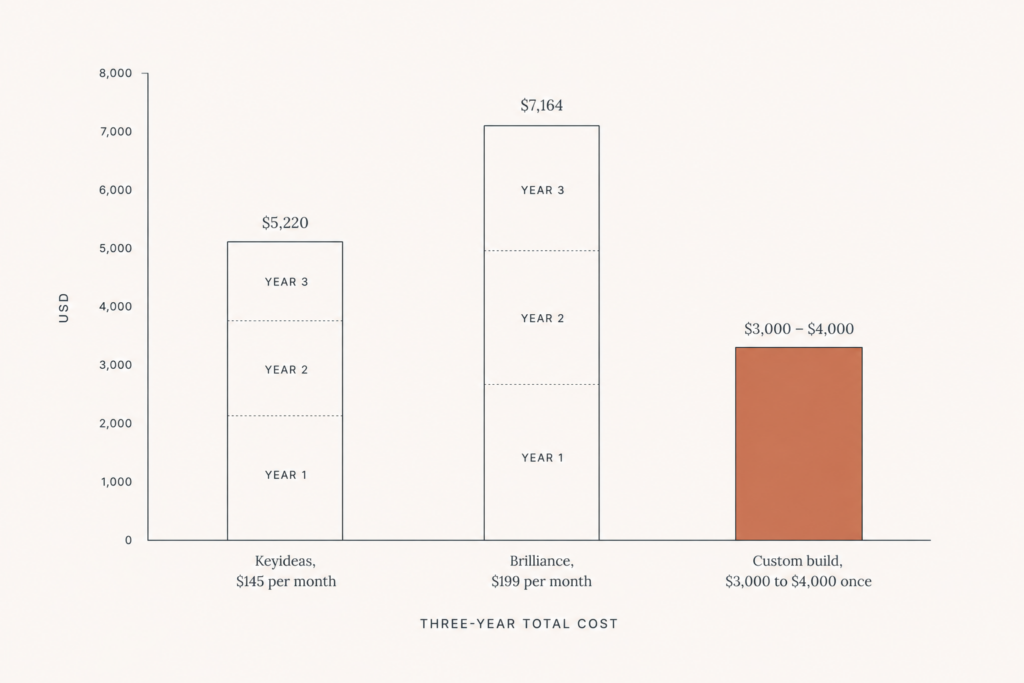
There are real apps in this space, and for some stores they are the right call. Here is the honest pricing picture as it stands.
- Keyideas RingBuilder: around 145 dollars a month, connects Nivoda, RapNet, VDB, and CSV, with access to a large diamond pool.
- Brilliance Builder: around 199 dollars a month, supports single or multiple suppliers with live inventory.
- TDP Ring Builder: about 1,499 dollars as a one-time cost.
- DOC Jewel Sync: a free option with diamond browsing and dynamic pricing.
- TransPacific custom build: roughly 3,000 to 4,000 dollars one-time, including a year of support.
These work, and if your needs are standard, an app gets you live quickly. The limits show up when you want full brand control, custom markup logic, a specific checkout flow, or a builder that behaves exactly like the rest of your store. An app caps what you can change, and the monthly ones keep charging for as long as you use them.
When an app is fine, and when you need custom
I am not here to talk you out of an app. Here is the honest split.
- An app is fine when your markup is simple, your catalog is standard, and you want a working builder this month without a custom project.
- A custom build makes sense when you are a high-AOV brand, your markup rules are specific, you want the builder fully inside your brand and theme, or you need it to do something the apps will not.
For a store doing real volume on engagement rings, the math favors custom sooner than people expect. A few thousand dollars once, against a couple hundred a month forever, pays back fast when each order is worth thousands.
How I build it
My approach centers on the two truths. I connect the feeds through JewelCloud, apply your markup rules in a pricing layer so the number is always right, and use a cache-and-validate pattern so browsing is fast and checkout is honest. The setting catalog and the stone feed combine into one purchasable product at checkout, with engraving, ring size, and metal handled cleanly. It is built into your theme, so it loads and looks like your store, not a boxed-in widget.
That is the work behind a configurator that performs because it is cached well, prices right because the markup logic is correct, and earns trust because it never shows a stone you cannot ship.
What it is worth
A ring builder is not a feature you add for show. It is the thing that lets a shopper commit to a four or five figure purchase with confidence. When it tells the truth about price and availability, conversion follows, and support tickets about wrong prices or sold-out stones disappear. For a high-AOV jewelry brand, that is the difference between a builder that looks nice and one that actually sells.
The shopper journey, step by step
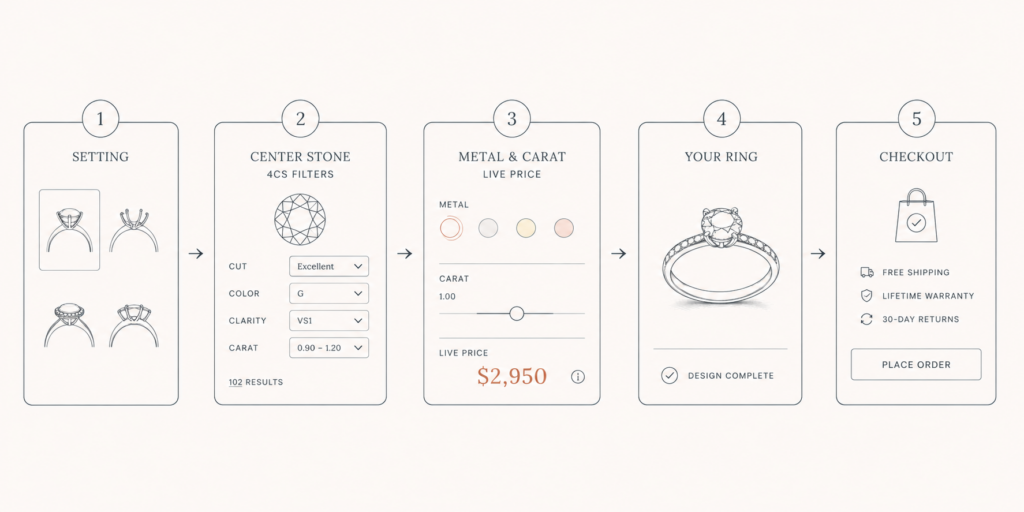
It helps to picture how a customer actually moves through a good ring builder, because every step is a place to win or lose the sale.
- They pick a setting style, and the builder shows it on a clean product page that matches your brand.
- They choose a center stone by filtering on the 4Cs, shape, and budget, with only buyable stones showing.
- They watch the price update in real time as they change metal, carat, and size, with your markup already baked in.
- They see the finished ring, with engraving and size locked in, as a single product they can add to cart.
- They check out knowing the stone is real and the price is final, which is exactly when confidence turns into a purchase.
Every one of those steps depends on the two truths from earlier. Break price truth or availability truth and the journey stalls right at the moment of commitment.
Drop-ship fulfillment, without the headache
Most jewelry brands do not hold the diamonds they sell in a builder. They drop-ship from the supplier once the order comes in. A good builder is built for this. The virtual stones from the feed are clearly sellable, the order captures the exact stone the customer chose, and your team places it with the supplier without guesswork. You sell a huge catalog without carrying the inventory cost.
Why brand control matters more in jewelry
In most ecommerce, a slightly off-brand widget is a minor annoyance. In jewelry, it is a trust problem. Someone about to spend several thousand dollars on a ring reads every signal, and a configurator that looks bolted on, loads slowly, or behaves differently from the rest of the site plants doubt at the worst possible moment. A builder that is genuinely part of your theme removes that doubt. This is the strongest argument for custom in this category. Not features, but the quiet confidence that comes from a store that feels like one coherent thing.
What to ask before you buy an app or commission a build
Whether you go with an app or a custom build, these questions separate a real ring builder from a pretty demo:
- Does it validate the exact stone is still available at add-to-cart, or only at browse time?
- Can it apply my markup rules by stone type and carat band, not just a flat percentage?
- Does the finished ring become one clean product at checkout, with the stone and setting tied together?
- Does it match my theme, or does it sit in an iframe that breaks on mobile?
- Who owns the code and the configuration if I want to change suppliers later?
If a solution cannot answer these clearly, it will cost you sales or margin down the line.
A quick FAQ
Do I need my own diamond inventory?
No. Most stores run entirely on feed inventory from RapNet, Nivoda, IDEX, Polygon, or VDB, and drop-ship each order. Your own stones can sit alongside the feed if you have them.
How long does a custom ring builder take to build?
It depends on the feeds and the markup logic, but a focused build is a matter of weeks, not months. The supplier integration and the pricing rules are usually the longest parts.
Will a custom builder slow my store down?
Not if it is built right. The cache-and-validate pattern keeps browsing fast by serving cached feed data, and only checks live availability at the moment it matters. Done well, a custom builder is faster than a heavy third-party app loading its own scripts on every page.
See the work behind GemFind RingBuilder, and the longer story in this case study. If you want a ring builder that fits your brand and tells your customers the truth, tell me about your store and get a quote.
Want the full picture? See my Shopify development for jewelry stores.

Comments are reviewed before they appear, so yours will not show up straight away. Your email is never published.