
Most jewelry brands I audit are sitting on a money printer they forgot to turn on.
It is their email automations. Not the newsletter. Not the Friday campaign blast. The quiet, behind-the-scenes flows that fire when someone abandons a $900 cart at 11pm and never comes back.
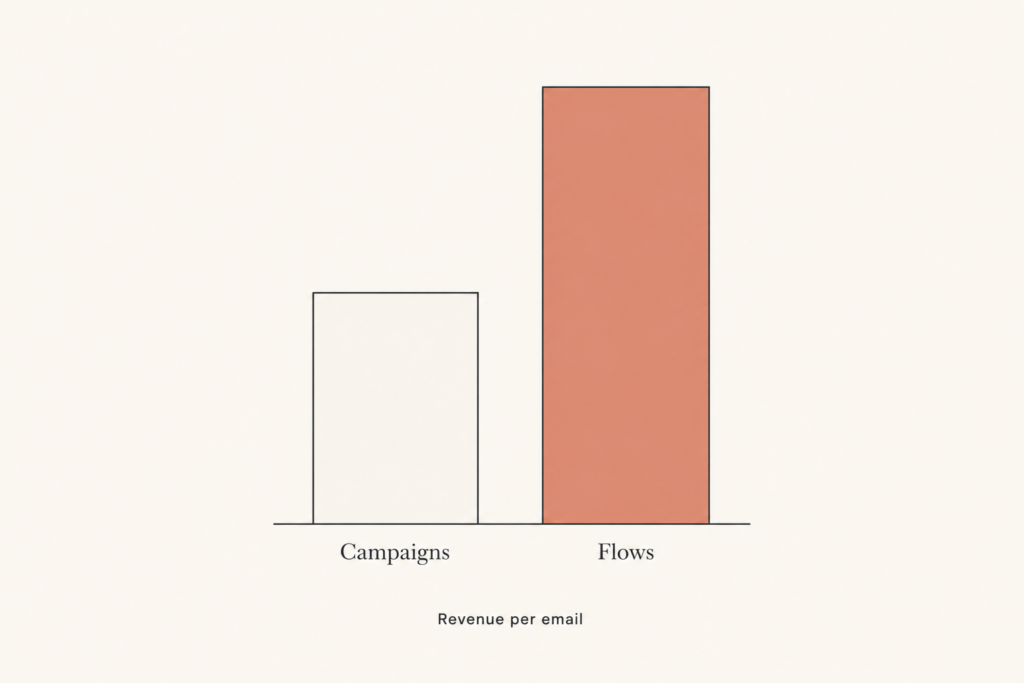
Here is the part that surprises owners. Across ecommerce, automated flows make up about 5.3% of email sends but drive roughly 41% of all email revenue. The revenue per recipient on a flow runs close to 18 times higher than a campaign.
For jewelry, the gap is even wider. High-ticket, considered purchases lean harder on flows because the buying window is longer. People do not impulse-buy a $1,200 engagement piece on the first visit. They circle it for days. The split for brands like yours often lands near 70/30 in favor of flows.
So if your flows are an afterthought, you are leaving the biggest lever untouched. Let me show you the stack that works, with real numbers, and the 2026 rules that decide whether any of it reaches the inbox.
Start with the abandoned cart flow, but never send just one email
The most common mistake I see is a single abandoned cart email. One reminder, sent two hours later, then silence.
The data is brutal on this. Klaviyo’s own analysis found three-email abandoned cart sequences pulled in $24.9 million in revenue compared to $3.8 million for single-email setups. That is a 6.5x difference for the same triggered moment.
A jewelry sequence I trust looks like this:
Email one, about 1 hour after abandonment. Short. No discount. Just the item, a clear photo, and a single button back to the cart. Treat it like a helpful nudge, not a sales pitch.
Email two, around 24 hours later. Now you add trust. Real reviews, your return policy, your warranty or lifetime care, and proof that buying a high-ticket piece from you is safe.
Email three, about 48 to 72 hours later. This is where a gentle incentive can earn its place, or a scarcity signal if the piece is limited or made to order. For luxury, a soft “your selection is reserved for 48 hours” usually beats a loud coupon.
The benchmark to aim for: top performers recover 8% to 12% of abandoned carts. Average abandoned cart flows earn around $3.65 per recipient. The elite ones hit $28.89 per recipient. On a high-AOV catalog, that spread is the difference between a flow that pays a salary and one that pays rent on a showroom.
Split the flow by cart value, because a $50 cart and a $500 cart are not the same shopper
This is the single highest-leverage move in the whole article, so read it twice.
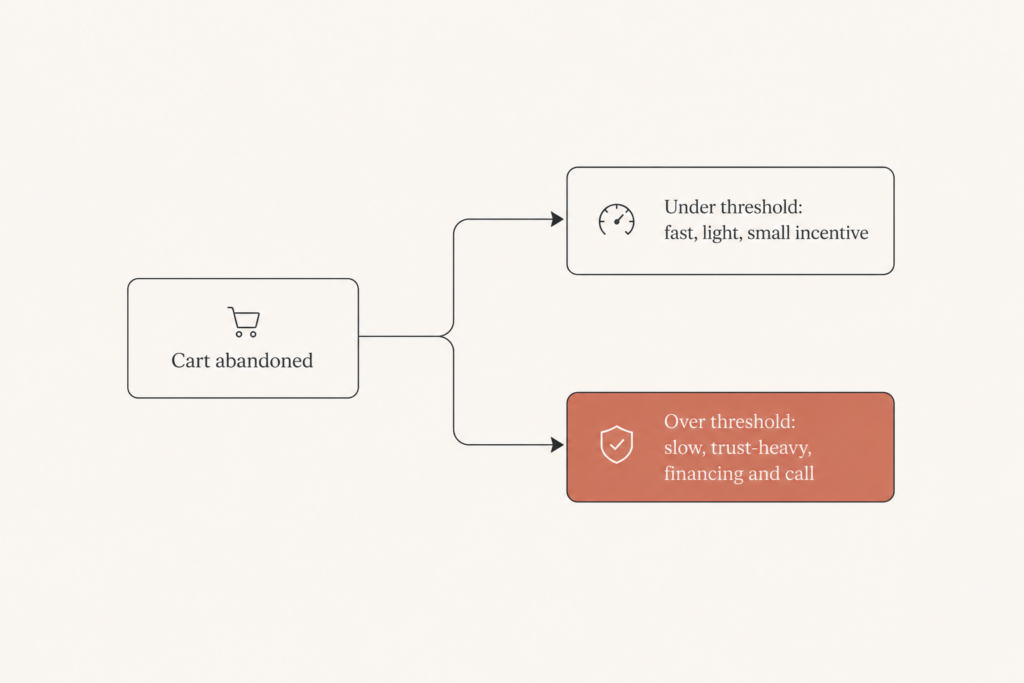
Sending the same abandoned cart email to a $50 cart and a $500 cart is a mistake. Their hesitation is different. Their objections are different. The first might just need free shipping. The second needs reassurance, financing options, or a chance to talk to a human.
Segmentation by cart value, customer type, or acquisition source routinely doubles click-through rates. For jewelry, I usually split at least three ways:
Carts under a set threshold get a faster, lighter sequence with a small incentive.
Carts above that threshold get a slower, trust-heavy sequence. More social proof, financing if you offer it, and an invitation to book a styling or sizing call.
First-time buyers and returning customers get different copy, because a repeat buyer does not need to be sold on your brand again.
You are not building more flows for the sake of it. You are matching the message to the size of the decision.
The welcome flow sets the tone, and the price expectation
When someone joins your list, they are warmer than they will ever be again. Do not waste it on a single “thanks for signing up” note.
For a jewelry brand, the welcome flow does three jobs. It tells your story so price feels earned. It shows craftsmanship, materials, and the people behind the bench. And it removes friction for the nervous first-time buyer with clear answers on sizing, returns, and care.
One quick win: A/B test the subject line on your very first welcome email. Subject line tests on the welcome email alone can swing open rates by 10 to 20 percentage points. That first open trains the inbox to trust you, which matters more than ever in 2026 (more on that below).
If you offer a signup incentive, deliver it in email one and remind once. Then pivot to story and trust. A welcome flow that only screams “10% off” attracts discount hunters, not the customers who buy the $2,000 piece.
Post-purchase and winback: where the real margin hides
Acquiring a jewelry customer is expensive. The money is in the second and third order.
Post-purchase upsell and cross-sell flows are among the highest revenue-per-recipient automations there are, often delivering 90% or more RPR than a standard campaign. For jewelry, the natural plays are obvious once you look. Bought the necklace, show the matching earrings. Bought the ring, introduce the care kit or the insurance partner. Bought an everyday piece, introduce the premium line.
The winback flow is where jewelry differs most from a t-shirt brand. Do not nag a jewelry buyer after 30 days. They did not run out of anything.
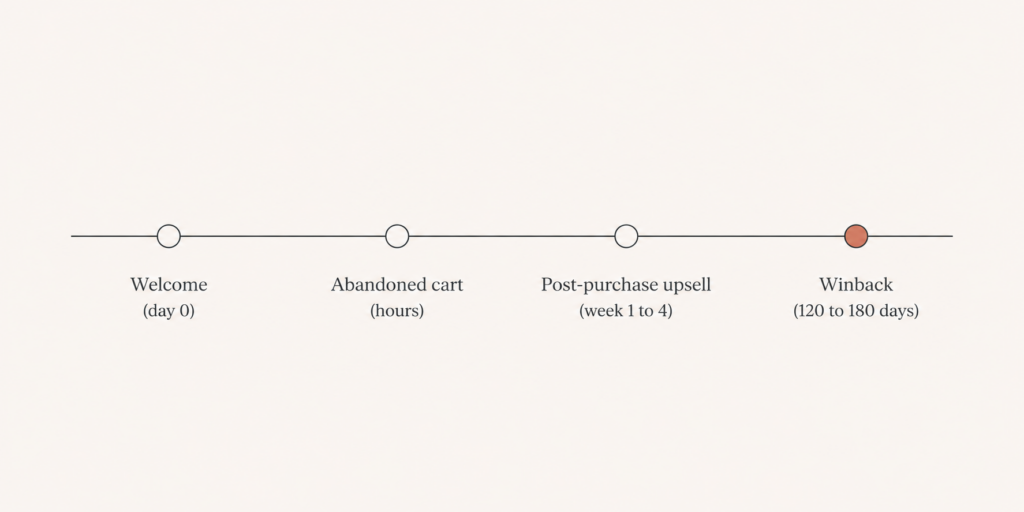
For durable, high-consideration products, a winback window of 120 to 180 days fits the actual buying rhythm. People buy jewelry around occasions: anniversaries, birthdays, holidays, the next big milestone. Time your winback to the next occasion, not to an arbitrary monthly cadence.
None of this matters if your email lands in spam
Here is the trap. You can build the perfect flow stack and still earn nothing, because in 2026 the inbox providers got strict.
Gmail and Yahoo tightened the screws. The “good enough” setups that slid by two years ago now get filtered. If you send more than 5,000 emails a day, which most growing jewelry brands hit fast, you are a bulk sender and the rules apply to you.
What they actually require now:
SPF, DKIM, and DMARC all set up and aligned. Note that DKIM is not optional. A domain with SPF and DMARC but no DKIM still fails Google’s check.
DMARC published, even if it starts at p=none. The expectation is that you move toward p=quarantine or p=reject over time, not that you set it and forget it.
One-click unsubscribe that actually works on every marketing message, no matter the send size.
A spam complaint rate under 0.10%. That used to be the dream number. Now it is the floor. Cross 0.30% and Gmail will not even apply its usual delivery mitigation. Your domain is on its own.
So before you obsess over subject lines, get your authentication clean and keep your list healthy. Prune people who have not opened in months. A smaller engaged list beats a big cold one every single time, and it protects the complaint rate that keeps you in the inbox.
If you are not sure where you stand, check your DMARC record and your Klaviyo deliverability dashboard today. This is the cheapest fix with the highest payoff in the whole stack.
Let Klaviyo’s 2026 AI do the boring optimization
Klaviyo shipped a wave of AI tooling this year, and a few pieces are genuinely worth turning on for a jewelry brand.
Personalized send time uses each subscriber’s real behavior to send when they are most likely to open and buy. Klaviyo reported top campaigns saw a 35% lift in click rate with it. For a considered purchase, hitting someone in their actual browsing window matters.
Audience Optimization scores each recipient’s likelihood to unsubscribe before a send and quietly removes the high-risk profiles. That protects the complaint rate we just talked about, which protects deliverability, which protects revenue. It all connects.
Next Best Product recommendations now run inside SMS and WhatsApp flows too, not just email. For a brand where the matching piece is the obvious second sale, that is a clean win across channels.
You do not need to flip on every AI feature. Start with send-time optimization and audience health, since those two protect and compound everything else.
What to do this week
You do not need a three-month project to capture most of this. You need a focused week.
Day one, audit deliverability. Confirm SPF, DKIM, and DMARC are set and aligned. Check your spam complaint rate.
Day two, fix the abandoned cart flow. If it is one email, make it three. If it is one path, split it by cart value.
Day three, build or rewrite the welcome flow to sell the story, not just a coupon. A/B test the first subject line.
Day four, add one post-purchase upsell flow that matches your best cross-sell pair.
Day five, set a winback flow at 120 to 180 days, timed to occasions.
Do that, and you turn the quiet money printer back on. For most jewelry brands, this is the highest-return week of work in the entire year, and it does not cost a cent in ad spend.
If your flows are thin, your deliverability is shaky, or you just want a second set of eyes on the numbers, that is exactly the kind of work I do. A short call is usually enough to spot where the revenue is leaking.
Building a jewelry store? See my Shopify development for jewelry stores.

Comments are reviewed before they appear, so yours will not show up straight away. Your email is never published.