
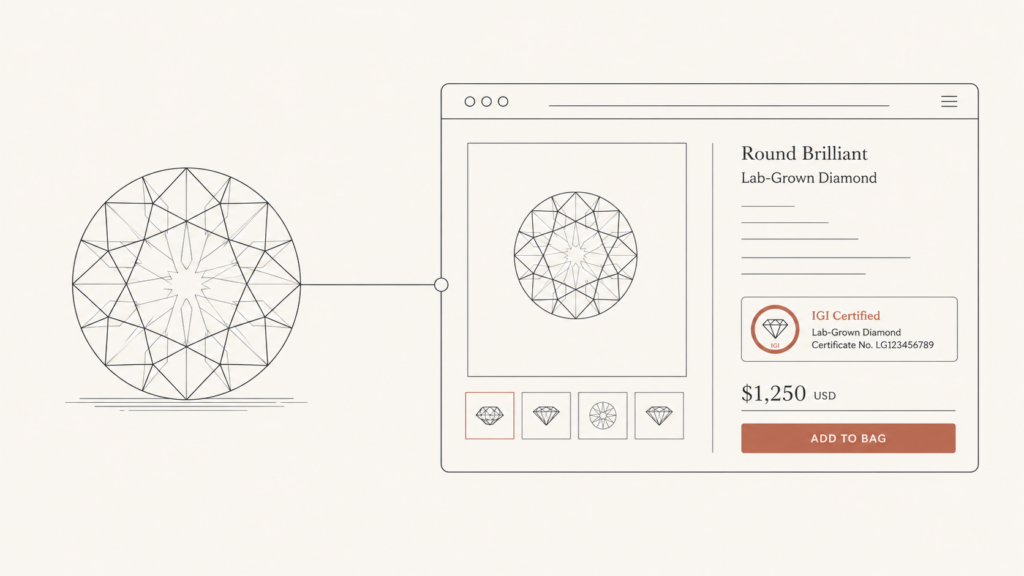
Picture this: a couple lands on your product page for a two-carat round. They love the stone. They read the price, half of what the mined equivalent costs three stores over. Then they open four more tabs. Then they compare. Then they ghost.
That is the real problem with selling lab-grown diamonds online. The stone is no longer rare, and neither is your offer. When every retailer can source a near-identical 1-carat D VVS1 for roughly the same wholesale number, price stops being a moat and becomes a race. The friction is not that shoppers doubt lab-grown. It is that they cannot tell you apart from the next tab.
Here is the thing: the jewelers winning this category are not the cheapest. They are the most trusted. This article covers the full picture: why price-cutting is a trap right now, how to build the trust signals that actually convert, how to disclose and certify correctly so you stay on the right side of the FTC, and the product-page mechanics that turn a browser into a buyer.
Why you cannot sell lab-grown diamonds online on price anymore
For years the pitch wrote itself. Lab-grown got cheaper every quarter, so “same look, less money” did the closing for you. That era is over.
Pricing has stabilized. After wholesale levels fell around 26% in some segments through 2025, 2026 data shows only modest fluctuation, with slight upticks in a few categories and flatlines in most. Premium specs, the 1-carat D to E color, VVS1 to VVS2 stones, hit a functional price floor by late 2025. A 1-carat round now averages around $725 and a 2-carat round sits near $1,700. Those numbers are broadly the same wherever a customer looks.
That is not bad news. It is a shift in what you sell. When the stone commoditizes, the value moves to everything around it, guidance, certification, service, and confidence at checkout. The category is also enormous and still growing: the global lab-grown market ran $29.46 billion in 2025 and is projected to reach $33.54 billion in 2026 on its way to $91.85 billion by 2034. Demand is not the constraint. Differentiation is.
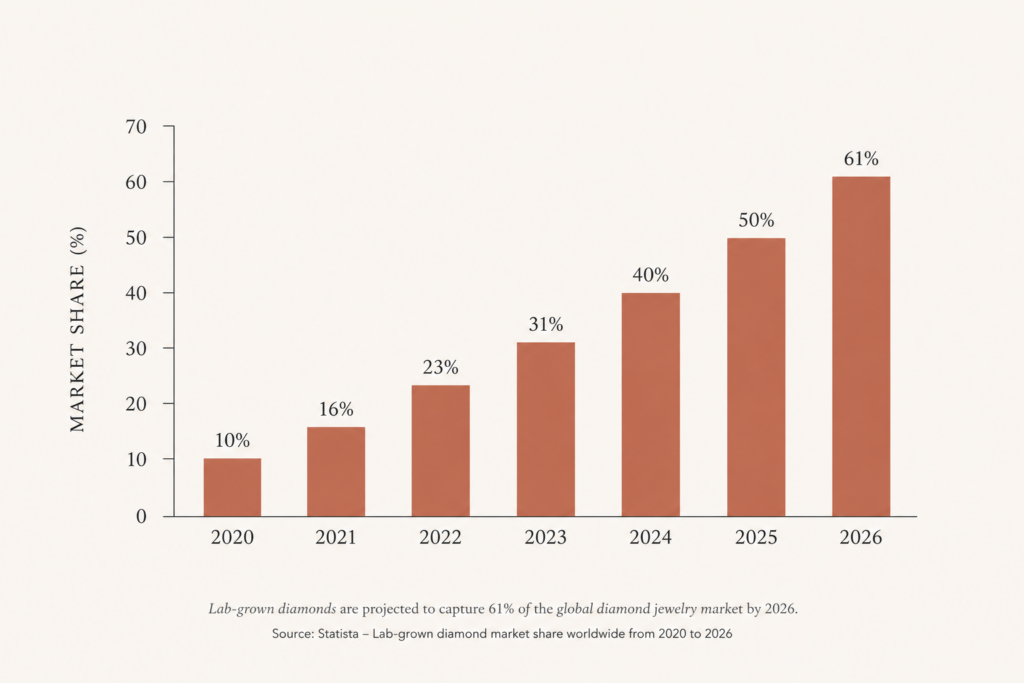
And it gets more pointed. The Knot’s 2026 Real Weddings Study found 61% of couples bought an engagement ring featuring a lab-created diamond, a 239% jump since 2020. More than half of engagement rings sold now carry a lab-grown center stone. The buyers already believe. Your job is to be the one they trust to press “buy.”
Trust is the conversion lever, not price
The average online jewelry store converts somewhere between 1.19% and 1.5% of visitors, against a market projected to hit $85.7 billion in 2026. That gap between traffic and sales is not a pricing problem. It is a trust problem. High-consideration, high-ticket purchases stall when the buyer cannot resolve one quiet question: can I believe what this page is telling me?
So build the page to answer it. Trust in jewelry ecommerce is not a vibe. It is a stack of concrete signals, and each one removes a specific doubt.
- Real photography and video of the actual stone or an honest representation, not a stock render that could be anyone’s inventory.
- A visible, verifiable grading certificate on every diamond over a threshold you set.
- Plain-language sourcing and materials information, so the shopper never has to guess what “lab-grown” means on your site.
- Social proof placed near the decision, reviews, real customer photos, and named testimonials, not a badge in the footer.
- A human within reach, a live advisor or booked consultation for the buyer who wants reassurance before spending four figures.
That last point matters more than most stores admit. The pattern that converts high-value lab-grown pieces is layered: an AI assistant or quote flow handles engagement and qualification at scale, then routes the serious buyer to a human for the conversation that actually closes. Automation for volume, a person for the close. If you have thought about a conversational layer on your store, the same logic behind an AI quote engine for jewelry applies directly here.
One caution: trust signals only work when they are real. A stock render dressed up as your inventory, a review widget stuffed with generic five-star lines, or a “certified” badge that links nowhere all do the opposite of what you intend. The modern buyer cross-checks. They reverse-image-search the photo, they read the one-star reviews first, they Google the certificate number. Fake trust is worse than no trust, because getting caught once poisons the whole page. So the rule is simple: every claim on the page should be something the customer can verify without leaving your control. That is the difference between a store that feels premium and one that feels like a drop-shipper hiding behind a nice theme.
Disclose correctly, or the sale is built on sand
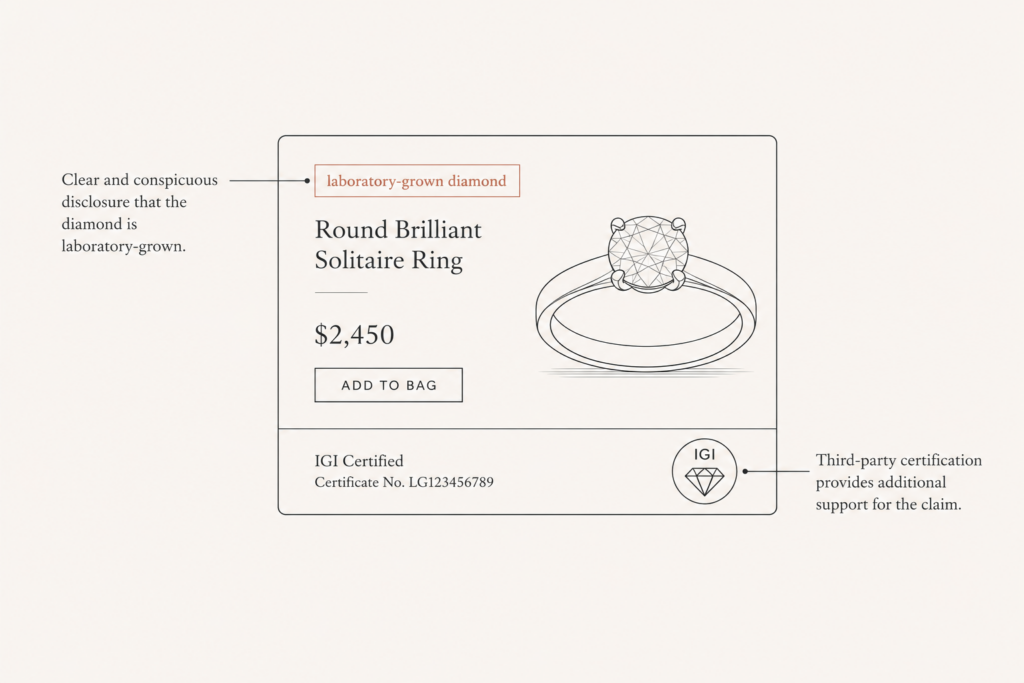
Before you optimize anything, get the labeling right. The FTC’s Jewelry Guides are specific: if you sell laboratory-created diamonds, you must tell consumers they are not mined. Describe them as “laboratory-grown,” “laboratory-created,” or “[manufacturer]-created,” and place that disclosure immediately before the word “diamond,” equally conspicuous, early in the product description. Not buried in a spec table. Not a lighter gray line under the fold.
There is a second trap: sustainability language. The FTC advises against unqualified “eco-friendly,” “eco-conscious,” or “sustainable” claims. Growing a diamond is energy-intensive. If you make an environmental claim, you have to qualify it with the specific basis, or drop it. That is not a compliance footnote. It is a trust decision, because the buyer who catches an overstated green claim stops believing the rest of your page.
Get this right and disclosure stops being a constraint. It becomes a differentiator. Honest, upfront labeling reads as confidence, and confidence is exactly what a hesitant four-figure buyer is scanning for.
Certification is not overhead. It is a sales tool.
A lab-grown diamond without a visible certificate is a claim. With one, it is a fact. Shoppers in 2026 expect provenance, grading, and sourcing transparency, and the stores that surface a real IGI or GIA report on the page, rather than “available on request,” remove the single biggest objection to buying a stone sight unseen.
Treat the certificate as merchandising, not paperwork. Show the report number. Link the stone to its lab record. Let the buyer verify it themselves. That small act, handing the customer the tools to check your work, does more for conversion than another discount code.
There is a technical payoff too. When you structure that grading data properly in your catalog, cut, color, clarity, carat, certificate ID, and lab, you feed both traditional search and AI shopping surfaces the exact fields they use to recommend stones. That is the same discipline behind structured product data for jewelry, and it compounds: the data that reassures a human also gets your stones surfaced by the assistants people now shop through.
The product page mechanics that actually convert
Trust and compliance set the table. The product page closes the deal. Here is where lab-grown pages leak buyers, and how to plug it.
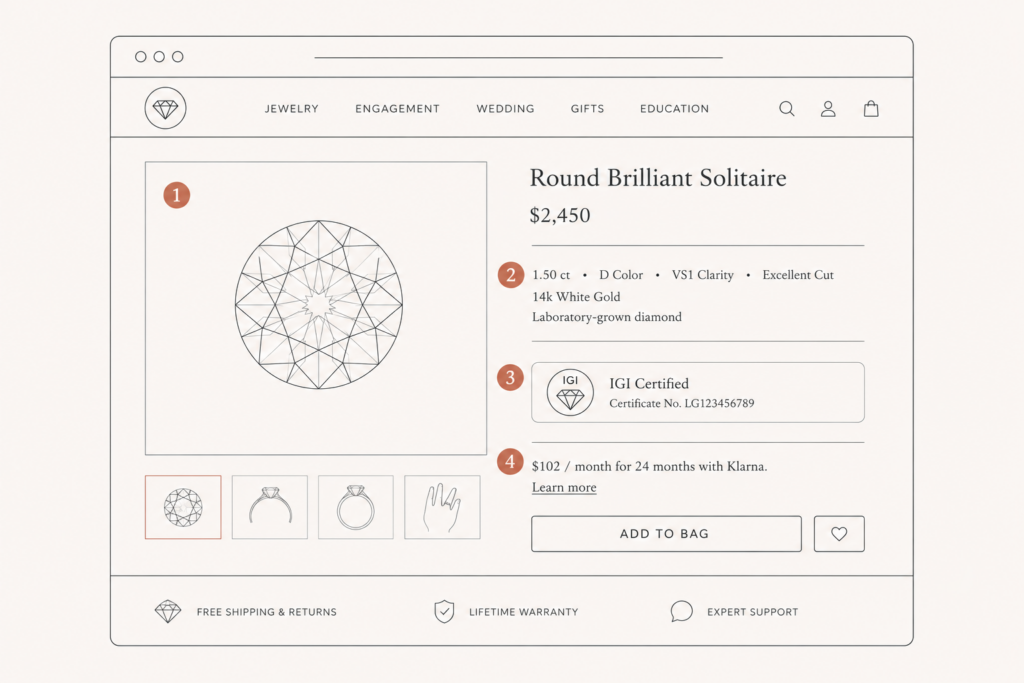
First, lead with the stone, not the stock photo. Buyers spending on a two-carat want to see that carat. Real imagery, 360-degree spin, and video beat a catalog render every time, because they answer “is this the actual thing I am buying” before it becomes a doubt.
Second, make specs legible to a non-expert. Most shoppers cannot read a grading report cold. Translate it. A one-line plain-English summary next to the technical grades, “colorless, eye-clean, excellent cut,” carries the buyer who does not know what VVS2 means but knows they want to feel smart about the purchase.
Third, remove sticker shock at the exact moment it appears. Lab-grown buyers are trading up on size, the average stone rose to 1.9 carats in 2025 while the average ring price fell to $4,600. Four thousand dollars is still a pause. A financing option shown inline, framed as monthly rather than lump sum, short-circuits that hesitation. The mechanics of doing this without wrecking margin are worth their own read on buy now pay later for jewelry.
Fourth, guide, do not dump. A customizer that lets the buyer set shape, carat, and setting, then shows a live certified stone and price, converts far better than a wall of identical thumbnails. Progressive disclosure, showing the essentials immediately and revealing the deeper grading detail only when the buyer reaches for it, keeps the page calm instead of overwhelming. These are the same conversion patterns covered in depth in jewelry product page optimization.
Where discovery actually happens now
One more shift worth building around: the funnel starts earlier and further out. Social platforms, Instagram and TikTok especially, have become the trust-building and aesthetic-curation layer before the buyer ever reaches your site. For fine jewelry the pattern is consistent. Discovery and desire form on social, then the customer moves to your DTC page to verify and buy.
That means your product pages and your social presence are one system, not two. The stone a shopper falls for in a reel needs to be findable, certified, and buyable when they land. Break that chain, a stone that is out of stock, a page with no certificate, a price that jumps at checkout, and the trust you built on social evaporates in a single tab.
There is a newer channel forming alongside social, and it is worth preparing for now. Buyers increasingly ask an AI assistant to find and compare stones before they ever open a retailer’s site. Those assistants do not read your marketing copy. They read structured fields: certificate, cut, color, clarity, carat, price, availability. If your catalog exposes that data cleanly, your stones get surfaced and cited. If it hides behind images and free text, you are invisible to the tool doing the shortlisting. The same certificate discipline that reassures a human, then, is what earns you a place in the machine’s recommendation. Both audiences want the same thing, verifiable facts they can act on, and the store that serves them once serves them both.
The bottom line on how to sell lab-grown diamonds online
Selling lab-grown diamonds online is not a pricing exercise. It is a trust exercise. The stone is a commodity now, the demand is already there, and the retailer who wins is not the one with the lowest number. It is the one who discloses honestly, certifies visibly, translates the specs, and stands behind the piece.
So here is the practical split. If your catalog is straightforward and your volume is modest, start simple: fix your FTC disclosure, put a verifiable certificate on every stone, add real imagery, and show financing inline. That alone lifts most jewelry pages. If your inventory is deep, your stones are configurable, or you are routing live buyers between an assistant and a human advisor, you need a real system, structured stone data, a live-inventory configurator, and a conversion path built for four-figure decisions, not a stack of plugins fighting each other.
If you are not sure which side of that line you are on, reach out to Javaid Ahmad for a straightforward conversation about your store. No lengthy discovery calls, no vague proposals, just a clear answer on what to fix first and what it takes. You can start with a free store audit at javaid.dev/contact.
FAQ
Q: How do I sell lab-grown diamonds online without competing only on price? A: Shift your value from the stone to the service around it. Since lab-grown pricing has stabilized and looks similar across retailers, the differentiators are trust signals: real imagery, visible certification, honest disclosure, plain-language specs, and a human advisor for the close. Buyers pay for confidence, not just carats.
Q: What does the FTC require when I sell lab-grown diamonds online? A: You must disclose that the stone is not mined, using terms like “laboratory-grown,” “laboratory-created,” or “[manufacturer]-created” placed immediately before the word “diamond” and equally conspicuously, early in the description. You must also avoid unqualified “eco-friendly” or “sustainable” claims unless you state the specific basis for them.
Q: Do lab-grown diamonds still sell if prices have stopped dropping? A: Yes. Demand is at record levels, with about 61% of 2026 engagement rings featuring a lab-created diamond, and the global market is still growing double digits. Stable pricing actually helps, because it lets you sell on trust and service instead of a moving discount.
Q: How much cheaper are lab-grown diamonds than natural ones? A: Lab-grown typically costs 40% to 80% less than a comparable mined stone, depending on specs. A 1-carat round lab-grown averages around $725 and a 2-carat round around $1,700, which is why buyers are trading up in size while still spending less overall.
Q: What is the single biggest thing that improves lab-grown diamond conversion? A: A verifiable grading certificate shown directly on the product page, with the report number and a way for the buyer to check it themselves. It removes the core objection to buying a stone sight unseen and reads as confidence rather than a claim.
Q: Should I let customers configure their own lab-grown diamond ring? A: For deeper inventory, yes. A configurator that shows a live certified stone and price as the buyer selects shape, carat, and setting converts better than a grid of identical thumbnails, as long as you use progressive disclosure so the page stays calm rather than overwhelming.

Comments are reviewed before they appear, so yours will not show up straight away. Your email is never published.