
You are about to spend tens of thousands of dollars, and the platform sales deck is not going to tell you the truth. The Adobe Commerce vs Magento Open Source decision is the single most expensive call most Magento merchants make all year, and the wrong pick quietly drains six figures over a three-year window. I have built and migrated Magento stores for US and UK retailers long enough to watch both editions make people rich and bury people in invoices.
So let me cut through the marketing. Here is exactly when each edition wins, what the real numbers look like in 2026, and the moment you should consider leaving Magento entirely.
Adobe Commerce vs Magento Open Source: What Actually Separates the Two Editions
First, clear up the name confusion. Magento Commerce became Adobe Commerce after Adobe bought the platform, and today the genuine fork in the road is Adobe Commerce vs Magento Open Source. Same core codebase. One side is the free open source product, the other is the commercially licensed enterprise version sitting on top of it.
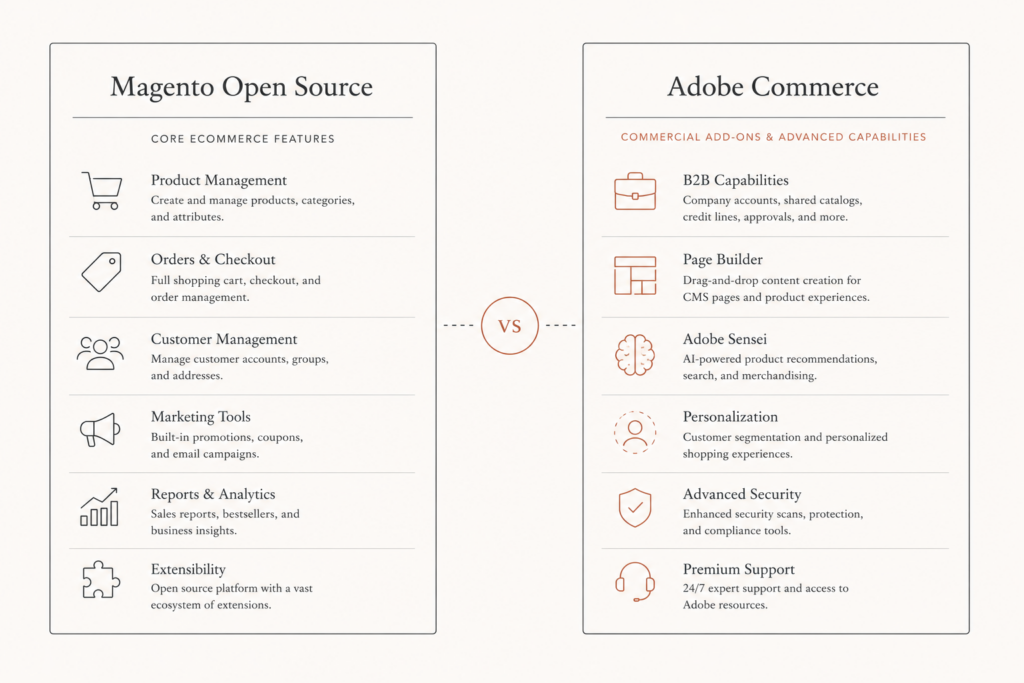
Here is the part most blog posts bury: Magento Open Source is not a stripped-down demo. It ships the full ecommerce platform. Catalog, checkout, multi-store, multi-currency, the works. What you pay Adobe for is the commercial feature layer, the managed cloud infrastructure, and a support contract with an SLA attached.
The commercial layer is where the real gap lives. Adobe Commerce adds:
- Native B2B suite (company accounts, shared catalogs, negotiable quotes, purchase orders, requisition lists)
- Page Builder drag-and-drop content editing
- Customer segmentation and content staging with preview
- Live Search and AI product recommendations powered by Adobe Sensei
- RMAs, reward points, and gift cards baked in
- Advanced reporting and Adobe’s official support
None of those exist in Open Source out of the box. You can rebuild some of them with extensions and custom code, and I have done exactly that for plenty of clients. But you are trading license dollars for developer hours, which brings us to the only question that actually matters.
The Money Conversation Nobody Has Upfront
Magento Open Source is free to license. Zero. Adobe Commerce is not, and the pricing climbs with your revenue because it runs on a GMV-tiered model (gross merchandise value).
Here is what the 2026 numbers actually look like, based on current vendor benchmarks:
- Under $1M GMV: roughly $22,000/year on-premises, around $40,000/year on Cloud
- $1M to $5M GMV: $30,000 to $55,000/year on-premises, $55,000 to $80,000/year on Cloud
- $5M to $25M GMV: $55,000 to $120,000/year on-premises, up to $190,000/year on Cloud
- $25M+ GMV: negotiated, frequently $190,000+/year on Cloud
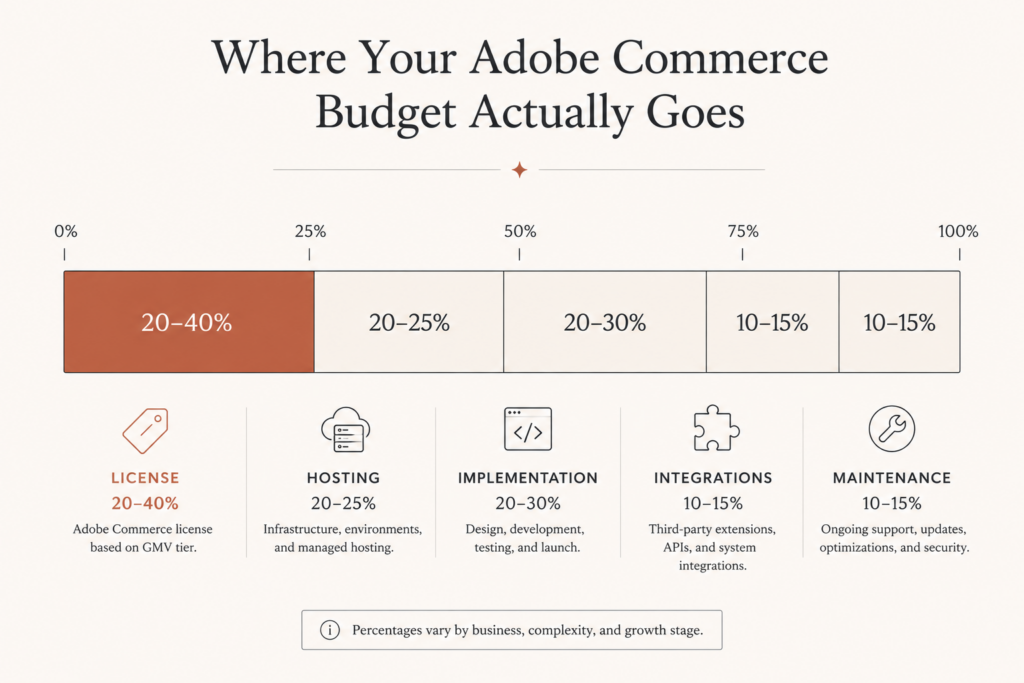
Now read this next part twice, because it is the trap. That license is not your real bill. Across a working Adobe Commerce store, the license consistently works out to just 20 to 40 percent of total annual spend. The rest is implementation, integrations, hosting, extensions, and maintenance. A $50,000 Cloud quote routinely becomes $122,000 to $200,000 once everything is loaded in, and a full build-and-run store often lands at $122,000 to $450,000+ per year.
And Open Source being free? That word is doing a lot of lifting. You still pay $5,000 to $90,000+ annually in development, hosting, and maintenance. The license cost disappears, the operating cost does not.
Hosting: The Quiet Difference That Changes Everything
This is where Adobe Commerce earns part of its keep. The Cloud edition (PaaS) bundles managed hosting on AWS or Azure, Fastly CDN, a web application firewall, automatic updates, and PCI compliance. You are not standing up servers or babysitting infrastructure at 2am.
With Magento Open Source, hosting is entirely your problem. Production servers realistically run $200 to $2,000+ per month, and you need a competent DevOps person or agency to keep performance and security tight. That is not a knock on Open Source. It is a responsibility you are accepting in exchange for control and lower license cost.
The honest read: if you do not have a technical team, Open Source hosting will eat the savings you thought you were getting.
B2B Is The Real Decider
If you sell B2B, this section is the whole article. Magento is still the number one B2B ecommerce platform in 2026, and B2B stores on Magento show average order values around 2.5 times higher than their B2C counterparts. That is not a rounding error. That is a reason the platform exists.
Adobe Commerce bundles the full B2B module into every license at no extra charge: company accounts, shared catalogs, negotiated quotes, purchase orders, requisition lists. On Open Source, you are rebuilding all of that with extensions and custom development, and it gets expensive fast and harder to maintain over time.
So the rule I give clients is blunt. Serious B2B requirements push you toward Adobe Commerce. Straight B2C usually does not. I have also moved B2B operations off Magento entirely when the fit was wrong, like the Magento to WordPress B2B migration I documented for Romsons, so paying Adobe is not automatically the right answer just because you sell wholesale.
Security and Patching in 2026
Good news here for both camps. Adobe ships security patches for Open Source and Adobe Commerce on the same Magento 2.4 line, and starting January 2026 it moved to a monthly isolated security fixes schedule for more predictable protection. The most recent patch landed on May 12, 2026, covering Open Source 2.4.8-p5, 2.4.7-p10, and 2.4.6-p15.
But here is the deadline you cannot ignore: version 2.4.6 reaches end of life and stores must upgrade before August 11, 2026. After that, 2.4.6 gets no more patches and any store left behind is exposed. On Open Source, applying those patches is your team’s job. On Adobe Commerce Cloud, a lot of that maintenance burden is handled for you. That difference is worth real money over a year.
And do not underestimate the human cost of falling behind on patches. I have inherited Open Source stores that skipped two patch cycles because the merchant had no developer on retainer, and the cleanup after a breach costs far more than the patching ever would have. If you go Open Source, budget for a maintenance retainer the same way you would budget for a license. It is not optional.
Performance and Customization: Where Open Source Still Shines
Let me give Open Source its due, because the cost talk can make it sound like the budget option. It is not. It is the control option.
With Open Source you own the code outright. You can rewrite checkout, build a fully custom catalog structure, integrate any ERP or PIM you want, and go headless without asking permission or paying a premium tier. For developers who know Magento well, that freedom is the entire point. I have shipped Open Source builds that outperform Adobe Commerce Cloud stores simply because the hosting and caching layer were tuned by hand for that specific catalog.
Adobe Commerce gives you guardrails and a support line. Open Source gives you a blank canvas and the bill for the brushes. If your competitive edge lives in a deeply custom storefront, Open Source plus a strong team will usually beat a locked-down enterprise license. If your edge is somewhere other than your tech stack, those guardrails are worth paying for.
When You Should Leave Magento Entirely
Sometimes the right answer is neither edition. I will say what the sales engineers will not: Magento’s total cost of ownership runs roughly 3 to 10 times higher than Shopify once you stack hosting, $100 to $200/hour specialist developers, security patching, and PCI audits. Merchants commonly spend $40,000 to $130,000 per year just keeping Magento running before a single new feature ships.
When merchants migrate to Shopify, they typically report TCO that is 30 to 40 percent lower over three years and 60 to 70 percent less developer time on maintenance. That is a serious pull.
Consider leaving Magento when:
- Your catalog and customizations are modest enough that Shopify covers them
- You are spending more on keeping the lights on than on growth
- You lack the in-house technical depth Magento honestly demands
- Your B2B needs are light enough for Shopify B2B or a simpler stack
If that sounds like you, plan the move carefully, because the SEO risk is real. I put together a Magento to Shopify SEO redirects checklist precisely so merchants stop torching their rankings during migration. And if you are going premium, weigh whether headless Shopify is actually worth it before you commit to that architecture.
So, Which One Should You Actually Choose?
Here is my hands-on, no-spin verdict for 2026.
Choose Magento Open Source if you are below roughly mid-seven figures in revenue, you have a technical team or a reliable agency, your B2B needs are light, and you want maximum control without a license bill.
Choose Adobe Commerce if you have meaningful B2B requirements, your revenue justifies the license, you want managed cloud hosting plus support, and you would rather pay Adobe than build and babysit that feature layer yourself.
Choose neither if Magento’s total cost of ownership is outpacing your growth and a platform like Shopify covers your real needs.
The platforms share a codebase, so the migration path between the two editions is well-trodden. Your data comes with you. That means you do not have to get this perfect on day one, but you should get it right, because the wrong call here is the most expensive mistake in your tech stack.
FAQ
Is Magento Open Source still free in 2026?
Yes. The Open Source license is free to download and use. You pay nothing for the software itself, but you still cover hosting, development, and maintenance, which typically runs $5,000 to $90,000+ per year depending on your store’s complexity.
What is the difference between Adobe Commerce and Adobe Commerce Cloud?
Adobe Commerce can run on-premises (you license the commercial software but host it yourself) or as Adobe Commerce Cloud, which bundles managed AWS or Azure hosting, Fastly CDN, a firewall, automatic updates, and PCI compliance. Cloud costs more because the infrastructure and management are included in the price.
Do I need Adobe Commerce for B2B?
Not strictly, but it helps a lot. Adobe Commerce bundles native B2B features (company accounts, shared catalogs, negotiated quotes, requisition lists) into every license. On Open Source you rebuild those with extensions and custom code, which adds cost and maintenance. For serious B2B, the Adobe Commerce math usually wins.
When does Magento 2.4.6 stop getting security patches?
Magento 2.4.6 reaches end of life and must be upgraded before August 11, 2026. After that date it receives no further security patches, so stores still on 2.4.6 should plan an upgrade now to stay protected.
Is it cheaper to leave Magento for Shopify?
Often, yes. Merchants who move to Shopify commonly report a total cost of ownership that is 30 to 40 percent lower over three years and noticeably less developer maintenance time. Whether it is right for you depends on your catalog size, customizations, and B2B needs.
The Bottom Line
The Adobe Commerce vs Magento Open Source decision is not about which platform is better. It is about which one fits your revenue, your team, and your B2B reality without quietly bleeding
Licence choice is only the start of the Magento decision. Upgrades, speed work, and the move off Magento entirely are covered in my Magento writing.

Comments are reviewed before they appear, so yours will not show up straight away. Your email is never published.