
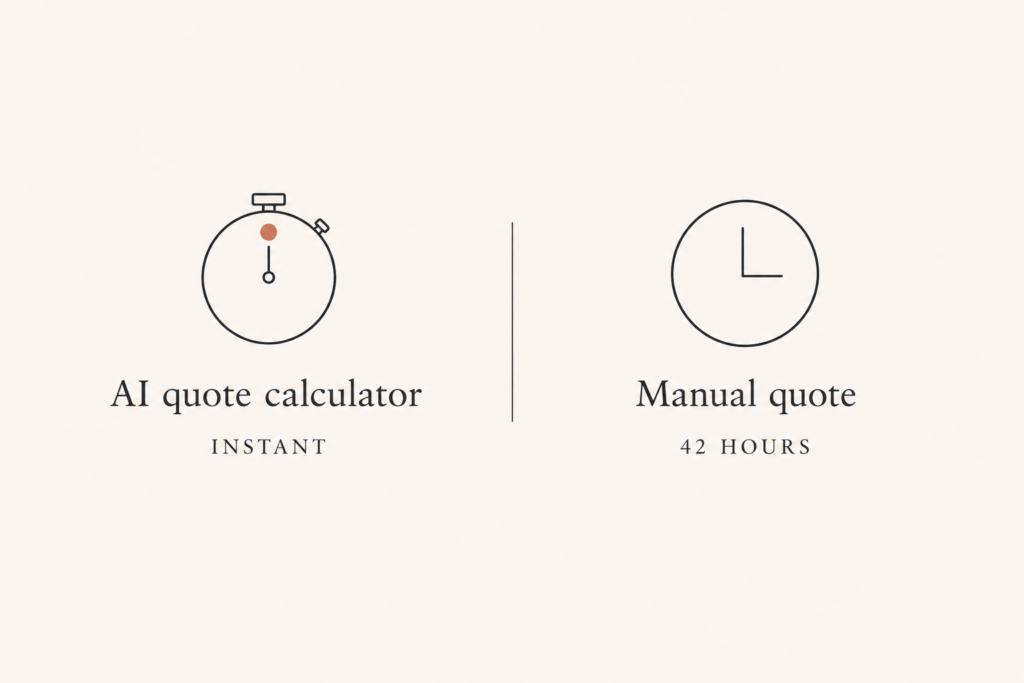
Your contact form is leaking money. Right now, someone is sitting on your pricing page, ready to spend, and your only ask is “fill this out and we will get back to you.” They want a number. You gave them a waiting room. That gap is exactly where an AI quote calculator earns its keep.
I build these tools for a living, on WordPress, Shopify, Webflow, and Wix, and the pattern is always the same. The moment a visitor can answer a few smart questions and watch a real price assemble in front of them, the relationship changes. They stop being a passive browser and start being a buyer. In this article I will show you why that shift matters more than ever in 2026, and exactly how to build a calculator that captures, qualifies, and books leads while you sleep.
Why static forms are losing in 2026
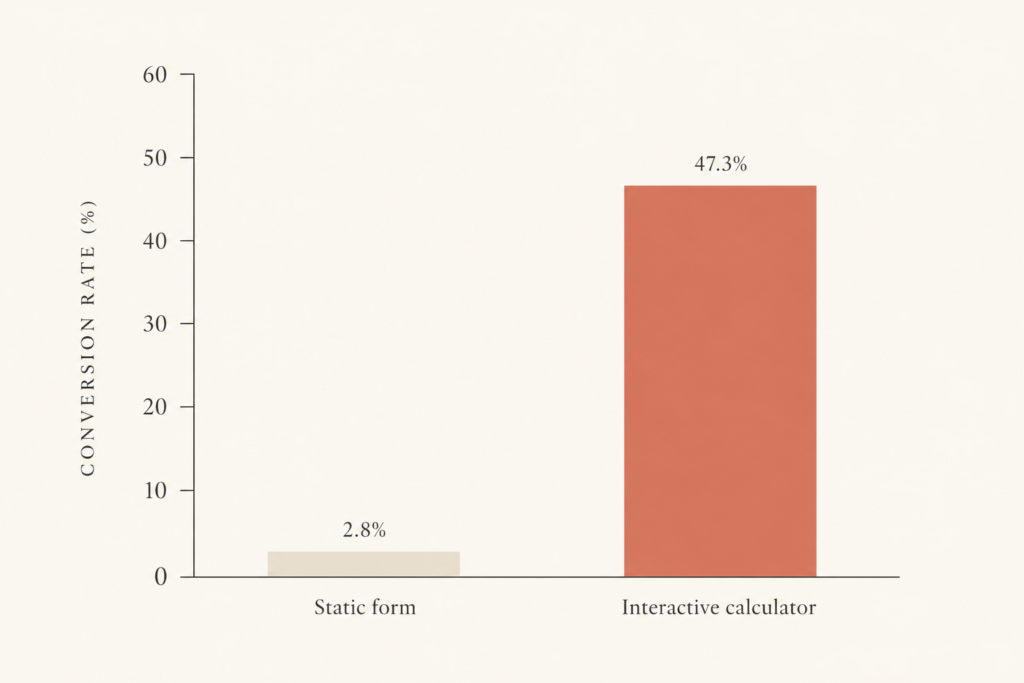
Let me hit you with the number that should make you nervous. Interactive forms convert at an average of 47.3%, while traditional static forms sit at 2.8%. That is roughly a 16x gap, and it is the single biggest reason I tell clients to retire their old “request a quote” box.
Here is what is really going on under that statistic. Buyers have changed. As of 2026, 67% of B2B buyers prefer self-service options over speaking to a sales rep, and 33% want a completely rep-free buying experience. Millennials and Gen Z now make up 71% of procurement professionals, and they shop the way they shop everything else, on their own time, with instant answers.
A static form fights that instinct. It asks for effort and gives nothing back. An AI quote calculator does the opposite: it gives something back on every click.
There is also a trust dividend most owners miss. When a buyer can see how their choices move the price, they feel in control, and control builds confidence. That confidence is what carries them from “just curious” to “let me lock this in.” A form can never create that feeling, because a form is a one-way request. A calculator is a conversation.
What makes an AI quote calculator different from a regular one
A plain calculator runs fixed math. You pick options, it multiplies, it spits out a price. Useful, but rigid. An AI quote calculator adds a layer of intelligence on top of that math, and that layer is where the magic happens.
Three things separate the AI version from the basic one:
- Conversational input. Instead of forcing a buyer through 12 dropdowns, the tool can let them describe the job in plain language (“I need a 2,000 square foot deck repainted”) and parse that into the right pricing variables.
- Dynamic pricing logic. The calculator adjusts in real time based on location, urgency, materials, or season, so the quote reflects reality instead of a stale flat rate.
- Smart validation and routing. AI catches nonsense inputs, flags high-value leads, and routes them differently from tire-kickers before a human ever looks at the form.
I dig into the conversational side in depth over in conversational quote engines vs forms, because that one decision (chat-style versus stepped form) changes your whole build. The short version: AI does not replace your pricing rules. It wraps them in a smoother, faster, more human experience.
The speed-to-lead advantage you cannot ignore
Here is the part most business owners underestimate. The biggest win from an AI quote calculator is not the quote itself. It is what happens in the 60 seconds after.
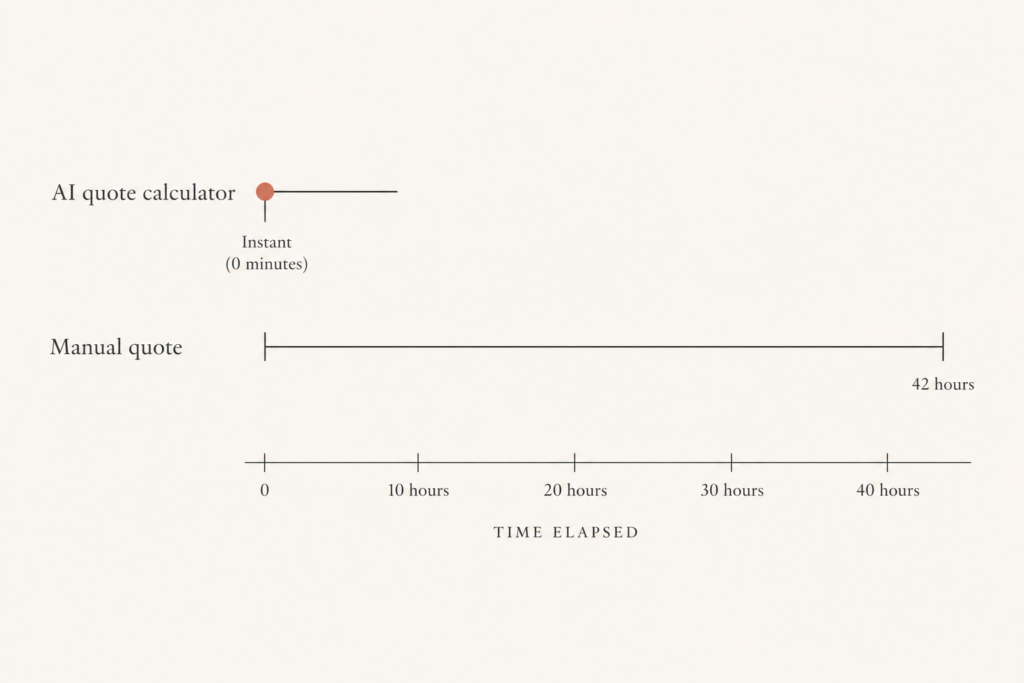
The research on this is brutal. Leads contacted within 5 minutes are 21 times more likely to qualify than leads contacted after 30 minutes. And 78% of customers buy from the company that responds first. Yet the average B2B lead response time is 42 hours. Forty-two hours. Your competitor is sending that quote next Tuesday.
An AI quote calculator collapses that window to zero. The buyer gets a number instantly, your CRM gets a hot lead instantly, and your automation fires a follow-up before the prospect closes the tab. You are not just quoting faster. You are quoting first, which is most of the battle.
How to build a calculator that actually converts
I have shipped enough of these to know that the platform matters less than the structure. A great calculator on Wix beats a sloppy one on a custom React build. Here is the structure I use on every project.
Start with multistep logic, not one giant form
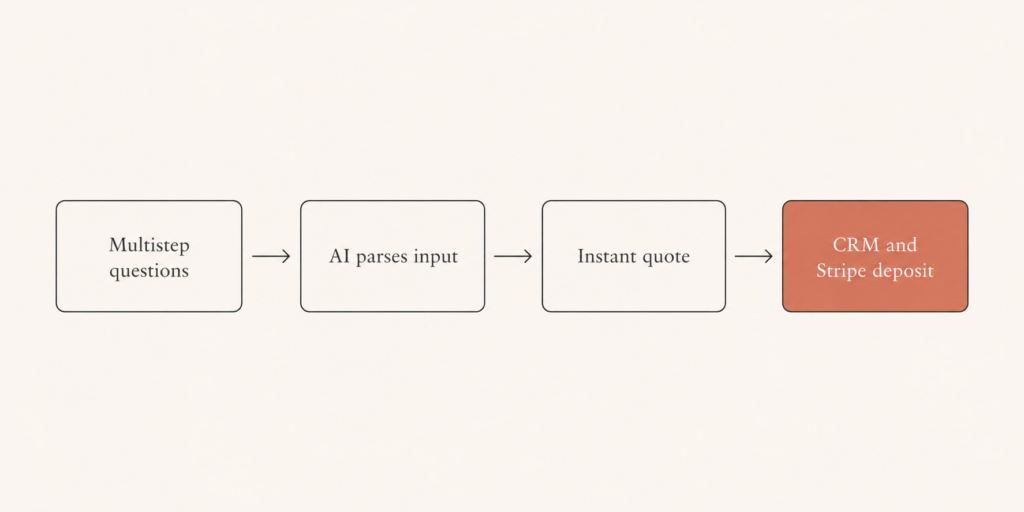
Nobody finishes a 20-field wall of inputs. Break the quote into 3 to 5 short steps, each asking one focused thing. Step one is the easy, low-commitment question (project type). The contact details come at the end, after the buyer is already invested in their result.
This is not a guess, it is a completion-rate lever. I broke down the specific patterns that lift finish rates in calculator UX patterns that lift completion, and the multistep flow is consistently the heaviest hitter. Show a progress bar, keep each step under 15 seconds, and never ask for an email before you have given value.
Layer in conversational AI where it helps
You do not need AI on every field. Use it where free-form input beats dropdowns: describing scope, uploading a photo of the job, or asking a follow-up question. The AI parses messy human language into clean pricing variables, then hands control back to your deterministic math. This keeps quotes accurate while keeping the experience natural.
Wire it straight into your CRM
A quote that lands in an inbox is a quote that gets lost. Every calculator I build pushes leads directly into the client’s CRM (HubSpot, Pipedrive, GoHighLevel, whatever they run) with the full quote breakdown attached. That means your sales team or your automation sees the deal size, the inputs, and the contact details the second the buyer hits submit. Tag high-value quotes so your best leads jump the queue.
Take a deposit with Stripe to filter for intent
This is the move that separates a lead machine from a lead pile. For service businesses, I add an optional Stripe deposit step right at the quote stage. A buyer who pays a refundable $50 or $100 deposit to lock in their estimate is a buyer who is serious. It crushes no-shows, it pre-qualifies harder than any form field, and it starts revenue flowing before the first call.
If you are still deciding which calculator tool or plugin fits your stack, my cost estimation calculator WordPress buyers guide for 2026 walks through the realistic trade-offs so you do not overspend on features you will never use.
Real numbers on what this does for a business
Let me ground this in outcomes, because pretty UX means nothing without results. Interactive content generates roughly 2x more conversions and 5x more pageviews than static content, and brands deploying AI-driven assessment tools report a 78% average lift in lead capture rates.
On the ground, the wins compound. One pattern I see repeatedly: a service business swaps a “contact us for pricing” page for a working AI quote calculator and watches their quote volume multiply, while the quality of each lead climbs because the calculator pre-qualifies on budget and scope. B2B teams using conversational AI in their sales flow have reported response times cut by 60% and self-serve conversions up 22%.
The takeaway is simple. An AI quote calculator does not just collect more leads. It collects better leads, faster, and qualifies them before your team spends a minute.
Common mistakes that kill calculator performance
I get called in to fix as many broken calculators as I build from scratch. The failures cluster around a few avoidable mistakes:
- Asking for contact info too early. If the email field comes before the buyer sees value, completion craters. Always quote first, capture second.
- Hiding the price. A calculator that makes the buyer “request” the number they just built is a bait and switch. Show a real range, then offer the detailed breakdown by email.
- Skipping mobile testing. Most quote traffic is mobile in 2026. If your steps feel clunky on a phone, your conversion rate dies there.
- No CRM connection. A calculator without automated lead routing is a vanity tool. The integration is where the revenue lives.
Fix those four and you are ahead of most of the market.
Frequently asked questions
What is an AI quote calculator?
An AI quote calculator is an interactive tool on your website that gathers a buyer’s requirements, often through conversational or stepped input, and instantly returns a real price or estimate. The AI layer handles natural-language input, dynamic pricing adjustments, and lead validation, while your underlying pricing rules keep the math accurate.
How much does it cost to build a custom quote calculator?
It depends on complexity. A clean multistep calculator with CRM integration is a modest, fixed-scope project. Adding conversational AI, dynamic pricing tables, and Stripe deposits raises the build. The smarter way to think about it is payback: if the tool lifts your conversion rate from the 2.8% static-form average toward double digits, it pays for itself fast.
Can I add an AI quote calculator to WordPress, Shopify, Webflow, or Wix?
Yes. I build them on all four. WordPress and Shopify give you the most room for deep CRM and payment logic, while Webflow and Wix work well for cleaner, design-led calculators. The right platform depends on your existing stack and how much custom pricing logic you need.
Will an AI quote calculator give away pricing my competitors can copy?
This is the most common fear, and it is usually overblown. You control exactly what the calculator reveals. Many of my clients show a smart range rather than an exact figure, then deliver the precise quote by email or after a deposit. You get the conversion benefit of transparency without publishing your full price book.
How does a quote calculator capture leads if someone does not buy?
Even an incomplete or browsing visitor leaves valuable signals. By capturing the email at the result step and pushing every interaction into your CRM, you build a retargetable list of warm prospects who told you exactly what they want. That data alone often justifies the build.
Turn your website into a lead machine
The math is not subtle anymore. Static forms convert at 2.8%, interactive calculators reach 47%, and the businesses winning in 2026 are the ones giving buyers an instant, intelligent quote instead of a waiting room. An AI quote calculator is the most direct path from “just looking” to “ready to buy.”
If you want one built right, with multistep logic, real CRM integration, and Stripe deposits that filter for serious buyers, that is exactly what I do. Tell me about your business and your pricing, and I will map out the calculator that fits. Grab a free consult at javaid.dev/contact and let us turn your website into a machine that quotes, qualifies, and books while you sleep.

Comments are reviewed before they appear, so yours will not show up straight away. Your email is never published.