
You want to launch on Shopify, but every answer to “how much does a Shopify store cost” is either a vague “it depends” or a sales page pushing you toward the most expensive plan. That is frustrating when you are trying to budget. I build these stores for US and UK retailers every week, so let me give you the real numbers instead.
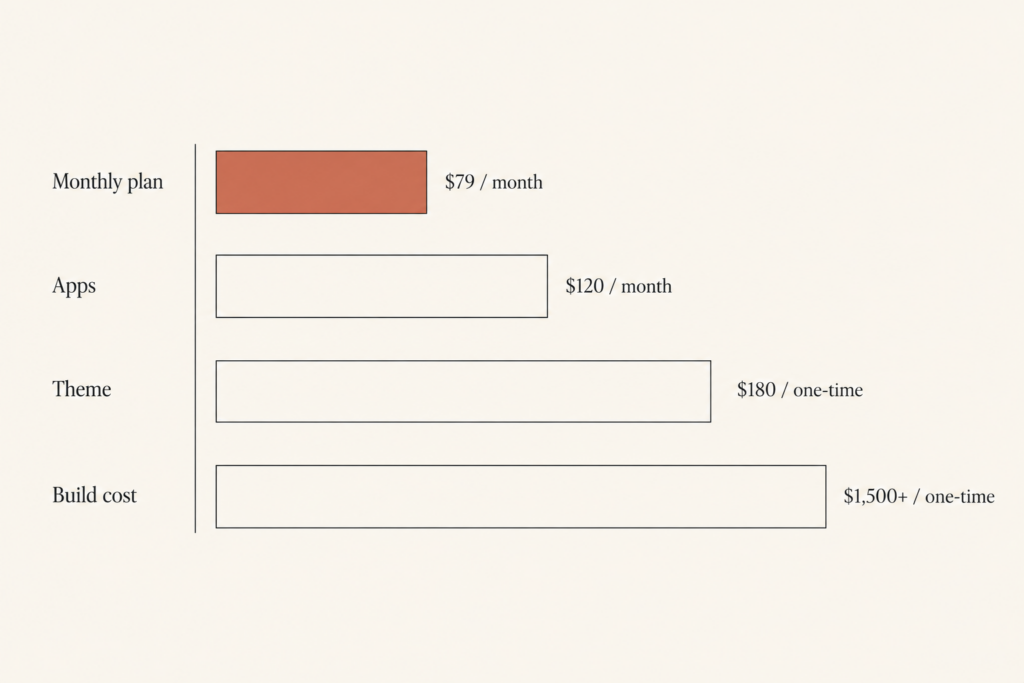
Here is the short version. A Shopify store in 2026 costs anywhere from about $40 a month for a scrappy DIY launch to $25,000 or more for a fully custom build. The spread is huge because “a Shopify store” can mean a weekend side project or a seven-figure jewelry brand. Below, I break the cost into the four buckets that actually matter so you can build a budget that fits where you really are.
The monthly plan: your smallest cost
Let us start with the part everyone fixates on, which is also usually the cheapest. Shopify runs four plans in 2026.
- Basic: around $39 a month (closer to $29 if you pay annually). Right for new and small stores.
- Grow: around $105 a month. The sweet spot for stores doing real volume that need better reporting and lower card rates.
- Advanced: around $399 a month. For higher-volume stores that want the lowest standard rates and advanced reporting.
- Plus: starts around $2,300 a month on an annual contract. Enterprise features, checkout customization, and higher API limits.
Here is the part most guides bury: the plan you pick changes your payment processing rate, and at scale that matters more than the subscription. With Shopify Payments you pay roughly 2.9% plus 30 cents per online order on Basic, dropping to around 2.5% plus 30 cents on Advanced. On a store doing $80,000 a month, that rate difference can save more than the cost of the upgrade itself. So do not just compare sticker prices. Compare total cost at your real volume.
And if you use a third-party gateway like PayPal as your primary processor instead of Shopify Payments, Shopify adds a transaction fee on top, up to 2% on Basic. That fee disappears on Plus, which is one of the quieter reasons big brands move up. I wrote a full breakdown of when the jump to Shopify Plus pays off if you are weighing that decision.
Apps: where budgets quietly leak
This is the bucket that surprises people. The base plan is predictable. Apps are not.
A typical growing store spends $50 to $200 a month on apps, and I have audited stores paying far more without realizing it. Reviews, subscriptions, upsells, loyalty, search, page builders, and back-in-stock alerts all stack up. Each one looks like $15 or $29 a month in isolation. Add eight of them and you are at $200 before you have sold anything.
The takeaway: app spend is a recurring tax on your store, so treat it like one. Every quarter, list every app, what it does, and what it costs. Kill anything you would not re-buy today. On one jewelry store I cut $480 a month in app spend by replacing a few bloated apps with native theme code that did the same job faster. That is $5,760 a year back in the business, and the site got quicker too.
A rough working budget for apps:
- Lean launch: $0 to $50 a month. Free apps plus what Shopify gives you natively.
- Growing store: $80 to $200 a month. A handful of paid tools that each earn their keep.
- Scaling brand: $300 a month and up. Subscriptions, advanced search, and a page builder, with someone watching the bill.
The build: theme plus the work to launch
Now the big variable: who actually builds the thing. This is where “how much does a Shopify store cost” gets a wide answer, because it depends entirely on how custom you go.
A premium Shopify theme is a one-time purchase of roughly $180 to $400. That is your design foundation. From there, your options break down like this.
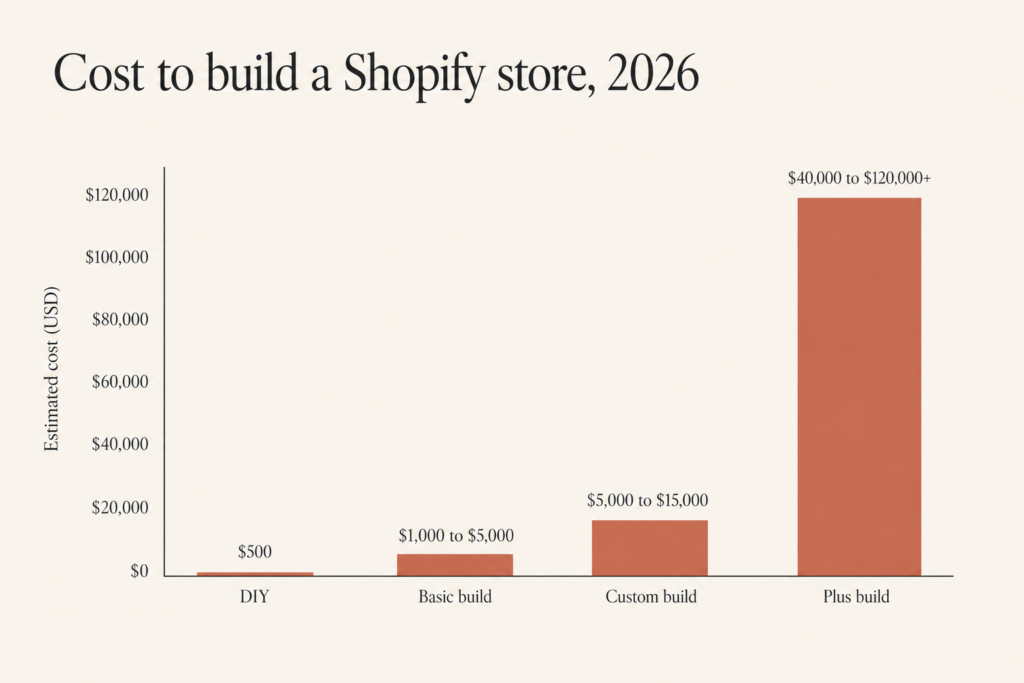
DIY launch: if you set everything up yourself on a free or cheap theme, you can be live for around $500 all-in, counting the theme, a couple of apps, and a domain. It works for testing an idea. It rarely converts like a built store.
Freelancer build: Shopify developers charge a wide range. Junior freelancers run $15 to $30 an hour, mid-level developers $40 to $80, and top specialists $100 and up. A solid, professionally built store on a customized theme typically lands between $1,000 and $5,000.
Custom build: when you need bespoke functionality, a custom product configurator, supplier integrations, or a real design system, you are in the $5,000 to $15,000 range. This is where most serious brands sit.
Agency or Plus build: agencies bill $90 to $200 an hour depending on region, and a full Shopify Plus project runs $40,000 to $120,000 or more. You are paying for project management, QA, and structured delivery, not just code.
The honest takeaway: the gap between a $45-an-hour developer and a $150-an-hour agency is real, but more expensive is not automatically better for you. A focused freelance specialist often delivers a tighter, faster store for a high-AOV brand than a big agency does, and you talk to the person actually doing the work.
The hidden costs nobody quotes you
Here is what gets left off most estimates, and what wrecks budgets later.
- Performance debt. A slow store costs you money on every visit. If your theme and apps push load times past three seconds, conversion drops. Fixing it later costs more than building it right. I covered the playbook in getting a Shopify store under three seconds.
- Maintenance. Plan for ongoing work: app updates, theme tweaks, seasonal changes, bug fixes. Budget a few hundred dollars a month or a retainer if you do not have an in-house person.
- Content and product setup. Photography, copy, and loading 200 products by hand takes real time. If you outsource it, it is a line item.
- Migration. Moving from another platform is its own project, with redirects and data mapping that protect your SEO. Skip it and you lose rankings.
- Going headless. Tempting, but expensive and rarely worth it for most stores. I explain when headless Shopify is actually worth it so you do not overspend chasing it.
So what should you actually budget?
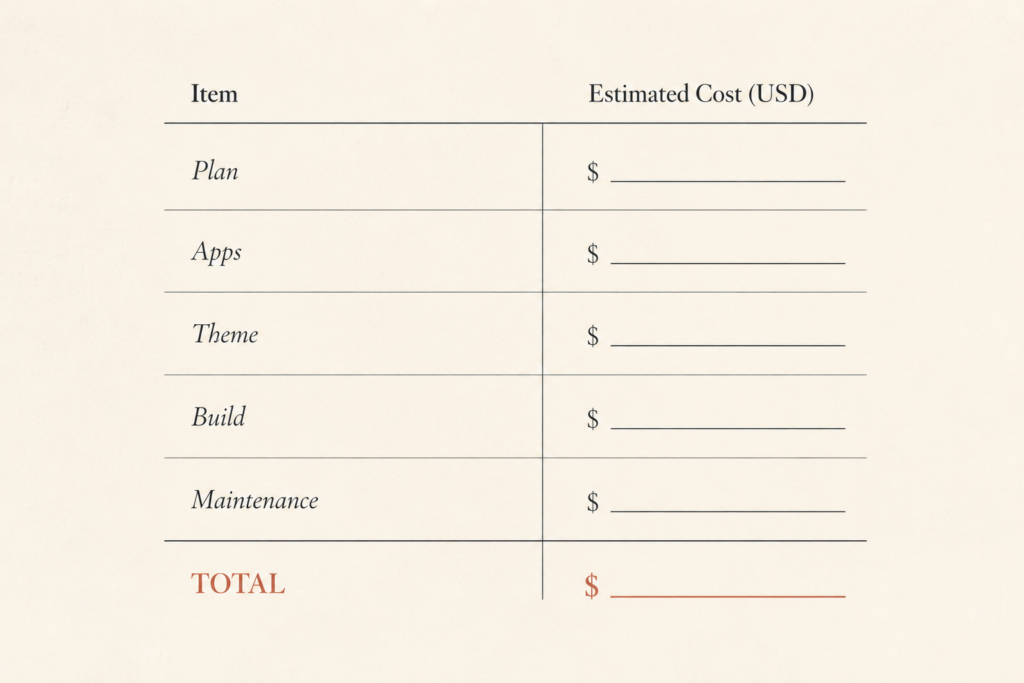
Let me make it concrete. For a real, professionally built store you intend to grow, plan for roughly $3,000 to $8,000 to launch, plus $150 to $400 a month to run it in year one. That covers a customized theme, a sensible app stack, and a developer who builds for speed and scale instead of patching things later.
If you are just testing an idea, $500 and a free theme is fine. If you are an established brand with custom needs and high order value, budget more and hire someone who understands margins, not just Liquid. The right number is the one that matches your stage, not the cheapest one you can find.
FAQ
How much does a Shopify store cost per month in 2026? Plan subscriptions run from about $39 a month (Basic) to $399 a month (Advanced), with Plus starting near $2,300. Add apps, and most real stores spend $150 to $400 a month all-in once they are running.
Is Shopify cheaper than hiring a developer to build a custom site? Yes, for most businesses. Shopify handles hosting, security, and payments for a flat fee, so you avoid the cost of building and maintaining that infrastructure yourself. You still pay a developer for design and custom features, but the platform does the heavy lifting.
How much does it cost to hire a Shopify developer? Freelance rates range from $15 to $30 an hour for junior developers up to $100 or more for specialists. Agencies bill $90 to $200 an hour. A professionally built store usually costs $1,000 to $5,000, and a custom build $5,000 to $15,000.
What are the hidden costs of a Shopify store? Apps, premium themes, transaction fees on third-party gateways, ongoing maintenance, content setup, and performance work are the usual surprises. Apps and maintenance are the two that quietly grow over time, so review them every quarter.
Do I need Shopify Plus? Only if you are doing high volume, need checkout customization, or want the lowest payment rates and the third-party fee removed. Most stores do great on Basic, Grow, or Advanced until they are well into six figures a month.
Conclusion
The real answer to “how much does a Shopify store cost” is that it is four budgets, not one: your plan, your apps, your build, and the hidden running costs most people forget. Get those four right and you will spend money where it actually returns, instead of overpaying for a plan you do not need or apps you never use.
If you want a straight read on what your specific store should cost, with no upsell, that is exactly the kind of thing I help with. Book a call or get a free audit at javaid.dev/contact. I will tell you where the money should go and where it is leaking.

Comments are reviewed before they appear, so yours will not show up straight away. Your email is never published.