Picture this. A store owner opens Klaviyo on a Monday, sees that last week’s campaign to 40,000 subscribers made $1,900, and decides the fix is to send more campaigns. So they do. Open rates slide. Unsubscribes climb. Gmail starts quietly filing them next to the payday loan offers.
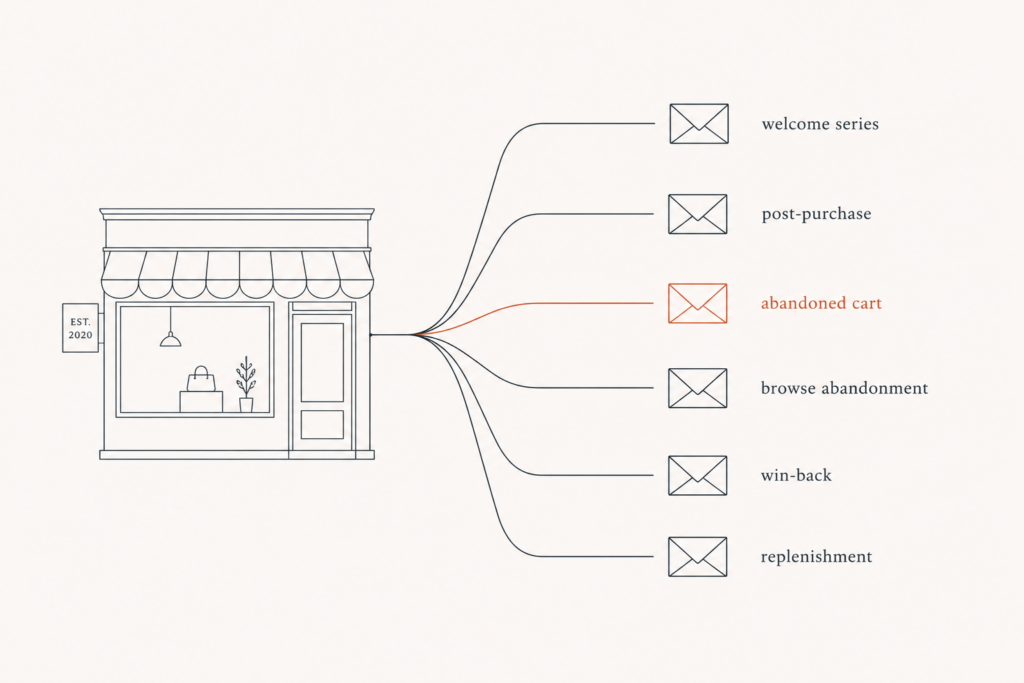
The problem was never the campaign calendar. The problem is that the money in email doesn’t live in campaigns at all. It lives in the automations that fire when a customer does something, and most stores have three of them half-built and switched off.
This article covers the full picture: which Klaviyo flows actually earn, the order to build them in, the benchmarks to hold yourself to, and the deliverability rules that decide whether any of it reaches an inbox.
Why Klaviyo flows beat campaigns on every metric that matters
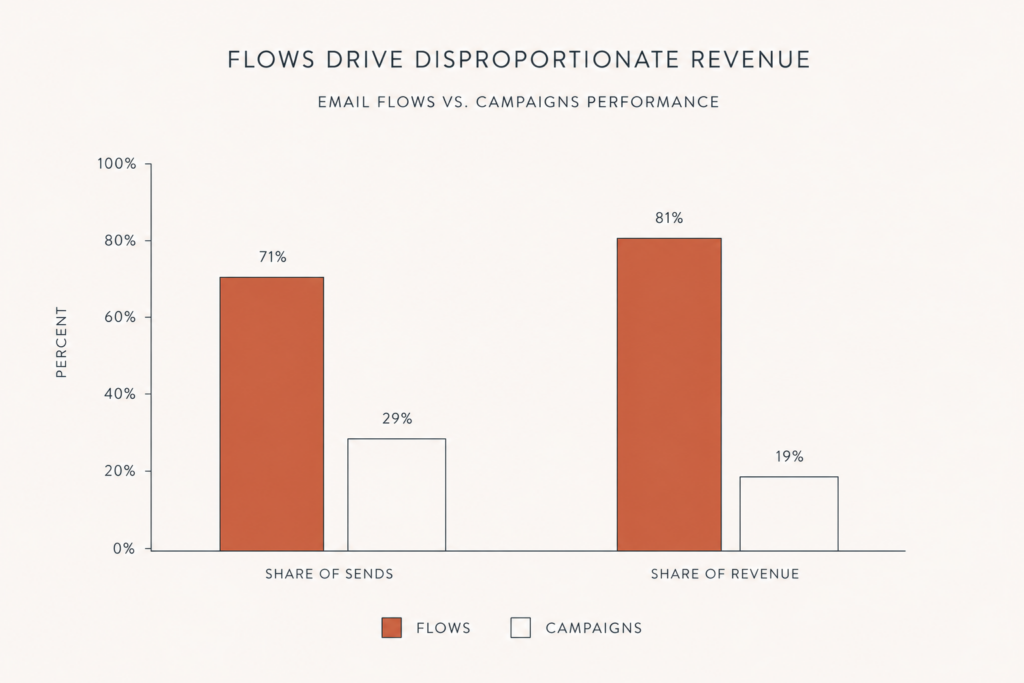
Campaigns are a broadcast. Flows are a response. That difference shows up starkly in the numbers.
Automated flows generate roughly 41% of total email revenue from just 5.3% of sends, with revenue per recipient running close to 18 times that of campaigns, based on aggregated ecommerce email benchmark data. Flows average north of 42% open rates against about 31% for campaigns, and placed-order rates of 2.11% against 0.16%.
Read that last pair again. A flow email is more than ten times likelier to end in an order than a campaign email.
Here’s the thing: that isn’t because flow copy is better. It’s because a flow arrives while intent is still warm. Someone left a ring in their cart 40 minutes ago. Someone just subscribed. Someone’s order shipped this morning. You’re not interrupting them. You’re answering them.
The practical read: if your flows are contributing less than a quarter of your email revenue, you don’t have an email problem. You have an automation problem.
The six Klaviyo flows worth building, in the order that pays back fastest
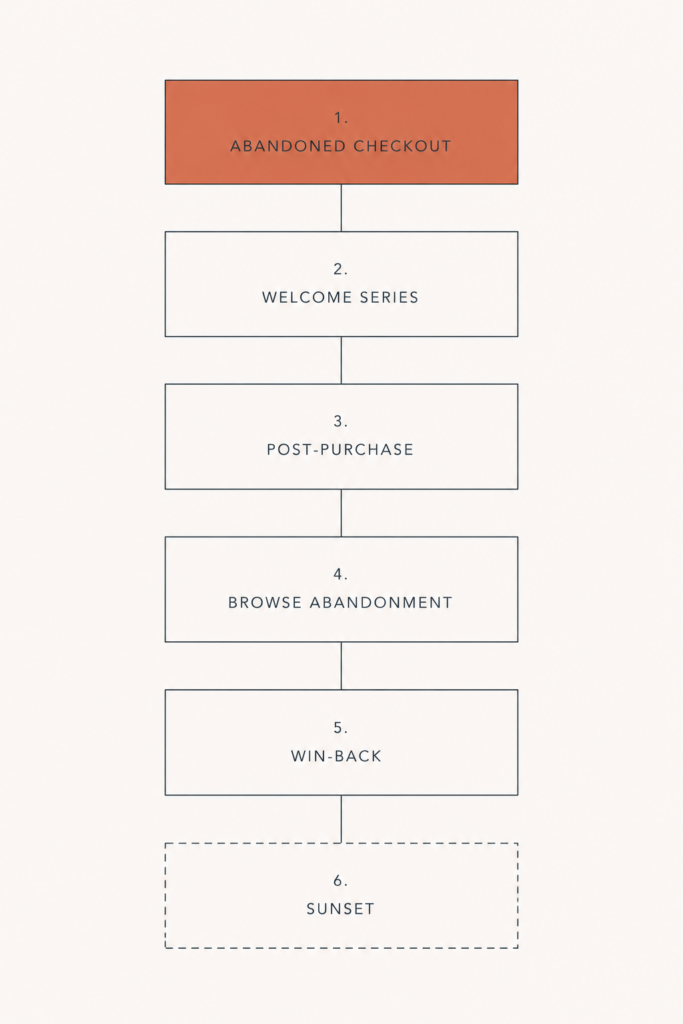
You don’t need eighteen flows. Most stores that come to Javaid Ahmad with a bloated Klaviyo account are running a dozen half-finished automations and getting nearly all their revenue from two of them. Build these six, in this sequence:
- Abandoned checkout. Fastest payback of anything in the stack. Three emails: one at 60 minutes, one at 24 hours, one at 48 hours with a light nudge. No discount in email one. You’d be surprised how many people were just distracted.
- Welcome series. Three to five emails over 10 to 14 days, with the first firing immediately and delivering whatever you promised at signup. Welcome plus abandoned checkout alone commonly account for the bulk of total flow revenue.
- Browse abandonment. Lower intent, much higher volume. Someone viewed a product and didn’t add to cart. Be useful, not pushy. Show the item, show two alternatives, stop.
- Post-purchase. The most under-built flow in ecommerce. Shipping expectations, care instructions, a review request timed to arrival, then a cross-sell that makes sense. Revenue per recipient is modest, but it’s the flow that produces second orders.
- Back in stock. If you carry anything that sells out, this one has the highest revenue per email in the entire stack. It’s also the easiest to turn on.
- Sunset / re-engagement. The cleanup crew. One or two emails to people who haven’t opened in 90 to 180 days, then suppress them. This flow doesn’t make money directly. It protects everything that does.
That’s the whole stack. Six flows. Everything else, the birthday email, the winback ladder, the VIP tier, is optimisation on top of a working foundation, and optimisation on top of nothing is just decoration.
The abandoned checkout flow is where your first hour should go
Start here for one reason: the intent is already paid for. Someone got through product page, cart, and checkout start. You’re not persuading. You’re removing a small obstacle.
The obstacle is usually one of three things. Shipping cost that appeared late. A payment method they didn’t have. Or a genuine interruption, a phone call, a toddler, a meeting.
So write email one for the interruption, not for the objection. A clean reminder, the exact items, one button. Save the incentive for email three, if at all. Leading with a discount teaches your best customers to abandon carts on purpose, which is an expensive lesson to teach.
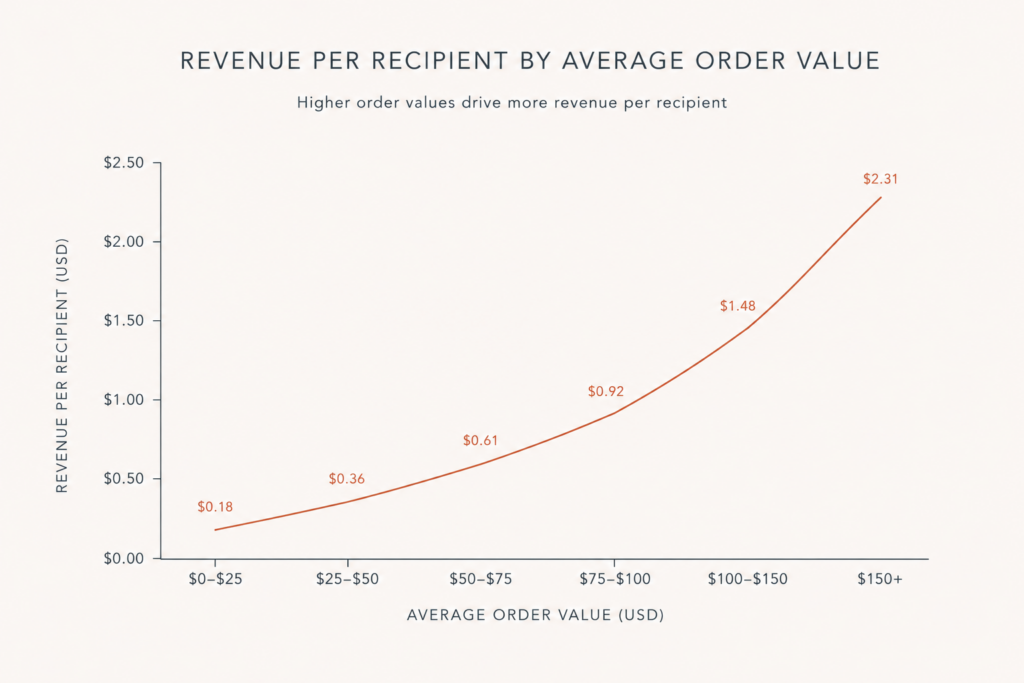
Revenue per recipient scales hard with AOV. Klaviyo’s own benchmark tables show abandoned cart RPR at the 75th percentile climbing from around $2.91 in the $44 to $83 AOV band to over $43 above $291 AOV, according to Klaviyo’s flow benchmark reference. High-AOV categories, jewelry in particular, get outsized returns from a flow that takes an afternoon to build. If you sell engagement rings, this is the single highest-leverage email you will ever write. The mechanics carry over from what we cover on Shopify abandoned cart recovery, but Klaviyo gives you the segmentation to do it properly.
What “good” looks like, so you stop guessing
Benchmarks are worth something only when they’re banded by your size and your AOV. Broad averages will mislead you.
A workable target, drawn from flow revenue benchmarks by brand stage: under $5M in annual revenue, 25 to 35% of email revenue from flows is normal. Between $5M and $20M, aim for 40 to 50%. Above $20M, mature programs land at 50 to 60%.
If you’re at 12%, the diagnosis is almost always the same. Flows exist but they’re not triggered properly, or the list they’re pulling from is stale, or the integration between the store and Klaviyo is dropping events silently. That last one is common enough to be worth a line: check your event data before you rewrite a single subject line. Broken tracking looks exactly like bad copy from the dashboard, which is the same trap we describe in why half your Shopify revenue data is wrong.
Measure flow performance on revenue per recipient, not open rate. Open rate is now a heavily inflated metric and a poor decision input. RPR tells you what a subscriber is worth. That’s the number.
Deliverability is the gate, and most stores fail it quietly
You can build all six flows perfectly and still make nothing, because none of them arrive.
Gmail and Yahoo treat any domain sending 5,000 or more messages a day to personal accounts as a bulk sender, and bulk senders must authenticate with SPF, DKIM and DMARC, offer one-click unsubscribe, and keep spam complaint rates below 0.30%, per Google’s published sender guidelines. Fail those and the mail doesn’t go to spam. It gets rejected.
And it gets worse: 0.30% is the ceiling, not the target. The number to manage against is closer to 0.10%. By the time you’re at 0.30% you’re already in remediation.
Three things protect you, and none of them are glamorous:
- Authenticate properly. SPF, DKIM, DMARC, and a dedicated sending subdomain. This is a one-hour DNS job that stores put off for years.
- Run the sunset flow. Dead subscribers don’t just fail to buy. They actively drag your sender reputation down, which means your good subscribers stop seeing you too. Suppressing a disengaged 20% of a list routinely makes the remaining 80% perform better.
- Stop buying volume. A giveaway that adds 8,000 emails from people who wanted a free iPad is a deliverability liability wearing a growth costume.
That’s not overhead. It’s the thing that makes the rest of the stack function.
Where Klaviyo’s AI features actually help, and where they don’t
Klaviyo has pushed hard into AI, and the K:AI product suite now covers subject line generation, send-time optimisation, predictive analytics, and agentic assistants for marketing and support.
Use the predictive fields. Predicted CLV and expected date of next order are genuinely useful segmentation inputs, and they’re hard to compute yourself. Use send-time optimisation. It costs nothing and it works.
Be more careful with AI-generated copy. It’s fine for a first draft of a subject line. It’s poor at the thing that actually makes a flow convert, which is knowing why this specific customer hesitated. A generated abandoned-cart email will be grammatical, on-brand, and utterly generic. The one that recovers the sale mentions the ring size guide.
The custom work that pays for itself
Most stores never need anything beyond native Klaviyo. Some do.
The line gets crossed when the trigger you need doesn’t exist as an event. A jeweller who wants a flow to fire when a customer configures a ring but doesn’t request a quote. A B2B supplier who wants a flow keyed to a stalled quote in their own system. A store whose inventory lives in an ERP rather than the storefront.
In those cases the work is a small custom integration that pushes the right events into Klaviyo, and the flow itself stays simple. Javaid Ahmad builds exactly this kind of event plumbing between Shopify, WordPress, Laravel apps, and Klaviyo, and it’s usually a fraction of the cost of the SaaS tool that claims to do it for you. The same logic drove the audit where we cut $480 a month in Shopify app spend: the expensive app was solving a problem that a few hundred lines of code solved better.
The bottom line on Klaviyo flows
Flows aren’t the supporting act to your campaign calendar. They’re the business. Campaigns are what you do when you have something to say; flows are what happens when your customer has something to say, and that’s the conversation worth automating.
So: if you’re a smaller store with a clean catalogue, build the six flows natively, get your authentication right, run the sunset flow quarterly, and leave it alone. It’ll carry a third of your email revenue on its own. If your triggers live outside the storefront, in a configurator, a quote system, or an ERP, the flows are the easy part and the event plumbing is the real project. Start there.
If you’re not sure which of those you are, that’s a short conversation, not a discovery process. Reach out to Javaid Ahmad through javaid.dev/contact for a straightforward read on your Klaviyo setup and what’s actually leaking. No lengthy discovery calls, no vague proposals, just a clear answer on next steps.
FAQ
Q: How many Klaviyo flows should a store actually run? A: Six covers almost everyone: abandoned checkout, welcome series, browse abandonment, post-purchase, back in stock, and a sunset flow. Stores running fifteen flows are usually earning nearly all of it from two.
Q: What percentage of email revenue should come from Klaviyo flows? A: Under $5M in annual revenue, 25 to 35% is normal. At $5M to $20M, 40 to 50%. Mature programs above $20M land between 50 and 60%.
Q: How fast should an abandoned cart flow fire? A: The first email within about an hour. Intent decays quickly, and a reminder sent the next morning is competing with everything else that happened since.
Q: Do I need a discount in my Klaviyo flows? A: Not in the first email of any flow. Leading with a discount trains customers to abandon carts deliberately, and it erodes margin on orders that would have closed anyway.
Q: Why are my Klaviyo flows getting good open rates but no revenue? A: Usually broken event tracking or a mismatch between the trigger and the content. Check that the store is actually sending the right events to Klaviyo before you touch the copy.
Q: Does a sunset flow really improve deliverability? A: Yes. Mailbox providers weigh engagement heavily, and a large disengaged segment suppresses inbox placement for everyone on your list. Suppressing them is the cheapest deliverability fix available.
Flows are where most of the money is, but they are not the whole channel. More on lifecycle and retention sits in marketing.

Comments are reviewed before they appear, so yours will not show up straight away. Your email is never published.