
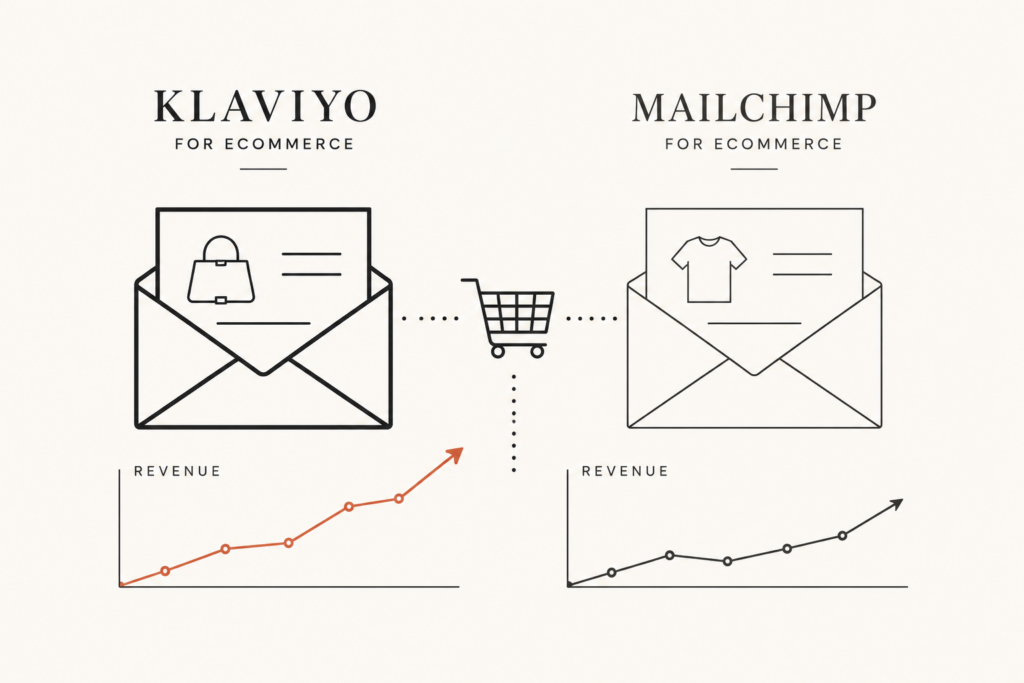
If you run an ecommerce store, your email platform is probably leaking money right now, and you cannot see it on the invoice. You see the monthly fee. You do not see the revenue you never collected because your abandoned cart flow was weak, your segmentation was blunt, or your sends quietly landed in spam. That gap is the whole ballgame in the Klaviyo vs Mailchimp decision.
I build and rescue stores on Shopify, WooCommerce, and Magento for a living, so I have set up both platforms more times than I can count. Here is the honest version, with real numbers as of 2026, so you can pick the one that actually pays you back instead of the one with the friendlier homepage.
Short answer: Klaviyo usually wins for ecommerce, Mailchimp usually wins for a newsletter or a service business. But the why matters, because the wrong choice can cost you five figures a year in missed revenue. Let me walk you through it.
Klaviyo vs Mailchimp: the core difference nobody explains
Mailchimp was built as an email tool that later bolted on ecommerce features. Klaviyo was built as an ecommerce data platform that happens to send email and SMS. That origin story shows up in everything.
Klaviyo ingests your store data (every product viewed, every cart started, every order placed, every refund) and lets you trigger and segment on all of it. Mailchimp connects to your store too, but the depth is shallower, and the features ecommerce brands actually need sit behind higher tiers.
So this is not really a question of which app sends prettier emails. It is a question of which platform turns your store’s behavior into revenue automatically. That is where the money is.
Why automated flows decide the winner
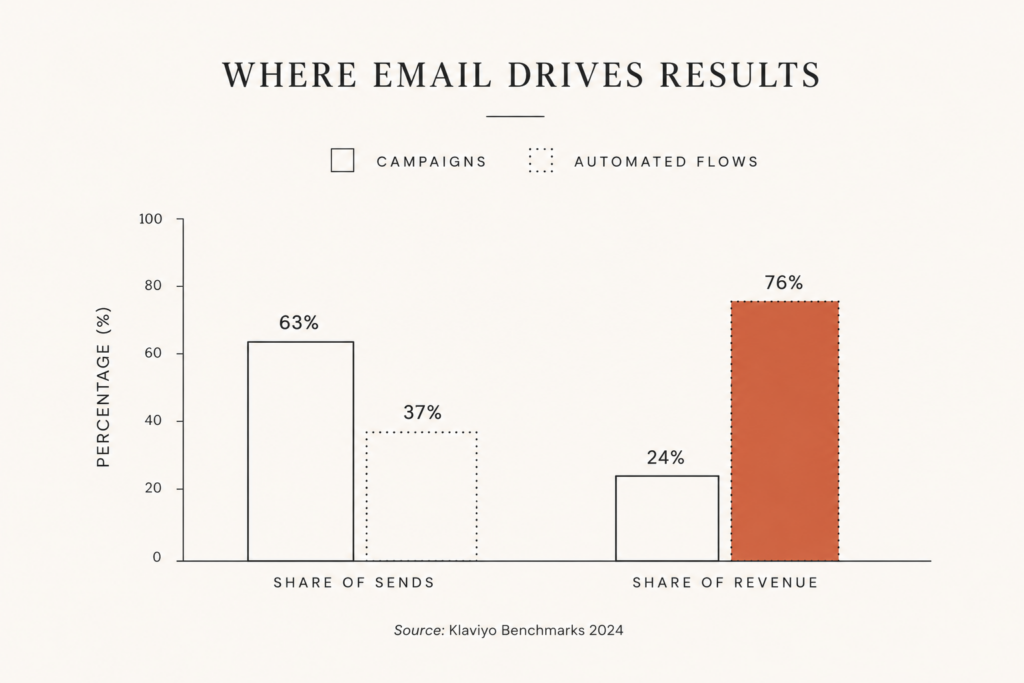
Here is the stat that should reframe your entire decision. According to Klaviyo’s 2026 benchmarks, drawn from more than 183,000 brands, automated flows generate nearly 41% of total email revenue from just 5.3% of sends. Flow click rates average 5.58% versus 1.69% for one-time campaigns, and flow placed-order rates average 2.11% versus 0.16%.
Read that again. Your welcome series, browse abandonment, abandoned cart, and post-purchase flows do almost no sending volume and carry almost half your email revenue. The platform that makes those flows easy, data-rich, and reliable is the platform that makes you more money.
This is the heart of Klaviyo vs Mailchimp. Klaviyo’s multi-step, behavior-triggered flows are the default experience on every paid plan. On Mailchimp, multi-step automation (the thing ecommerce lives on) is locked behind the Standard plan and up. If you are on Mailchimp Essentials thinking you have ecommerce automation, you mostly do not.
Real pricing in 2026, side by side
Let me kill the myth that Mailchimp is the cheap one. It looks cheaper at the sticker level, and sometimes at small lists it genuinely is, but the feature gating changes the math fast.
Here is roughly what you pay today:
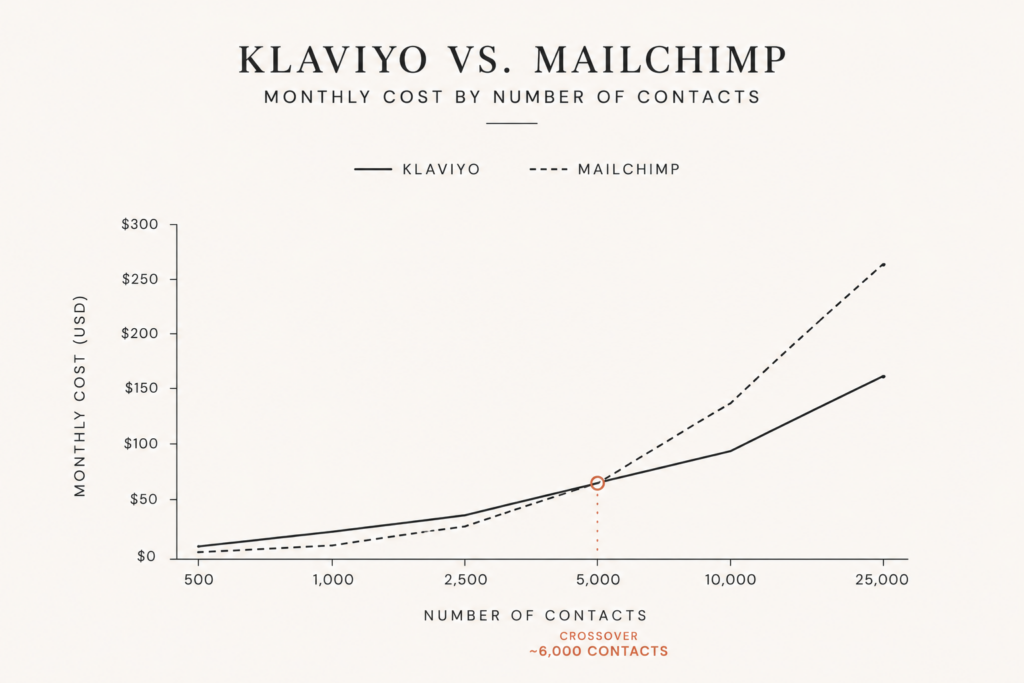
- At 500 contacts: Klaviyo Email is about $20/mo. Mailchimp Standard is about $20/mo, Essentials about $13/mo.
- At 5,000 contacts: Klaviyo is about $100/mo. Mailchimp Standard is about $81/mo.
- At 10,000 contacts: Klaviyo is about $200/mo. Mailchimp Standard is about $135/mo, and Premium starts around $350/mo.
- At 25,000 contacts: Klaviyo Email is about $400/mo.
- At 100,000 contacts: Klaviyo reaches roughly $1,350/mo.
On paper Mailchimp Standard undercuts Klaviyo by $65/mo at 10,000 contacts. But watch the add-ons. On Mailchimp, advanced segmentation needs Premium (at least $350/mo), transactional email (order confirmations, shipping notices, password resets) is a paid add-on starting around $20/mo, and SMS is yet another add-on. When you stack the features an ecommerce store actually uses, the gap narrows and often flips.
One more thing you need to know about Klaviyo. In 2025 it shifted from billing on “contacts emailed” to billing on all active profiles in your database. So if your list has a lot of dead weight, you are paying for it. List hygiene is not optional on Klaviyo, it is a line item. Prune aggressively.
The revenue side, where the real decision lives
Price is only half the equation. The other half is revenue per send, and this is where Klaviyo earns its premium.
Klaviyo’s own benchmark data puts revenue-per-recipient for top flows as high as $7.79, and email’s broad ROI across the industry sits between $36 and $42 for every $1 spent, climbing higher for retail and consumer goods. The average revenue per email for automated sends reached $2.87, against just $0.18 for scheduled campaigns. That is a 16x difference based purely on whether the send is triggered by behavior.
Now run the math on the premium. Say you pay Klaviyo $65/mo more than Mailchimp at 10,000 contacts. If a single browse-abandonment flow recovers a conservative 1.5% of product views on a store doing 20,000 monthly views at a $65 average order value, that is roughly $19,500 in incremental monthly revenue. The $65 premium is noise. The flow is the asset.
Key takeaway: do not choose on the monthly fee. Choose on revenue per subscriber, because at ecommerce scale that number dwarfs the price difference.
Deliverability is now a hard requirement, not a nice-to-have
This one is not optional anymore and it quietly favors whichever platform you configure correctly. Google and Yahoo began enforcing authentication for bulk senders in February 2024, and Microsoft added DMARC enforcement from May 2025. As of 2026, non-compliant bulk email is rejected outright by all three major inbox providers.
Practically, that means SPF, DKIM, and DMARC on a dedicated sending domain are mandatory, not advanced. Both Klaviyo and Mailchimp support this. The difference is that Klaviyo nudges ecommerce senders toward dedicated domains and warm-up discipline more aggressively, and its seed and engagement data make it easier to spot a deliverability problem before it tanks your revenue. If you send from a misconfigured domain on either platform, you do not have an email strategy, you have a spam folder.
When Mailchimp is genuinely the right call
I am not here to bury Mailchimp. It is a fine product for the right job, and I have left clients on it on purpose.
Choose Mailchimp when:
- You are under about 2,500 contacts and price sensitivity beats revenue optimization. The cheaper tiers are real savings at this size.
- You are a service business or content brand, not a transactional store. A consultant, a local studio, or a newsletter does not need behavior-triggered cart flows.
- Your team already knows it cold and your store volume is low enough that the revenue-per-email gap stays small in absolute dollars.
- You want an all-in-one marketing suite with landing pages, basic CRM, and social posting in one login and you value that breadth over email depth.
Below roughly 2,500 contacts, Mailchimp’s price advantage is real. Above that, Klaviyo’s revenue-per-send advantage typically overcomes the cost premium, and it keeps widening as you grow.
When Klaviyo is the obvious answer
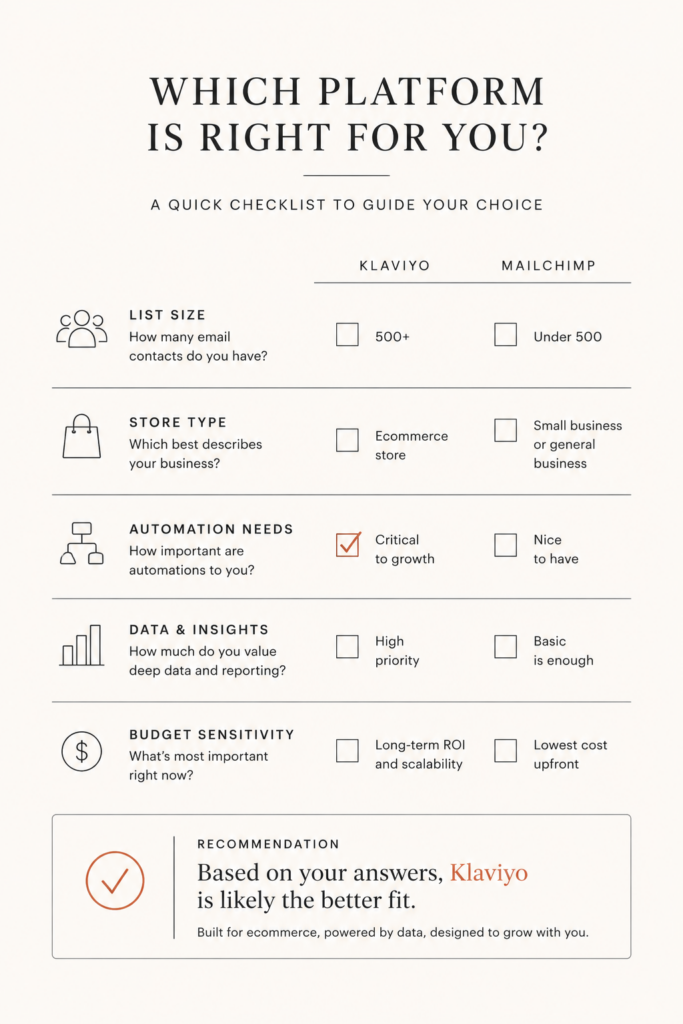
Pick Klaviyo when revenue per email is the point. If you run a Shopify, Shopify Plus, or WooCommerce store above a couple thousand contacts and you care about flows, segmentation, and SMS in one place, Klaviyo is built for exactly your problem. High-AOV brands feel this most, because every recovered cart is worth real money. I covered the specific flow stack I deploy for high-AOV jewelry brands in a separate write-up, and that stack is hard to replicate cleanly on Mailchimp.
The clincher is the data model. Klaviyo lets you segment on predicted lifetime value, time since last order, product affinity, and discount sensitivity, then act on those segments inside a flow without exporting anything. That is the difference between blasting your list and quietly compounding revenue.
How I actually decide for a client
When a store owner asks me which to use, I run three quick checks before I answer.
First, list size and growth rate. Under 2,500 and flat, Mailchimp is defensible. Growing past that, lean Klaviyo.
Second, how much revenue is automatable. If you have real cart abandonment, browse behavior, and repeat-purchase potential, Klaviyo’s flows pay for themselves many times over. If your catalog is tiny or one-and-done, the gap shrinks.
Third, internal capacity. Klaviyo rewards someone who will actually build and tune flows. If nobody will touch it, a simpler Mailchimp setup that gets used beats a powerful Klaviyo account that sits idle. The best platform is the one your team operates well.
If you want the deeper revenue plumbing, pair whichever platform you choose with clean conversion tracking so you can prove the email channel’s contribution. I walk through that setup in my guide on conversion tracking for multistep forms, and the same discipline applies to email attribution.
Frequently asked questions
Is Klaviyo better than Mailchimp for ecommerce?
For most ecommerce stores above roughly 2,500 contacts, yes. Klaviyo’s behavior-triggered flows, deeper segmentation, and higher revenue per send usually outweigh its price premium. Mailchimp remains a strong pick for small lists, newsletters, and service businesses that do not need cart-level automation.
Is Klaviyo more expensive than Mailchimp?
At the sticker level Klaviyo often costs more, for example about $200/mo versus $135/mo at 10,000 contacts. But Mailchimp gates advanced segmentation behind Premium and charges add-ons for SMS and transactional email, so once you match the feature set the gap narrows and frequently reverses. Klaviyo also bills on all active profiles, so list hygiene affects your cost.
Can I switch from Mailchimp to Klaviyo without losing my list?
Yes. You export your contacts and subscription status from Mailchimp and import them into Klaviyo, then reconnect your store integration so historical order and browsing data flows in. The careful part is reauthenticating your sending domain (SPF, DKIM, DMARC) and warming it up so deliverability holds during the move. Plan a short overlap rather than a hard cutover.
Does Mailchimp have abandoned cart emails?
It can, but multi-step abandoned cart automation requires the Standard plan or higher, not the Essentials or Free tier. Many store owners assume they have cart recovery running when they are on a plan that does not support it, which is exactly the kind of silent revenue leak worth auditing.
Which platform has better deliverability?
Both can deliver well when configured correctly, and both now require SPF, DKIM, and DMARC because inbox providers reject non-compliant bulk mail in 2026. Klaviyo tends to push ecommerce senders toward dedicated domains and gives clearer engagement signals to catch problems early, but a properly set up Mailchimp account is not at a structural disadvantage.
The bottom line
Klaviyo vs Mailchimp is not a fight about features on a comparison grid. It is a question about how much of your store’s revenue you want generated automatically while you sleep. Mailchimp is the right tool for small lists, newsletters, and service brands that want simple and cheap. Klaviyo is the right tool for ecommerce stores that want every cart, view, and order turned into a triggered, segmented, revenue-producing flow.
If you are above a couple thousand contacts and your email is still a glorified newsletter, you are leaving money on the table no matter which logo is on your dashboard. The platform matters less than the flows, and the flows are where the work is.
If you want a second set of eyes on your current setup, I run free audits of ecommerce email and store performance. Book a call or grab a free audit at javaid.dev/contact and I will tell you exactly where your email is leaking and what to do about it.
Picking the platform is the easy part. Making it earn its keep is the hard part, and that is what the rest of my marketing posts are about.

Comments are reviewed before they appear, so yours will not show up straight away. Your email is never published.