
You are asking shoppers to spend $5,000 on a ring they cannot touch, for a moment they will remember for the rest of their lives. That is the whole challenge in one sentence. And if your product page looks like a generic Shopify template with three flat photos and a “buy” button, you are losing those buyers before they ever reach the cart.
Here is the good news. The couples who want to buy are already online. The hard part is not traffic. The hard part is trust, friction, and proof. Get those three right and you can sell engagement rings online at a conversion rate that embarrasses the brand down the street still relying on showroom foot traffic.
Let me walk you through the exact playbook I use when I build for high-AOV jewelry brands.
Why 2026 Is the Year to Sell Engagement Rings Online
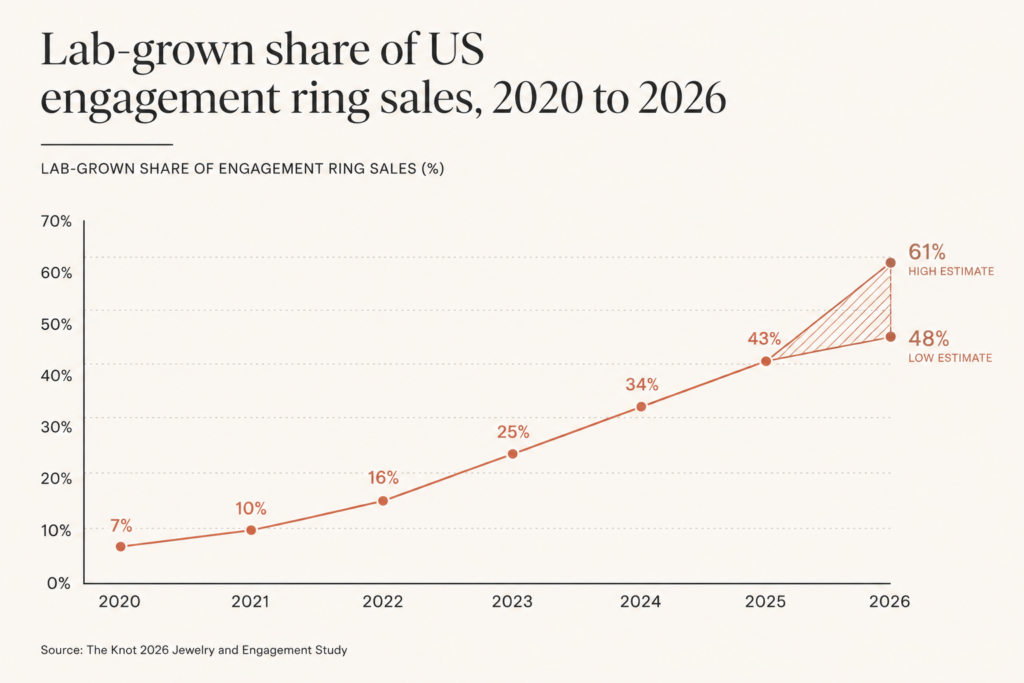
The market moved, and it moved fast. Lab-grown diamonds now account for somewhere between 48 and 61 percent of US engagement ring sales depending on whose data you trust, up from single digits in 2020. That shift did two things at once. It lowered the price barrier, and it pulled the entire buying journey onto the screen, because lab-grown shoppers research obsessively before they commit.
Meanwhile the global online jewelry market is projected to hit $85.7 billion in 2026. That is a lot of demand chasing a category that still converts at a stubborn 1.19 to 1.5 percent on average.
Read that number again. A 1.5 percent conversion rate sounds broken until you remember the average engagement ring order runs around $5,200. At that order value, a one percent conversion is not failure. It is category-normal behavior for a considered, emotional, once-in-a-lifetime purchase. Your job is not to chase fashion-jewelry conversion numbers. Your job is to win the small slice of visitors who are genuinely ready, and stop leaking the ones who are.
Start With the Configurator, Not the Catalog
Most jewelers build a catalog of finished rings and hope one matches what the buyer pictured. That is backwards. The modern engagement ring buyer wants to build the ring, not browse it.
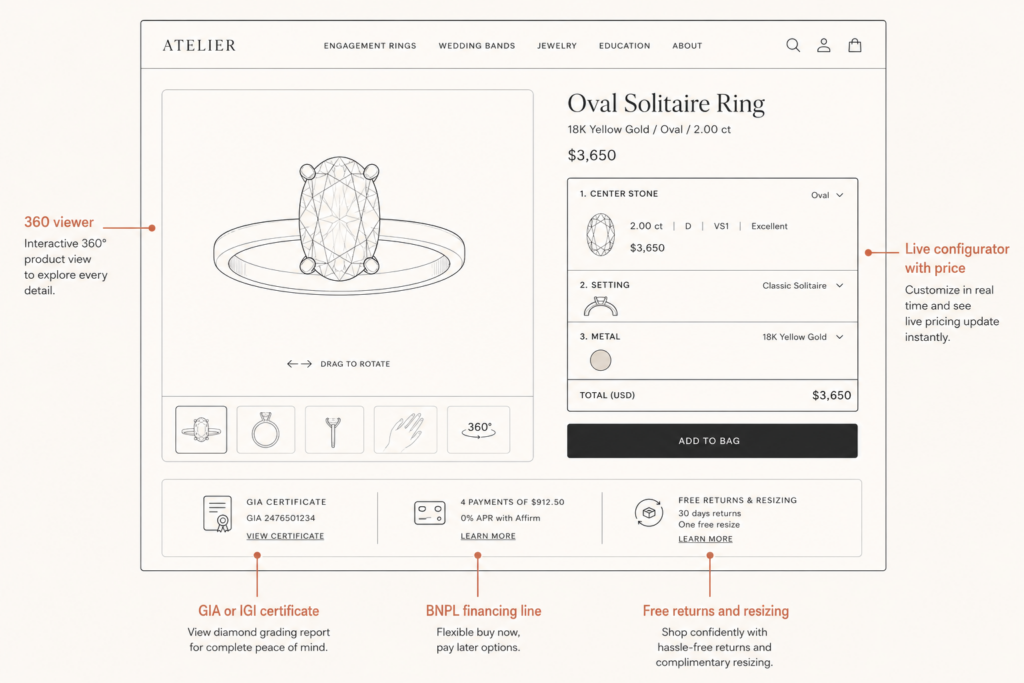
A real ring configurator lets a shopper pick the setting, choose the metal, swap the center stone shape, and watch the price update in real time. When the visual and the price both respond instantly to every choice, hesitation drops because the shopper feels in control.
When I build these, I obsess over three things:
- Real-time price updates. Every option change recalculates the price on screen. No “request a quote” dead ends. If the buyer cannot see what their choices cost, they leave.
- Visual feedback on every selection. Switch from a round to an oval center stone and the image should change, not just the spec line. The buyer is buying a feeling, so show the feeling.
- A clean handoff to checkout. The configured ring needs to carry every selection into the cart and the order as structured data, so your fulfillment team builds exactly what was configured, not their best guess.
That last point is where most configurators quietly fall apart. I wrote up a full breakdown of how I wire a Shopify engagement ring configurator with JewelCloud here: Shopify engagement ring configurator with JewelCloud. If you are selling configured rings without clean data flowing into the order, you are creating production errors that eat your margin.
One more thing on configurators. Do not bury them three clicks deep. The buyers who land on a “build your own ring” page convert at a meaningfully higher rate than browse-only visitors, because the act of building is itself a commitment. Put the configurator front and center on your engagement category page, and let it become the default way people shop your store rather than a hidden feature only power users find.
Show the Ring Like It Is in Their Hand
You cannot let a shopper hold a $5,000 ring through a screen. So you do the next best thing. You let them rotate it, zoom it, and watch the light move across the stone.
This is not a nice-to-have. 360-degree product views can lift conversions by up to 30 percent in jewelry, because rotating a ring simulates the act of picking it up. For a category built on sparkle, a flat JPEG hides the single most persuasive feature you have.
Here is what I put on every high-AOV ring page:
- A 360-degree spin of the actual ring, not a generic stock render.
- A short video showing how light moves through the stone as the ring turns.
- Macro zoom that holds focus at full magnification so buyers can inspect the setting and prongs.
- A hand or finger shot for scale, because “1.8 carats” means nothing until you see it worn.
Stack Your Trust Signals Where the Doubt Lives
Trust is the currency of high-AOV ecommerce. The highest-leverage move you can make on an engagement ring page is not a discount. It is removing the buyer’s quiet fear that they are about to get scammed on the biggest purchase of their year.
Stack these signals right where the doubt lives, which is usually next to the price and the add-to-cart button.
Certification, made visible
Embed the GIA or IGI grading report directly on the page, not buried in a PDF behind an email gate. With lab-grown and natural stones now sharing the same listings, certification clarity is one of the strongest trust signals you have. Let the buyer click and see the actual report tied to their stone.
Returns, resizing, and warranty up front
Shipping insurance, a clear return window, free resizing, and a lifetime warranty all reduce hesitation. Say them plainly. A buyer who knows they can return or resize without a fight will commit faster, because you just removed the worst-case scenario from their head.
Reviews with photos
Text reviews are fine. Photo reviews from real couples are gold. They prove the ring arrives looking like the listing, which is the exact anxiety a first-time online ring buyer carries.
Make the Money Part Feel Easy
A $5,000 ring is a lot to charge in one swipe. So give buyers a way to spread it out, and show that option before they get to checkout, not as a surprise on the payment screen.
Buy-now-pay-later has quietly become table stakes for jewelers. Affirm, Klarna, and Afterpay all partner with major ring sellers, and Affirm offers 0 percent APR financing up to $20,000 with terms stretching to five years. When you show a $5,200 ring as “from $217 a month,” the price stops being a wall and starts being a plan.
Put the monthly figure right under the total. That single line reframes the entire decision and pulls forward buyers who were ready emotionally but stalled financially.
Keep the Buyer Warm Until They Are Ready
Almost nobody buys an engagement ring on the first visit. They come back two, three, five times. So your site needs a memory.
A proper wishlist does more than save a favorite. For jewelry it has to save the full configuration, the chosen stone, the metal, and the price at the time, so a returning buyer picks up exactly where they left off. Generic wishlist apps forget all of that. I explained why jewelry wishlists need custom logic here: why jewelry wishlists need bespoke logic.
Pair that saved configuration with a gentle email sequence, and you turn a five-visit research journey into a sale instead of a lost session.
Think about the sequence the way the buyer actually behaves. The first email confirms the saved ring with the exact configuration and a clear image. The second answers the quiet questions they did not ask, such as resizing, certification, and shipping insurance. The third surfaces financing so the price feels manageable. None of this is aggressive. It simply meets the buyer at each stage of a decision that, for most couples, takes weeks and not minutes. That patience is what separates jewelers who sell engagement rings online at scale from the ones who treat every visit like a one-shot pitch.
Do Not Skip the Structured Data
This part is unglamorous and it is where the long game is won. Search engines and AI shopping assistants are increasingly the front door to your store, and they can only recommend what they can read.
Marking up every ring with proper Product, Offer, and AggregateRating structured data helps your listings show price, availability, and certification details directly in search and AI answers. For configurable rings this gets tricky, because you are describing a product that changes. I walked through how to handle it for jewelry in 2026 here: structured product data for jewelry in 2026.
Get this right and you start earning qualified traffic that arrives already trusting your price and your authenticity.
FAQ
How do I sell engagement rings online if shoppers cannot try them on?
You replace touch with proof. Combine a 360-degree viewer, macro zoom, a finger-scale shot, and a no-questions return and resizing policy. When buyers can inspect the ring from every angle and know they can send it back risk-free, the inability to try it on stops being a dealbreaker.
What conversion rate is realistic when I sell engagement rings online?
Expect 1 to 1.5 percent, which is normal for high-AOV considered purchases. With an average ring order near $5,200, a 1.2 percent conversion on strong traffic is healthy. Focus on revenue per visitor and trust signals, not on chasing fashion-jewelry conversion numbers.
Should I sell lab-grown or natural diamond engagement rings online?
Sell both, and label them clearly. Lab-grown now makes up roughly half of US engagement ring sales and lets buyers get a larger, higher-clarity stone for the same budget. Show certification for each so shoppers understand exactly what they are buying.
Does offering financing actually increase engagement ring sales?
Yes. BNPL options like Affirm at 0 percent APR reframe a $5,200 ring as a manageable monthly payment. Showing the monthly figure on the product page, not just at checkout, pulls forward buyers who were emotionally ready but hesitant about a single large charge.
Do I need a configurator to sell engagement rings online?
If you sell custom or semi-custom rings, yes. A configurator with real-time pricing and visual feedback lets buyers build the ring they pictured and see the cost instantly, which removes hesitation and reduces quote-request friction that kills momentum.
The Bottom Line
Selling engagement rings online in 2026 comes down to a simple loop. Let buyers build the ring, show it like they are holding it, stack trust where the doubt lives, make the payment feel easy, and remember them until they are ready. Do that and your conversion rate stops looking like a problem and starts looking like a moat.
If you want a second set of eyes on where your ring pages are leaking buyers, I run free conversion audits for jewelry brands. Book a call at javaid.dev/contact and I will show you exactly where the friction is.

Comments are reviewed before they appear, so yours will not show up straight away. Your email is never published.