
Seven out of every ten people who add to cart in your Shopify store leave without paying. That is not a typo, and it is not your store being broken. The average Shopify cart abandonment rate in 2026 sits at 70.2%, climbing to 76.8% on mobile. If you are not running a real Shopify abandoned cart recovery system, you are handing competitors the customers you already paid to acquire.
Here is the good news. Those carts are not gone. With the right sequence, timing, and a few checkout fixes, top stores quietly win back 15 to 20% of them. I build and rescue Shopify stores for US and UK retailers, and recovery is one of the fastest ROI levers I touch.
Why your carts are really getting abandoned
Before you chase people down with emails, fix the leak. Most abandonment is not mystery behavior. It is friction you can name.
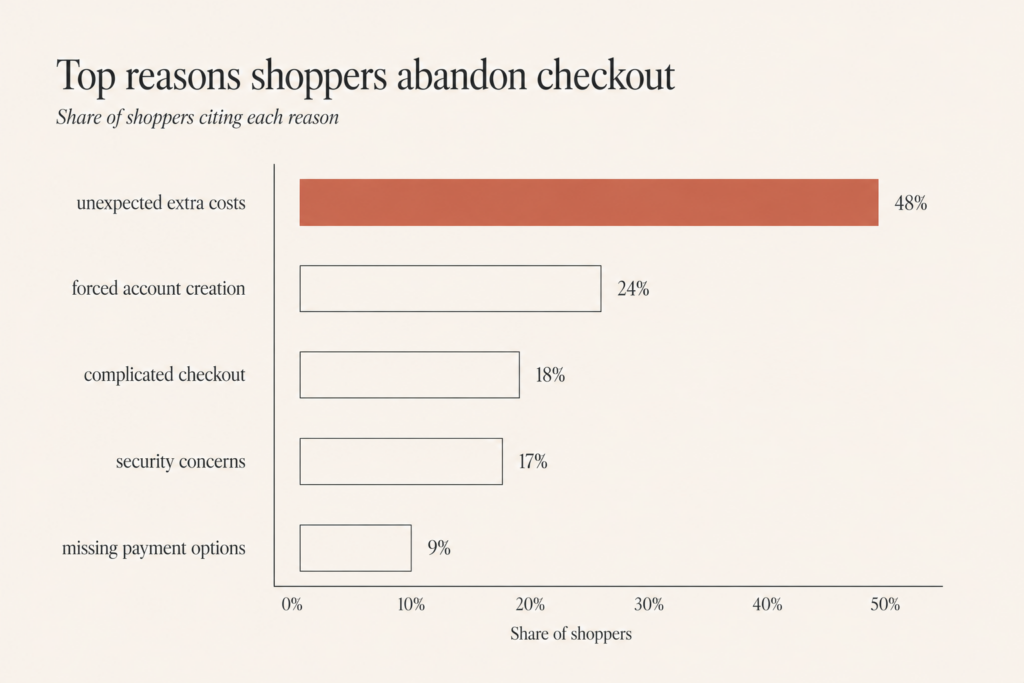
The number one reason people bail in 2026 is unexpected extra costs (shipping, taxes, fees), cited by 47 to 48% of abandoners. After that it is forced account creation (24 to 25%), a checkout that is too complicated (18%), security or trust concerns (17 to 19%), and missing payment options (9%).
Notice the pattern. Nearly half of all abandonment is a shipping shock problem. Someone falls in love with a product, hits checkout, sees a surprise delivery fee, and closes the tab. No email sequence fixes that as well as just not surprising them.
Fix the checkout before you chase the cart
You will recover more revenue by plugging holes than by emailing harder. Start with these.
Surface shipping costs early. Show real shipping in the cart drawer before checkout begins, not as a checkout surprise. Pair it with a free-shipping threshold set 15 to 30% above your current average order value. If your AOV is $65, set the bar at $75 to $85. Stores with a visible free-shipping progress bar see 12 to 18% higher AOV because shoppers add items to reach it.
Promote Shop Pay loudly. Shop Pay is the single biggest abandonment fighter Shopify has shipped, with roughly a 30-point completion gap over standard checkout and conversion as much as 50% better than typical guest checkout. Move it from a footer afterthought to a top-of-cart button, and surface Apple Pay and Google Pay on the product page too. Stores that do this typically lift completion 3 to 7 points within a month.
Keep checkout to one page. Single-page checkout carries a 20 to 26% lower abandonment rate than multi-step flows. Offer guest checkout. Every field you remove is money saved.
Win the mobile checkout. Mobile abandonment runs at 76.8% versus 62.4% on desktop, and mobile checkout typically sits 10 to 15 points worse than desktop. That gap is where most of your lost revenue hides. Make the buttons thumb-sized, autofill address and payment fields, default to digital wallets, and kill any step that forces a tiny-screen shopper to type more than they have to. If your mobile checkout feels like work, it is bleeding sales every single day.
And do not forget speed. A slow store leaks carts before recovery ever kicks in, so if your checkout drags, read my guide on getting a Shopify store under 3 seconds and the Core Web Vitals checklist.
The Shopify abandoned cart recovery sequence that works in 2026
Now the part most stores get wrong. They send one weak email at 24 hours and call it a recovery program. That leaves most of the money on the table.
The data is blunt. A three-email sequence produced $24.9 million in one analysis versus $3.8 million from single sends, a 6.5x difference. And the first message in a sequence drives 20 to 25% of all recoveries, so speed beats cleverness every time. A message sent within the first hour recovers 2 to 3x more carts than one sent 24 hours later.
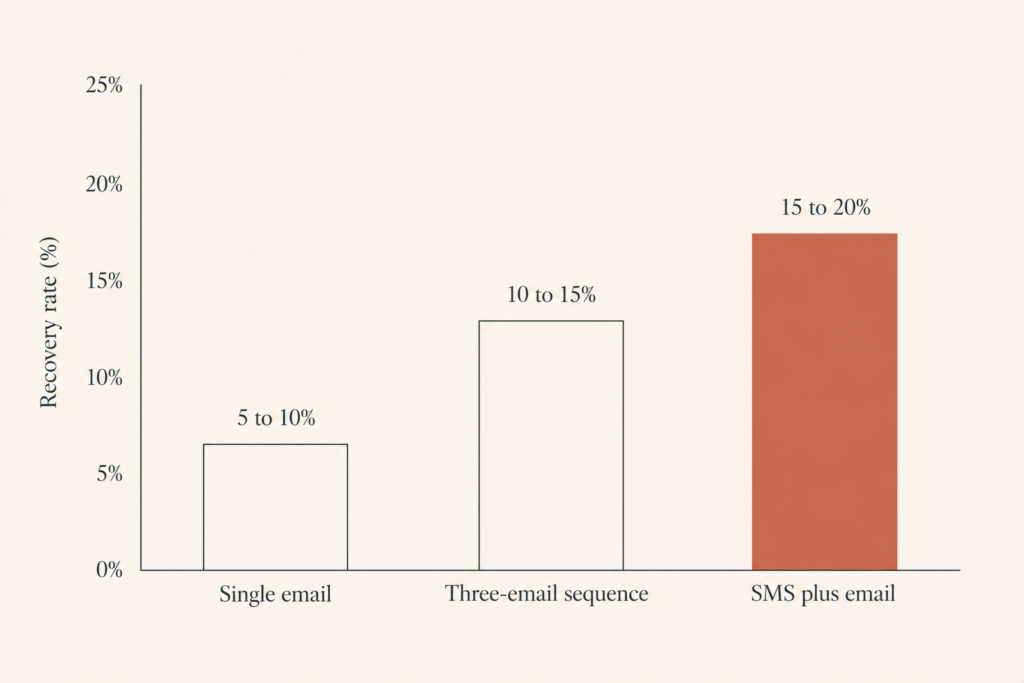
The biggest shift in 2026 is channel. SMS open rates exceed 90% (some sources cite 98%, read within 3 minutes), while email opens sit at 15 to 45%. SMS cart recovery converts at 15 to 20%, against 5 to 10% for email alone. The winning move is not picking one. It is layering both.
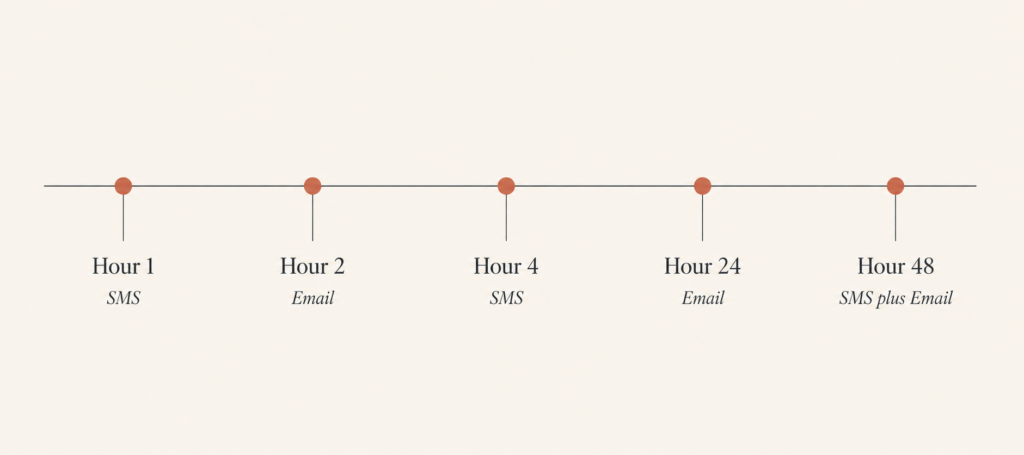
Here is the sequence I deploy:
- Hour 1, SMS: short, friendly nudge. “Still thinking it over? Your cart is saved, here is the link.” No discount yet.
- Hour 2, Email: the detailed reminder. Product image, name, price, a single clear button, and trust signals (reviews, returns, secure checkout).
- Hour 4, SMS: social proof. “Almost sold out” or a real review of the item they left.
- Hour 24, Email: handle objections. Shipping, sizing, materials, your guarantee. Educate, do not beg.
- Hour 25 to 48, SMS then Email: the incentive and final-chance message. Now you can introduce a modest code or free shipping.
Hold the discount until the back half of the sequence. If you lead with 15% off, you train customers to abandon on purpose. Product-specific personalization beats generic reminders by 40 to 60%, so always show the exact item, never a generic “you left something behind.”
Klaviyo, popups, and the tools that hold it together
You do not need a pile of apps. You need one strong flow engine and a smart popup.
For most stores I build the recovery flow in Klaviyo because it handles email and SMS in one timeline with clean Shopify data. I broke down the exact flow stack in my Klaviyo for jewelry brands post, and the same logic applies across niches.
Add an exit-intent popup to capture the email before the cart is ever abandoned. Cart abandonment popups convert at about 17% on average, so you recover intent before it leaks. Trigger it on exit intent and on the cart page, ask for one field only, and follow up with the same SMS-first sequence. The earlier you own the contact, the more of that abandoning 70% you can actually reach.
Key takeaway: capture the contact early, recover fast with SMS, then layer email. That order is what separates 8% recovery from 20%.
Measure it or you are guessing
If you cannot see recovery rate, channel performance, and revenue per send, you are flying blind. Track recovered revenue as its own line and segment by SMS versus email. Done right, abandoned cart flows often become the single highest-revenue automation in the account.
Clean event tracking matters here. My write-up on GA4, Meta, and LinkedIn tracking covers how to wire events so your numbers match reality, and recovery sits inside the broader Shopify conversion rate optimization work I do for clients.
Frequently asked questions
What is a good Shopify abandoned cart recovery rate in 2026? A solid benchmark is 10 to 15% of abandoned carts recovered through email, and 15 to 20% for top stores running multi-channel sequences. If you are below 10%, your timing or channel mix is the likely culprit.
How many emails should an abandoned cart sequence have? Three to five touchpoints. A single email leaves most recovery revenue uncollected, while a three-message sequence can produce several times the revenue of one send. Layer SMS in alongside email for the best result.
When should the first abandoned cart message be sent? Within the first hour, ideally 30 to 60 minutes after abandonment. The first message drives 20 to 25% of all recoveries, and sending within an hour recovers 2 to 3x more carts than waiting a full day.
Is SMS better than email for cart recovery? SMS has open rates above 90% and converts at 15 to 20%, versus 5 to 10% for email. But the best 2026 approach is not either or, it is both, alternating SMS and email across the sequence.
Should I offer a discount in the first recovery message? No. Lead with a reminder and trust signals, and hold any discount for the later messages. Leading with a code trains shoppers to abandon carts on purpose to wait for the deal.
The bottom line
Abandoned carts are not lost sales. They are sales you already earned and have not collected yet. Fix the checkout friction first, capture the contact early, then run a fast, multi-channel sequence that leads with reminders and saves discounts for later. Do that and recovering 15 to 20% of carts becomes a repeatable result.
If your Shopify store is leaking carts and you want a system that quietly pays for itself, book a call or grab a free audit at javaid.dev/contact. I will show you exactly where the money is leaving and what to do about it.

1 comment
[…] rings, this is the single highest-leverage email you will ever write. The mechanics carry over from what we cover on Shopify abandoned cart recovery, but Klaviyo gives you the segmentation to do it […]
Comments are reviewed before they appear, so yours will not show up straight away. Your email is never published.