

Picture this: a shopper asks ChatGPT for a lab-grown diamond tennis bracelet under $2,000. The assistant returns three options. Two are competitors. Yours is not there, because the agent could not read your catalog, and the stock data it did scrape was four days stale. You never saw the query. You never saw the loss. Nothing showed up in your analytics, because nothing happened.
That’s the quiet problem with agentic commerce. It doesn’t fail loudly. It just routes around you.
Here’s the thing most merchants got wrong about it: they spent the last year waiting to find out whether people would buy inside the chat window. The answer arrived, and it was no. But that answer is being misread as “agentic commerce didn’t happen,” when what actually happened is that it split in two. Discovery moved to the assistant. The transaction stayed on your site. This article covers the full picture: what agentic commerce actually is now, what the conversion data says, why in-chat checkout stalled, and the four moves that make a store legible to AI shopping agents without handing away your checkout.
What agentic commerce actually means (and what it doesn’t)
Agentic commerce is shopping done through an AI agent that can research, compare, and sometimes transact on the shopper’s behalf. That’s the definition. The part everybody argues about is where the “transact” happens.
For a while the industry assumed the answer was “inside the assistant.” OpenAI shipped Instant Checkout in ChatGPT with Stripe, built on the open Agentic Commerce Protocol, and promised over a million Shopify merchants would follow. Google and Shopify countered with the Universal Commerce Protocol.
Then the numbers came in. By February 2026, roughly 30 Shopify merchants had actually gone live on Instant Checkout, per Forrester’s Emily Pfeiffer, against the million-plus once promised. By March, OpenAI had scaled back its shopping plans and reframed Instant Checkout as “moving to Apps.”
So agentic commerce isn’t a checkout button. It’s a discovery channel with a handoff. That distinction is the whole game.
The conversion math that killed in-chat checkout
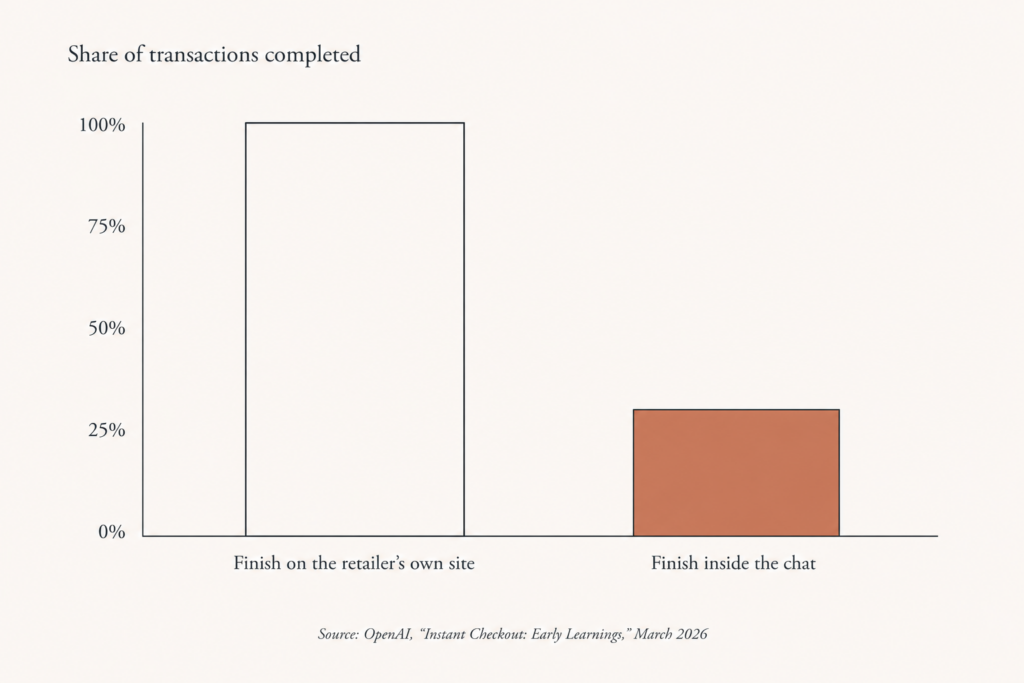
Walmart put around 200,000 products into Instant Checkout and measured what happened. According to Walmart EVP Daniel Danker, reported by CNBC and corroborated across trade press, shoppers who completed the purchase inside ChatGPT converted at roughly one third the rate of shoppers who clicked through to walmart.com and finished there.
Three times worse. On real traffic. At scale.
That’s not a bug you patch with a better button. It’s a signal about where trust lives. People will let an agent narrow the field. They still want to see the shipping estimate, the return policy, and the final price on a site they recognize before handing over a card.
And here’s the twist that makes “kill the channel” the wrong conclusion: the same Walmart traffic showed ChatGPT driving roughly twice the new-customer acquisition rate Walmart sees from search engines. The assistant was a genuinely strong front door. It just couldn’t close.
Independent consumer data says the same thing from the other side. A Semrush-commissioned survey of just over a thousand US shoppers with AI experience found 50% had bought something after using AI to research it, while only 22% had ever completed a purchase directly inside an AI tool. Half research through it. One in five buys through it. That gap is the business model.
AI traffic is small, and it is the best traffic you have
Now for the part that should change what you do this quarter.
Adobe Analytics tracked AI-referred traffic to US retail sites growing 393% year over year in Q1 2026. On its own that’s just a growth stat. The interesting one is quality. Per Adobe’s reporting, by March 2026 AI-referred visitors converted 42% better than non-AI traffic, spent 48% longer per visit, and produced revenue per visit around 37% above everyone else.
Twelve months earlier that same channel converted 38% worse. The reversal is the story.
The honest caveat: AI-driven sessions still sit below a fraction of a percent of total ecommerce traffic for most stores. This isn’t your revenue engine today. It’s the highest-intent, fastest-growing sliver of your traffic, arriving pre-qualified because the agent already did the comparison work the shopper used to do across six open tabs.
You don’t optimize for it because it’s big. You optimize for it because it converts, it compounds, and the cost of being invisible to it is invisible to you.
Why your catalog, not your content, decides whether agents see you
The failure mode that broke in-chat commerce is the same one keeping most stores out of AI answers: data quality.
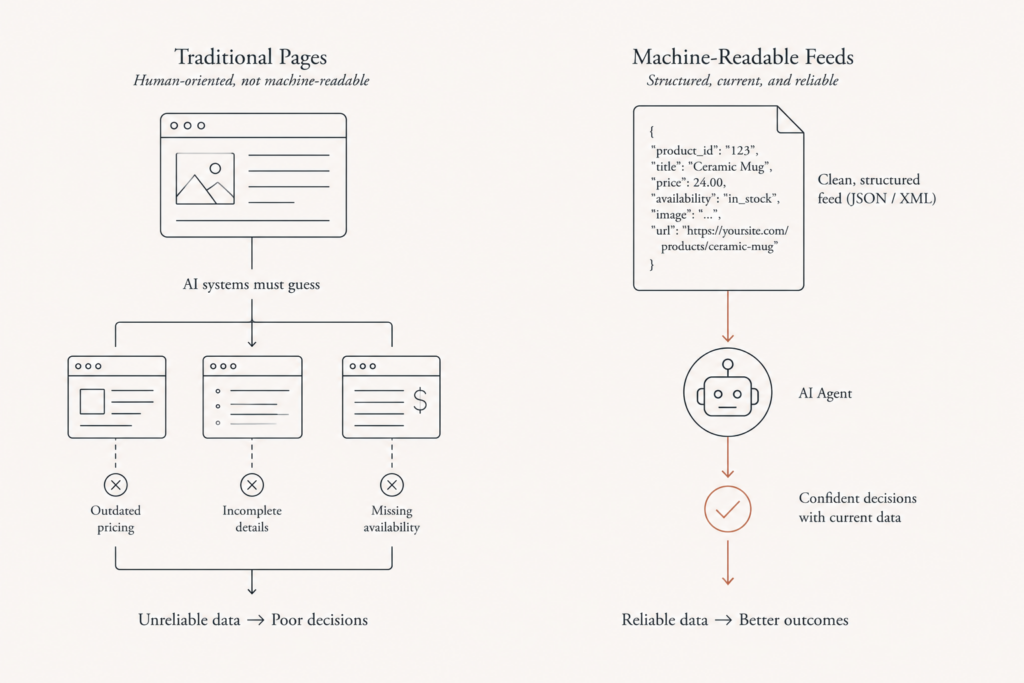
Forrester’s Pfeiffer traced the friction directly to it. Agents could crawl retailer sites, but stock status, delivery timing, and shipping costs were routinely stale by the time the agent quoted them. Her line was blunt: crawling and scraping is inadequate to get the breadth of product data you need to do commerce well. Shopify reports that AI searches routed through its structured Catalog convert roughly twice as well as ones relying on scraped pages, a vendor-stated figure but directionally consistent with the same argument.
So the question isn’t whether your product pages are well written. It’s whether a machine can read your inventory in real time and trust what it reads.
That means:
- A structured, real-time product feed. Live stock, live pricing, live shipping and delivery estimates, published through whatever standard your platform already exposes (Shopify Catalog, UCP, ACP). Do not hand-build protocol integrations. Support what the platform gives you and revisit as the backer lists shift.
- Complete Product schema on every PDP. Price, availability, currency, GTIN or SKU, review data. This is the same structured data work that earns rich results, so it pays twice. If you have not done this, it’s the highest-return hour in your week and it sits squarely in the technical SEO bucket.
- Variant-level truth. Agents ask “in stock, size 7, ships to Ohio by Friday.” If your feed answers at the product level and your reality lives at the variant level, the agent will either skip you or quote something wrong and burn the trust you were trying to earn.
- Server-rendered, fast product pages. An agent that times out on your page treats you as absent. The sub-3s budget that matters for humans matters more for machines, and the Core Web Vitals checklist is the same work.
- Clean, factual copy. Not adjectives. Specs. Materials, dimensions, carat weight, certification, care instructions. Agents extract; they don’t get persuaded.
The pattern underneath all five: feed it, don’t get scraped.
Keep the checkout. Feed the discovery.
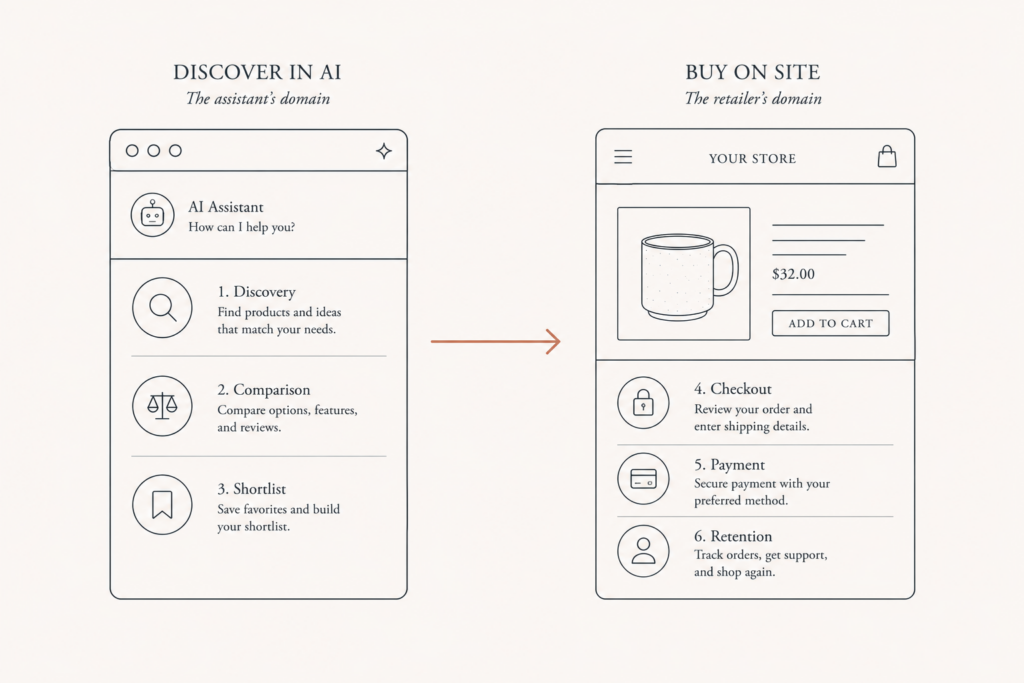
The strategic rule that emerged from the last ten months is short enough to put on a sticky note: the transaction stays close to whoever owns the customer relationship.
Amazon is the apparent exception that proves it. It renamed Rufus to Alexa for Shopping, added agentic purchase features, and is doubling down on in-platform transactions, while simultaneously fencing rival agents out of amazon.com. That isn’t a different rule. It’s the same rule, applied by a company that owns the relationship. For everyone else, the relationship lives on your storefront, so the checkout should too.
Which leaves a division of labor that’s easier to build for than the one everybody feared. The assistant does top of funnel: it finds you, compares you, and hands over a warm shopper who already knows what they want. Your site does the rest: checkout, payment, post-purchase, the repeat order.
One of the most common conversations at Javaid Ahmad starts with a merchant asking whether they need to build a ChatGPT app. Usually they don’t. What they need is a catalog a machine can read and a checkout that doesn’t leak. That’s a feed problem and a performance problem, not an integration project.
Measure it, or it stays invisible
The last move is the one most stores skip, and it’s why agentic commerce feels like a rumor to them.
If you only track checkout completion, an AI-referred visitor looks like any other visitor, or worse, like direct traffic with no source at all. You need AI-referred sessions broken out as a channel, and you need new-customer rate on that channel, not just revenue. Walmart’s two-times new-customer signal is exactly the value that stays invisible when you measure the wrong endpoint.
Set up a referral segment for the AI sources (ChatGPT, Perplexity, Copilot, Gemini, Claude), watch new-customer rate and revenue per visit, and treat the trend line as your read on whether the feed work is landing. Then keep going. On-site, an AI assistant grounded in your real catalog does the same comparison job the external agent did, except on your domain, with your margin, and your data.
The bottom line on agentic commerce
Agentic commerce isn’t a checkout. It’s a channel. The mistake wasn’t building for AI shoppers, it was building for the wrong half of the journey.
The evidence points one way. AI discovery brings genuinely new, high-intent buyers who convert better than anything else in your mix. In-chat checkout, so far, converts about a third as well as your own. So feed the discovery and own the transaction. That’s not a hedge against agentic commerce. That’s the version of it the data supports.
If your setup is simple, a Shopify or WooCommerce store with a clean catalog, this is a feed-hygiene and schema job you can knock out in a week: complete Product schema, variant-level availability, real-time stock in the feed, AI referral tracking in analytics. If it’s complex, a large catalog with ERP-driven inventory, supplier feeds, or configurable products where the price depends on options, the feed becomes an engineering problem and the answer is a proper integration rather than an app that promises to handle it. That’s the same category of work as replacing apps with native code: unglamorous, and it compounds.
If you want a read on where your store sits, reach out to Javaid Ahmad at javaid.dev/contact for a straightforward conversation about your catalog and your checkout. No lengthy discovery calls, no vague proposals, just a clear answer on next steps.
FAQ
Q: What is agentic commerce in simple terms? A: It’s shopping mediated by an AI agent that can research, compare, and sometimes buy on the shopper’s behalf. In practice today, the agent handles discovery and comparison, then hands the shopper to the merchant’s own site to complete the purchase.
Q: Did OpenAI shut down Instant Checkout in ChatGPT? A: Not deleted, de-emphasized. OpenAI scaled back in-chat Instant Checkout during early 2026 and reframed it as “moving to Apps.” Only around 30 Shopify merchants ever went live on it, against the million-plus promised at the September 2025 launch.
Q: Why does in-chat checkout convert worse than a website? A: Walmart measured in-chat completion at roughly one third the rate of a click-through to its own site. Shoppers want to verify shipping, returns, and final price on a storefront they recognize before paying, and scraped product data was often stale by the time an agent quoted it.
Q: How do I make my store visible to AI shopping agents? A: Publish a structured, real-time product feed through the standard your platform already supports, mark up every product page with complete Product schema including price and availability, keep stock accurate at the variant level, and make sure pages render fast for machines as well as humans.
Q: Is agentic commerce worth investing in if AI traffic is still tiny? A: The volume is small but the quality is not. Adobe reported AI-referred traffic converting 42% better than non-AI traffic in March 2026, with higher revenue per visit. The work is mostly feed hygiene and structured data, which pays off in regular search too.
Q: Do I need to build a ChatGPT app for my store? A: For most merchants, no. Shopify made products from millions of stores discoverable across the major assistants by default, and the durable pattern is discovery in the assistant, checkout on your site. A clean feed does more than a bespoke app.

Comments are reviewed before they appear, so yours will not show up straight away. Your email is never published.