
Picture this. It is 9am and your operations person is already three tabs deep. Copying tracking numbers from the carrier into the store. Pasting order details into a spreadsheet the warehouse actually reads. Answering the same “where is my order” email for the ninth time before coffee. None of it is hard. All of it is manual. And every hour spent on it is an hour not spent on the work that grows the business.
That is the quiet cost most stores never put on a line item. The problem is not that your team is slow. The problem is that the same three-step task runs forty times a day, and a human runs it every time.
This is where n8n for ecommerce earns its place. n8n is an open-source workflow automation tool, a way to connect your store, your apps, and your AI models with visual logic instead of code, so the repetitive work runs itself. This article covers the full picture: what n8n actually is, which ecommerce workflows to automate first, where AI agents fit, what you should never hand to a robot, and how to think about the return before you build a single node.
What n8n actually is, in plain terms
Strip away the jargon and n8n is a wiring board. You place nodes on a canvas, connect them, and each node does one job: fetch an order, check inventory, call an AI model, send a message, update a sheet. A trigger starts the flow (a new order, a scheduled time, an incoming email) and the workflow runs the steps in order.
Here’s the thing that matters for a store owner: n8n connects to hundreds of services out of the box, including a native Shopify integration, and you can self-host it. That last part is the difference. Most automation SaaS charges per task or per operation, so your bill grows exactly as your automation gets more useful. n8n self-hosted flips that. You pay for a server, not for every action. For a store running thousands of automated steps a day, that is not a small distinction. It is the whole business case.
And in 2026 the tool grew up. n8n’s AI Agent node now supports tool calling across Claude, GPT, Gemini, and Mistral, and the platform added dedicated nodes for Anthropic, Gemini, Perplexity, and others, according to documented release notes across the first half of the year. Translation: the same tool that moves your orders around can now read a support email, understand it, and draft the reply.
One more thing worth understanding before you build anything. n8n does not replace your store, your Shopify apps, or your inventory system. It sits between them, the connective tissue that carries data from one place to the next without a person in the middle. That framing keeps expectations honest. You are not ripping anything out. You are removing the manual copy-paste that lives in the gaps between the tools you already run.
Why automation is not optional anymore
Let me give you the numbers, because they reframe the decision.
Industry analysis suggests the highest-value ecommerce automations save teams 30 to 50 hours per week and cut operational costs 25 to 35 percent, with most operations freeing 20 to 30 percent of total team time, based on documented 2026 automation benchmarks. On the return side, Shopify’s own analysis of process automation puts the average at roughly $3.50 back per $1 invested, with top performers reaching 8x.
That is not a rounding error. That is a part-time hire you never make, redirected into work that compounds.
Here is the honest caveat, and I would rather you hear it from me than learn it the expensive way. Those figures are best-case, from teams that automated the right tasks and measured properly. Automate the wrong thing and you build a fragile machine that breaks at 2am and pages a human anyway. Which is exactly why the order of what you build matters more than how many workflows you build.
The five workflows to automate first
At Javaid Ahmad, the automation conversations that go well all start the same way. Not with “what can n8n do,” but with “what does your team do forty times a day that a machine could do once.” Start there. These five are where almost every store finds its first real hours.
- Order to fulfillment handoff. A new order triggers the flow, n8n validates the data, checks stock, writes the order into whatever your warehouse actually uses, and fires the confirmation. The repetitive copy-paste between systems disappears.
- Inventory threshold alerts. The workflow watches your high-velocity SKUs and pings your team and supplier the moment a product drops below a safety level you set. No more finding out you are out of stock from an angry customer.
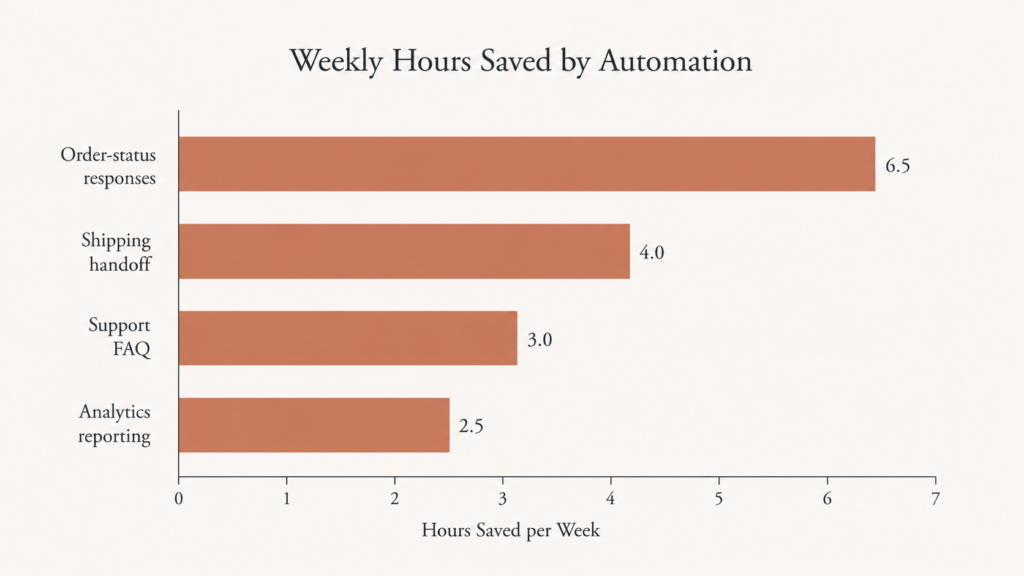
- Tracking and shipping notifications. The carrier updates, n8n catches it, updates the order, and messages the customer. Shipping handoff alone is one of the biggest daily time sinks in ecommerce, worth 3 to 8 hours a day for many teams.
- Post-purchase review requests. A timed sequence asks for a review at the right moment after delivery. Brands running this pattern report a 25 to 35 percent lift in verified reviews, and reviews move conversion on the product pages that matter most.
- Scheduled analytics reporting. Instead of someone rebuilding the same dashboard summary every Monday, n8n pulls the numbers and drops a plain-language digest into your inbox or Slack. Pair it with clean tracking (see the note on why half your Shopify revenue data can be wrong) and the report is actually trustworthy.
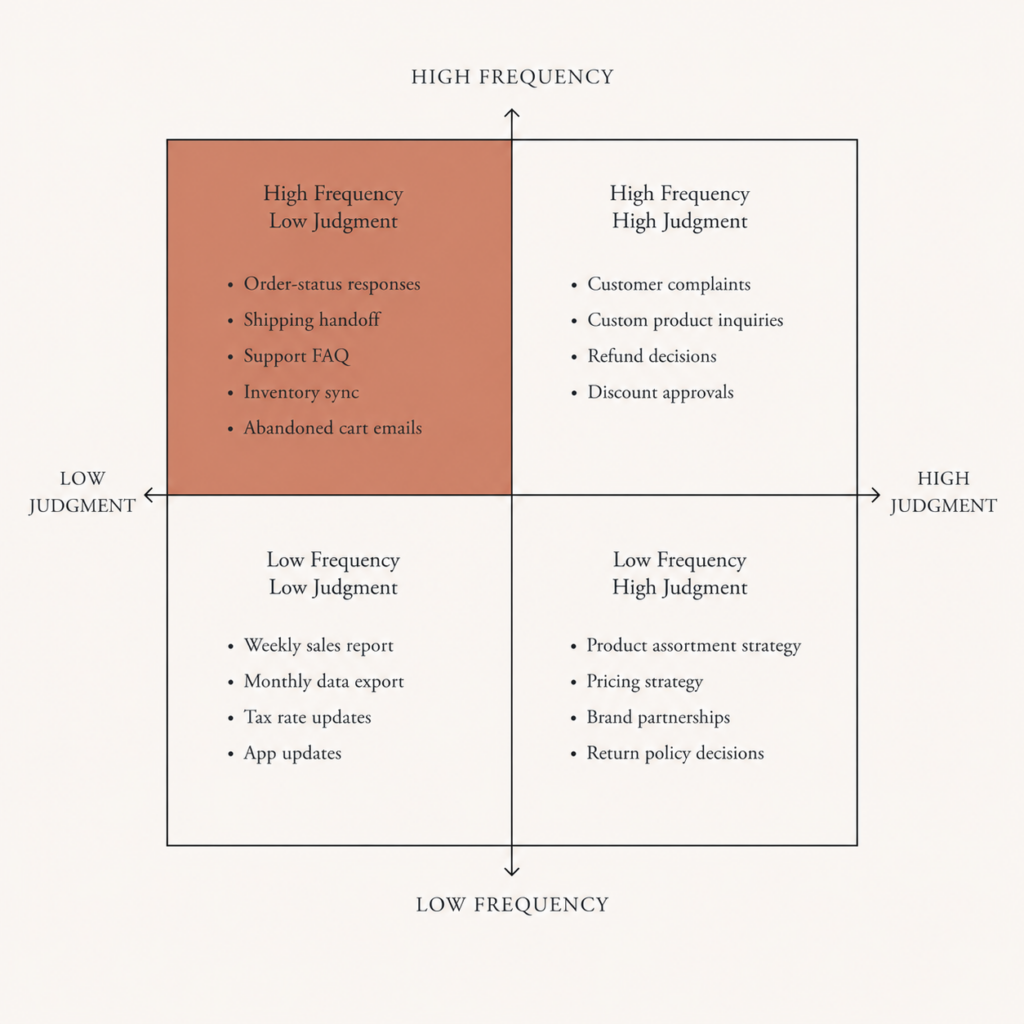
Notice what these five have in common. They are high-frequency, rules-based, and low-judgment. That is the sweet spot. The task runs constantly, the logic is clear, and a wrong answer is easy to catch. Start where the machine is obviously better and the risk is obviously small.
Where AI agents actually fit
Now it gets more interesting. The workflows above are deterministic, meaning they follow fixed rules. AI agents add judgment, and support is where that judgment pays off first.
An AI agent inside n8n reads the incoming message, decides what it is about, pulls the order context, and either answers or escalates. One documented five-person support team pointed an n8n agent at a repetitive forty-question workload, order status, returns, shipping delays, and resolved 78 percent of tickets without human involvement in the first week. The remaining 22 percent were routed to a human with the full conversation already attached. Across several ecommerce deployments, resolution rates landed in the 71 to 83 percent range depending on catalog complexity.
Read that carefully, because the design is the whole point. The agent did not replace the team. It cleared the repetitive 78 percent so the humans could spend their day on the 22 percent that actually needed a person. That is the right mental model for AI in operations, and it is the same one behind knowing when RAG is the right answer for a chatbot and when it is not.
The result? Your support queue stops being a wall and starts being a filter. The easy stuff clears itself. The hard stuff arrives with context. And your team stops answering “where is my order” for the ninth time before coffee.
If you want the wider framing of where autonomous workflows are heading, the agentic AI overview sets the direction. n8n is simply one of the most practical places to start building it today.
What you should never fully automate
Here is where most automation advice goes quiet, and where I will not. Some things should stay in human hands, or at least keep a human in the loop.
Refunds above a threshold. Pricing changes. Anything that touches a customer’s money or a legal promise. Bulk actions that hit your whole catalog at once. The rule I use with clients is simple: if a single wrong run causes damage you cannot quietly undo, the machine drafts and a human approves. Automation should remove the busywork, not the judgment.
There is also a real 2026 wrinkle worth flagging. With Shopify’s move to the new Dev Dashboard for custom apps starting in January, some older guides on connecting Shopify to n8n went out of date. The connection still works well, but the setup path changed. If you follow a tutorial from last year, you will hit a wall at the credential step. Use current docs, or have someone who tracks these changes set it up once, correctly.
How to think about the return before you build
Do not start with the tool. Start with the timesheet. Pick one task your team runs daily, count the minutes it eats across a week, and multiply by your loaded hourly cost. That number is your budget and your proof.
Then build one workflow. Just one. Watch it run for a week. Measure the hours it actually returns, not the hours a blog promised. When it holds, build the next. Small business benchmarks suggest owners reclaim a median of 5 hours a week and employees around 11.5 hours once automation is in place, according to 2026 adoption research. Those hours compound. One saved hour a day is a saved workweek every month and a half.
This is also, quietly, an app-replacement strategy. Every task you move into a self-hosted workflow is a task you are no longer paying a per-seat SaaS tool to do. It is the same logic behind cutting $480 a month in Shopify app spend. One well-built n8n instance can absorb the jobs of several single-purpose subscriptions, and it keeps working while you sleep.
A word on maintenance, because nobody sells it and everybody pays for it. A workflow is not a set-and-forget object. APIs change, a carrier renames a field, an app updates its webhook, and a flow that ran cleanly for months quietly stops. The stores that get burned are the ones that automate ten things fast and monitor none of them. The stores that win add a simple failure alert to every workflow, so when something breaks a human hears about it before a customer does. Build fewer flows, watch the ones you have, and the machine stays trustworthy.
The bottom line on n8n for ecommerce
n8n is not magic. It is leverage. The stores that win with it are not the ones that automate the most. They are the ones that automate the right things, in the right order, and leave the judgment calls to people.
So keep it simple. If the task is high-frequency and rules-based, order handoffs, stock alerts, tracking updates, review requests, automate it now and reclaim the hours. If the task carries real risk or needs a human read, money, pricing, promises, keep a person in the loop and let the machine only draft. Start with one workflow, prove the hours, then compound.
If your team is drowning in repeatable busywork and you want a straight answer on what to automate first, reach out to Javaid Ahmad for a straightforward conversation about your operations. No lengthy discovery calls, no vague proposals, just a clear read on which tasks are worth automating and which are not. Start at javaid.dev/contact.
FAQ
Q: What is n8n and how is it used for ecommerce? A: n8n is an open-source workflow automation tool that connects your store, apps, and AI models with visual logic instead of code. In ecommerce it handles order fulfillment handoffs, inventory alerts, shipping notifications, review requests, reporting, and AI-assisted support, so repetitive tasks run automatically.
Q: Is n8n better than Zapier or Make for a Shopify store? A: For low-volume, simple automations, all three work. n8n’s advantage is self-hosting, which means you pay for a server rather than per task, so cost does not balloon as your automation volume grows. It also has deeper AI-agent support in 2026, which matters if you plan to automate support.
Q: Can n8n reduce ecommerce support tickets? A: Yes. An n8n AI agent can read incoming messages, pull order context, and resolve routine questions like order status and returns. Documented deployments resolved 71 to 83 percent of repetitive tickets without a human, routing the rest to staff with full context attached.
Q: Do I need to know how to code to use n8n? A: For most standard ecommerce workflows, no. The visual builder covers the common cases. Code helps for edge cases and custom logic, and the initial Shopify connection setup changed in 2026, so having someone configure it correctly once saves time.
Q: How much time can n8n automation save an ecommerce team? A: It depends on which tasks you automate, but industry benchmarks put the highest-ROI automations at 30 to 50 hours saved per week across a team, with owners reclaiming a median of around 5 hours and employees around 11.5 hours each.
Q: What ecommerce tasks should I not automate with n8n? A: Anything involving money movement, pricing changes, large refunds, or catalog-wide bulk actions should keep a human in the loop. The safe rule is that if one wrong run causes damage you cannot quietly undo, the machine drafts and a person approves.

Comments are reviewed before they appear, so yours will not show up straight away. Your email is never published.