
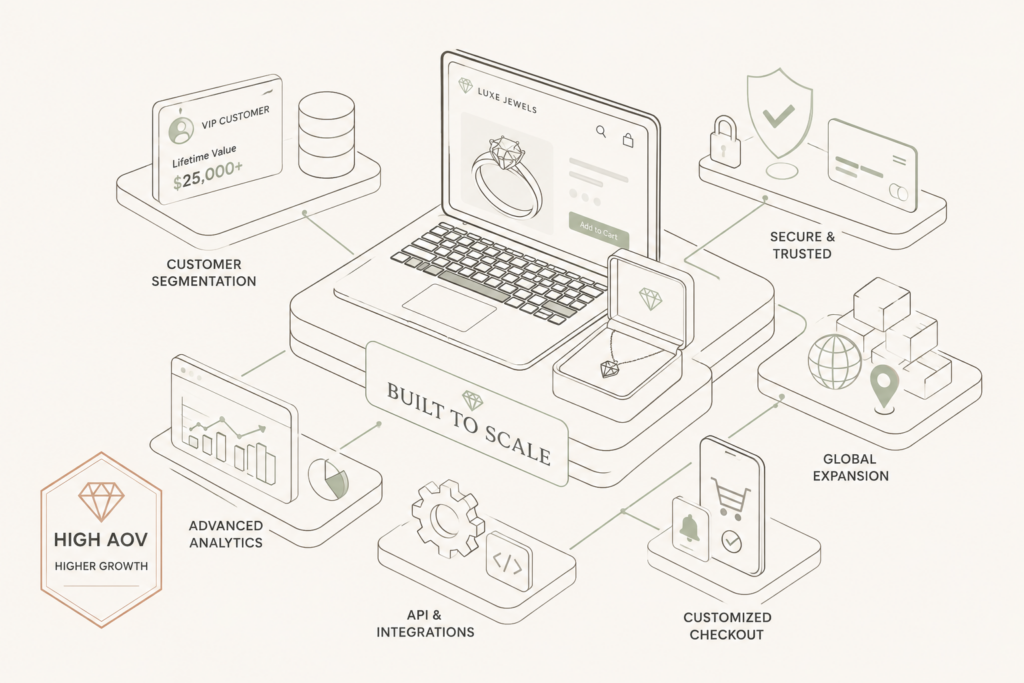
If you’re wondering how Shopify Plus helps high-AOV jewelry stores scale, the short answer is this: it’s rarely about product complexity. Most jewelry brands don’t outgrow standard Shopify because their catalog is too sophisticated. They outgrow it because their workflows are. A RingBuilder configurator that needs real-time stone pricing, a live Stuller inventory sync, a checkout experience built for someone spending $3,000 on an engagement ring, standard Shopify handles none of that cleanly. That’s the exact crossover point where Shopify Plus stops being a cost line and starts being a margin decision.
Working directly on Shopify Plus builds for high-AOV jewelry clients, I’ve watched this moment play out across multiple stores. The brand hits a ceiling, not from lack of demand, but from tooling that can’t keep up. The checkout can’t be customized the way the customer journey requires. The RingBuilder starts timing out under API rate limits. The supplier sync risks data mismatches during peak traffic. The platform isn’t broken; it’s just undersized for what the business has become.
This article isn’t a feature list for its own sake. It’s a practical breakdown of how Shopify Plus helps high-AOV jewelry stores scale, which specific features move the needle, which integrations pair with it, and whether the math makes sense for where your store is today.
Why standard Shopify creates a ceiling for jewelry brands
Standard Shopify gives you a checkout you can brand, but not truly control. For a jewelry brand, that’s a real problem. You can’t natively add custom gift messaging fields, high-resolution stone detail popups, or a personalized engraving input at checkout without working around the platform’s structural limitations. Checkout Extensibility on Plus changes that entirely, giving developers direct control over the checkout experience without fragile workarounds that break under pressure.
High-AOV jewelry stores also rely on custom configurators, supplier feed syncs, and complex pricing engines. Standard Shopify’s API rate limits throttle exactly these use cases. Plus offers API capacity that’s effectively 10x higher than standard plans, the difference between a RingBuilder that loads in under a second and one that times out during product fetches. That performance gap can negatively affect your conversion rate in ways that compound quickly at high ticket prices.
Growing jewelry teams hit the 15-staff-account ceiling faster than expected. Buyers, merchandisers, support staff, and wholesale reps all need different access levels. Plus removes that limit entirely and includes POS Pro at all locations, which matters considerably for jewelers running physical showrooms alongside their online store.
How Shopify Plus Helps High-AOV Jewelry Stores Scale: Key Features
Shopify Functions are the most underused tool in the Plus toolkit for jewelry brands. Functions let you deploy dynamic logic directly in the checkout: free shipping thresholds that push customers to add one more piece, volume-based discounts for bridal sets, and gifts-with-purchase triggers for orders over $1,500. For high-AOV stores, a well-structured free shipping threshold alone can increase average order value materially. These aren’t gimmicks; they’re purchase psychology applied at the exact moment it matters.
Shop Pay converts at 1.72 to 1.91 times higher than guest checkout. On a $2,000 engagement ring purchase, that gap is the difference between a completed sale and an abandoned cart. One-tap checkout removes the friction that causes high-intent buyers to second-guess themselves at the payment screen, a uniquely damaging problem for high-ticket purchases where the buyer is already carrying emotional weight about the decision.
Checkout Extensibility and Flow automation
Checkout Extensibility lets you add post-purchase upsells, matching bands, warranty plans, or ring care kits, on the order confirmation page without interrupting the primary checkout flow. This is how you increase AOV without increasing cart abandonment. Shopify Flow handles the back-end logic that would otherwise require a developer every time: auto-tagging customers when they cross a lifetime spend threshold, syncing VIP segments to Klaviyo, and pausing ads for out-of-stock custom pieces.
Custom apps and supplier integrations that Plus actually enables
RingBuilders aren’t plug-and-play, no matter what the app listings suggest. They require real-time stone inventory, dynamic pricing by carat and cut, and a checkout flow that handles custom order workflows without breaking. Shopify Plus, with its higher API capacity and full Checkout Extensibility support, gives developers the infrastructure to build these tools properly rather than as fragile workarounds bolted onto a platform that wasn’t designed for them. If you’re evaluating off-the-shelf options, look for Ring Builder solutions like the TDP Ring Builder app as examples of how product configurators integrate into Plus stores.
This is core work at Javaid Ahmad® (see our Shopify Plus Guides for Growing Stores): building jewelry-specific configurators, RingBuilders, and AI quote engines that run cleanly inside a Plus storefront rather than being pasted in from the outside. The difference in build quality is significant, both in load performance and in how the tool holds up during high-traffic periods like Valentine’s Day or engagement season.
Stuller, GemFind, and supplier sync architecture
Connecting a live Stuller or GemFind catalog to a jewelry storefront requires a sync architecture that standard app solutions rarely handle at scale. Plus’s API headroom lets you build a custom sync layer using Laravel-backed middleware that pulls live inventory without hitting rate limits or introducing data mismatches during high-traffic periods. Stuller’s API requires proper authentication, staged data handling, and real-time inventory logic, consult the Stuller API documentation when planning your integration. Generic connectors often miss important edge cases; for practical performance guidance on catalog connections, see resources like GemFind performance optimization.
Many jewelry brands on Plus are paying $400 to $800 per month across multiple apps that overlap in functionality. In practice, a single custom-built app can often replace several of them, reduce page load weight, and cost less over a 12-month window than the SaaS stack it replaces, though the actual savings depend on your specific app mix and build scope. This is one of the clearest ROI levers available to Plus merchants who are already on the platform but haven’t audited their app overhead.
Third-party integrations that reduce friction on $500 to $5,000 purchases
Klarna is a widely used BNPL integration among upscale jewelry brands on Shopify Plus, and the reason is straightforward: breaking a $3,000 ring into monthly payments changes the psychology of the purchase. For buyers who were on the fence, a financing option at checkout can be the deciding factor. For purchases above $1,000, some merchants also deploy Affirm alongside Klarna, since Affirm’s longer-term financing plans (up to 48 months) often perform better at higher price points.
Virtual try-on tools on Plus storefronts show a 22% lift in conversion for try-on sessions and a 19% drop in returns for pieces in the $500 to $5,000 range. Those return numbers matter disproportionately for jewelry because of the high handling and restocking cost per piece. A 19% reduction in returns on a $2,000 average order is a meaningful margin improvement, not just a nice-to-have feature.
Yotpo for UGC and Gorgias for live chat are the two most commonly paired trust tools on jewelry Plus stores. Both integrate cleanly at the Plus tier with deeper API access than standard plans allow. For jewelry specifically, live chat at the product page level, answering questions about stone grades, sizing, and customization options, directly reduces the hesitation that kills high-ticket purchases.
Infrastructure and stability during high-traffic product launches
Shopify Plus runs on infrastructure backed by Cloudflare’s CDN across 180+ global points of presence. For a jewelry brand launching a Valentine’s Day collection or a limited-edition bridal series, that auto-scaling means the store handles traffic spikes without manual intervention. The high-performance checkout is built to process over 10,000 transactions per minute, and Plus merchants consistently report strong uptime even during flash sale events that would strain a lower-tier setup.
Launchpad lets you schedule a sale, enable discounts, swap themes, and revert everything post-event without touching a line of code. For jewelry brands running seasonal promotions across multiple collections, this eliminates launch-day errors that eat into the sales window. The automated rollback alone has saved more than a few jewelry brands from spending the final hour of a promotion manually unwinding discount configurations.
Plus merchants can also deploy headless storefronts using Shopify’s Hydrogen framework with free global hosting on Oxygen. For jewelry brands where product photography is central to conversion, a headless setup delivers sub-second load times with no compromise on visual quality. Slow product pages on high-AOV items don’t just frustrate buyers, they signal a lack of professionalism that directly contradicts the premium positioning the brand is working to establish.
The ROI math: what Shopify Plus actually costs and what it returns
Shopify Plus starts at approximately $2,300 per month on a three-year term or $2,500 per month on a one-year term. Compared to Shopify Advanced at $399 per month, the gap looks large until you factor in what’s included: unlimited staff accounts, POS Pro at all locations (which costs $89 per location per month on Advanced), and a transaction fee drop from 0.6% to 0.2% on third-party gateways.
At $300,000 per month in revenue, the 0.4% transaction fee difference saves $1,200 per month, nearly covering the incremental cost over Advanced. At $500,000 per month, the savings reach $2,000 per month. Based on transaction fee savings alone, the breakeven for most jewelry brands typically lands around $1.5 million in annual revenue, though this varies depending on gateway mix and POS location count. Below that threshold, Advanced is usually the smarter financial decision (see Shopify Plus vs Advanced: When the Jump Pays Off). Above it, Plus is often paying for itself in transaction savings before you factor in conversion improvements from Shop Pay and checkout customization.
A prioritized 90-day implementation makes the transition measurable rather than overwhelming. Here’s the sequence that works:
- Weeks 1, 3: Migrate checkout to Plus and enable Shop Pay.
- Weeks 4, 6: Build or connect your RingBuilder or supplier integration with proper API architecture.
- Weeks 7, 9: Configure Flow for VIP automation and add BNPL at checkout.
- Weeks 10, 12: Audit and consolidate your app stack to reduce SaaS overhead.
Working with a specialist who has done this specifically for jewelry brands cuts the timeline significantly and avoids the costly detours that generalist developers tend to miss. For a step-by-step migration playbook, review How to Migrate to Shopify Plus the Right Way.
Final thoughts
Shopify Plus is not a default upgrade for every jewelry brand. It earns its cost when a store hits the complexity ceiling that standard plans can’t clear: custom checkout logic, supplier integrations that require real API headroom, automation workflows that run without constant developer involvement, and the infrastructure to survive peak sales days without downtime. The platform is capable of all of it, but capability isn’t the same as execution.
The numbers speak to how Shopify Plus helps high-AOV jewelry stores scale in concrete terms: a 1.72x checkout conversion improvement with Shop Pay, $1,200 to $2,000 per month in transaction fee savings at meaningful revenue volumes, a 22% conversion lift with virtual try-on, and the operational clarity that Launchpad and Flow bring to a high-touch jewelry business. These results are real, but they require the underlying architecture to be built correctly from day one.
If you’re evaluating the upgrade, or already on Plus and not getting the return you expected, the issue is usually the build, not the platform. At Javaid Ahmad®, this is exactly the kind of work we specialize in: production-grade Shopify Plus builds for jewelry brands that need more than a template and a bundle of third-party apps. If you want a straight answer on whether Plus makes sense for your store right now, reach out directly and we’ll look at the numbers together.
Q: When should a high-AOV jewelry store consider upgrading to Shopify Plus?
A: Upgrade when your workflows—not your product catalog—hit limits: when custom configurators (like RingBuilder) time out under API rate limits, supplier syncs (for example, a live Stuller inventory feed) risk data mismatches, or you need deeper checkout control. In practice Plus becomes a margin decision once those bottlenecks start costing conversions or operational time.
Q: How does Checkout Extensibility on Shopify Plus help jewelry checkouts?
A: Checkout Extensibility gives developers direct control over the checkout experience so you can add custom gift messaging, high-resolution stone detail popups, or personalized engraving inputs without fragile workarounds. It also enables post-purchase upsells on the order confirmation page so you can offer matching bands, warranty plans, or care kits without interrupting the primary flow.
Q: What are Shopify Functions and how can they increase average order value (AOV)?
A: Shopify Functions let you deploy dynamic checkout logic such as free shipping thresholds, volume-based discounts for bridal sets, and gifts-with-purchase triggers for orders over $1,500. These targeted incentives applied at checkout can nudge buyers to add one more piece or upgrade a purchase, materially increasing AOV for high-ticket items.
Q: How does Shopify Plus handle API rate limits compared with standard Shopify?
A: Plus offers API capacity that’s effectively 10x higher than standard plans, which prevents RingBuilder configurators and supplier syncs from timing out during product fetches. That performance gap improves load times and conversion rates, especially for configurations that must fetch real-time stone pricing or live inventory.
Q: Does Shopify Plus change staff account limits and POS capabilities for jewelry brands with showrooms?
A: Yes—Plus removes the 15-staff-account ceiling, allowing buyers, merchandisers, support staff, and wholesale reps to have appropriate access levels. It also includes POS Pro at all locations, which is important for jewelers running physical showrooms alongside their online store.
Q: How much does Shop Pay improve conversion for expensive jewelry purchases?
A: Shop Pay converts at approximately 1.72 to 1.91 times higher than guest checkout, meaning on a $2,000 engagement ring that uplift can be the difference between a completed sale and an abandoned cart. One-tap checkout reduces the payment-screen friction that disproportionately affects high-intent, high-ticket buyers.
Q: Which integrations are commonly cited as putting pressure on standard Shopify for jewelry stores?
A: Custom configurators like RingBuilder and supplier inventory feeds such as Stuller are common pressure points because they require real-time pricing, inventory sync, and high API throughput. When those integrations start timing out or causing data mismatches during peak traffic, that’s a strong signal standard Shopify is undersized for the business.

Comments are reviewed before they appear, so yours will not show up straight away. Your email is never published.