
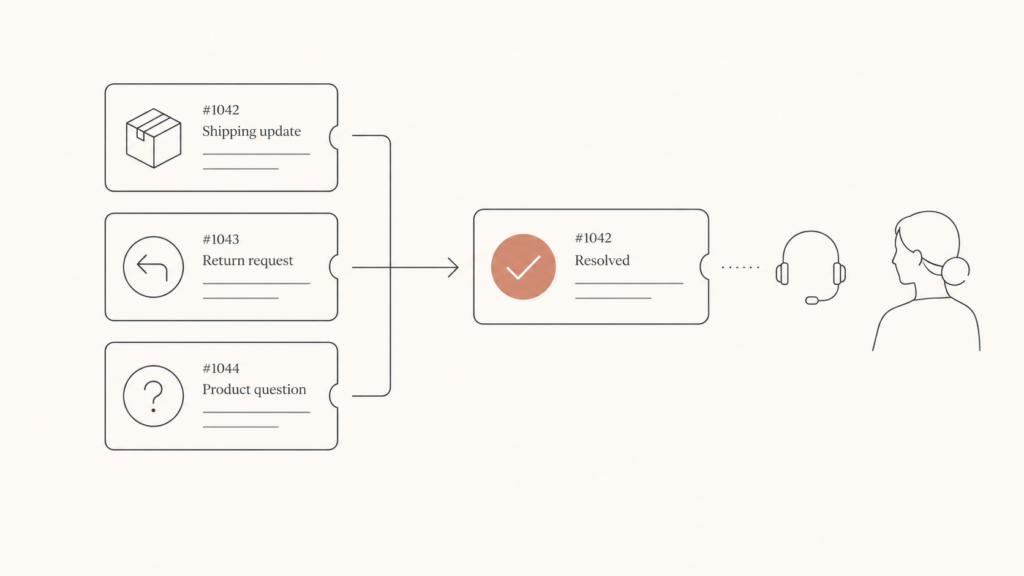
Picture your support inbox at 9 a.m. on a Monday. Forty new messages. You open the first one. “Where is my order?” The second one. “Where is my order?” The fifth, the ninth, the fourteenth. Same question, different order numbers. Your team spends the morning copy-pasting tracking links instead of handling the two refund disputes that actually need a human brain.
That is the real problem AI customer service solves. Not “the future of support.” Not a robot personality. It solves the fact that most of your queue is the same handful of questions asked a thousand ways, and a person is answering every one by hand.
Here’s the thing: AI customer service for ecommerce has quietly crossed from experiment to default. Roughly 66% of customer service organizations were using AI agents in 2026, up from 39% a year earlier, based on adoption data compiled across the industry. The question is no longer whether to use it. It’s how to deploy it so it closes tickets instead of frustrating customers into a longer queue.
This article covers the full picture: which tickets an AI agent should actually handle, what “resolve” really means, how to roll one out without burning trust, where deployments fail, and what the honest cost math looks like.
Why your support queue is mostly the same five questions
Before you automate anything, you need to see the shape of your own inbox. Ecommerce support is unusually predictable. That predictability is the whole opportunity.
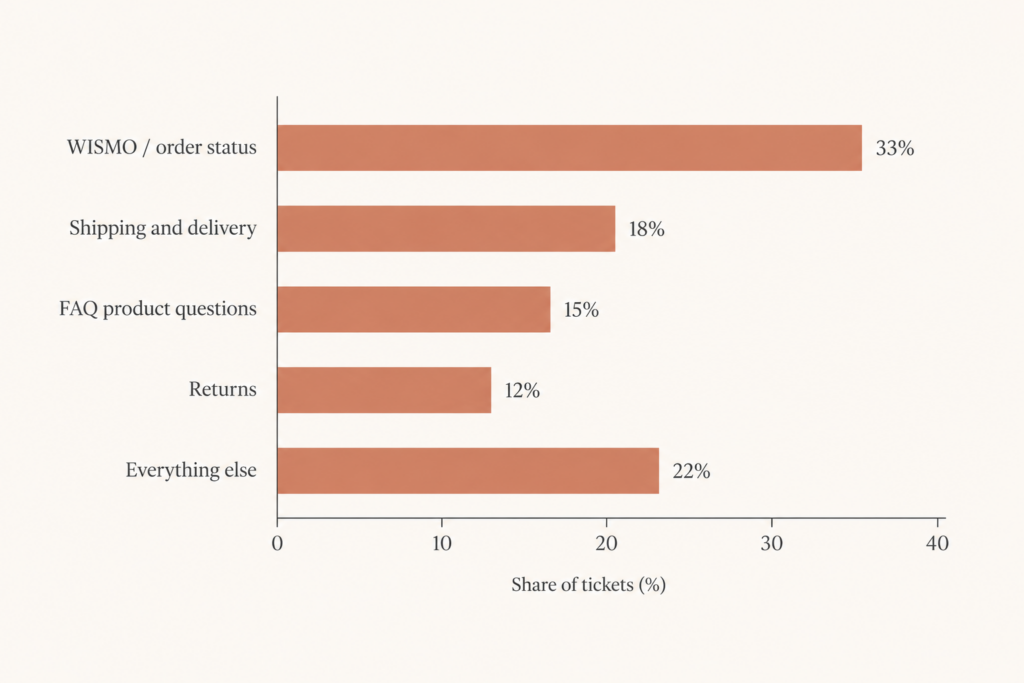
The biggest single category is WISMO, short for “where is my order.” WISMO alone drives somewhere between 20% and 40% of monthly ticket volume, and it climbs past 50% during peak periods, according to ticket-deflection analyses of ecommerce inboxes. Stack the next few categories on top of it and the pattern gets sharper. Order status, shipping and delivery questions, FAQ-style product questions, and returns together account for roughly three-quarters of tickets before you touch a single hard case.
Read that again. Most of your team’s day is spent on questions that have a correct, lookup-able answer. The order is in transit. The return window is 30 days. The ring is available in size 7. None of that requires judgment. It requires data and a fast reply.
That’s the automatable core. And it’s exactly what an AI agent connected to your store data does well: pull the order, read the tracking status, quote the policy, answer in the customer’s language, close the ticket. The hard cases (a lost package, a chargeback, a custom sizing dispute) stay with your people, who now have the time to handle them properly.
What “resolve” actually means, and why deflection isn’t it
Here’s the distinction that separates a good deployment from an expensive one. Deflection and resolution are not the same thing.
Deflection means the customer didn’t reach a human. That’s it. A deflection-first bot that answers with a help-center link and hopes the customer goes away sits at roughly 25% to 55% “success,” by benchmark data on the two approaches. Some of those are genuinely solved. Many are just customers giving up. Giving up is not resolution. It’s churn with a delay.
Resolution means the ticket is actually closed. The customer got their answer, their refund started, their address changed, their order tracked. A well-built agentic deployment resolves 75% to 80% of inbound contacts end to end, and ecommerce brands in particular tend to land in the 70% to 84% range because their highest-volume questions are so data-rich, per resolution-rate benchmarks across thousands of deployments.
The gap between those two numbers is the whole game. A deflection bot that “handles” 50% of tickets by frustrating people is a liability. A resolution agent that closes 75% is a system that quietly carries load.
So when you evaluate any tool or build, ask one question. Does it take an action, or does it just talk? An agent that can look up the order, process the return, and update the record is doing support. An agent that only recites the FAQ is a search box with a personality.
How to deploy AI customer service for ecommerce without burning trust
You don’t flip a switch and point a bot at every customer on day one. That’s how you end up with a viral screenshot of your AI apologizing in a loop. Roll it out the way you’d ship any system that touches customers: narrow, measured, then wider.
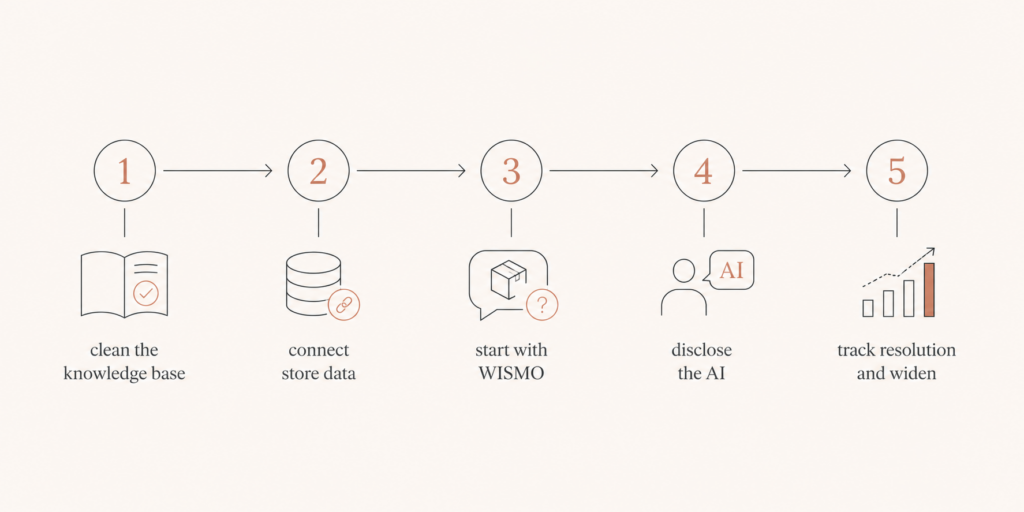
- Fix your knowledge base first. The agent is only as good as what it can read. Stale shipping policies, a missing returns page, contradictory answers across your help center, all of it becomes wrong answers at scale. Clean, accurate, current content is the foundation, and it’s the single biggest determinant of whether the agent gives reliable answers. Do this before anything else.
- Connect it to real store data. WISMO can’t be answered from a knowledge base. It needs live order and tracking data. Wire the agent into your order system so it can look up an order and read its status, not guess. This is where the resolution rate actually comes from, and where an approach like retrieval over your own data instead of a generic model earns its keep.
- Start with one narrow job. Point the agent at WISMO and order status only. It’s the highest-volume, most predictable, most automatable category, and between 70% and 90% of those questions can be handled without a human, according to WISMO automation guidance for Shopify stores. Prove it there before you expand.
- Be honest that it’s an AI. Tell customers up front. Trust goes up, not down, when you don’t pretend a bot is a person. It also sets the right expectation for when the handoff comes.
- Track resolution, then widen. Watch closed-ticket rate, not just deflection. When WISMO is solid, add returns, then FAQ product questions, then shipping edge cases. Start small, measure, expand. That order matters more than the tool you pick.
The unglamorous truth is that steps one and two are 80% of the work. Most failed deployments skip them, plug in a bot, and blame the AI when it hallucinates a refund policy that doesn’t exist.
The handoff is where most deployments fail
You can get the answers right and still lose the customer at the exit. The handoff from AI to human is the part almost everyone underestimates. Roughly 90% of leaders admit they struggle with it, and nearly all of them say a smooth transition is essential, per operational surveys of AI support teams.
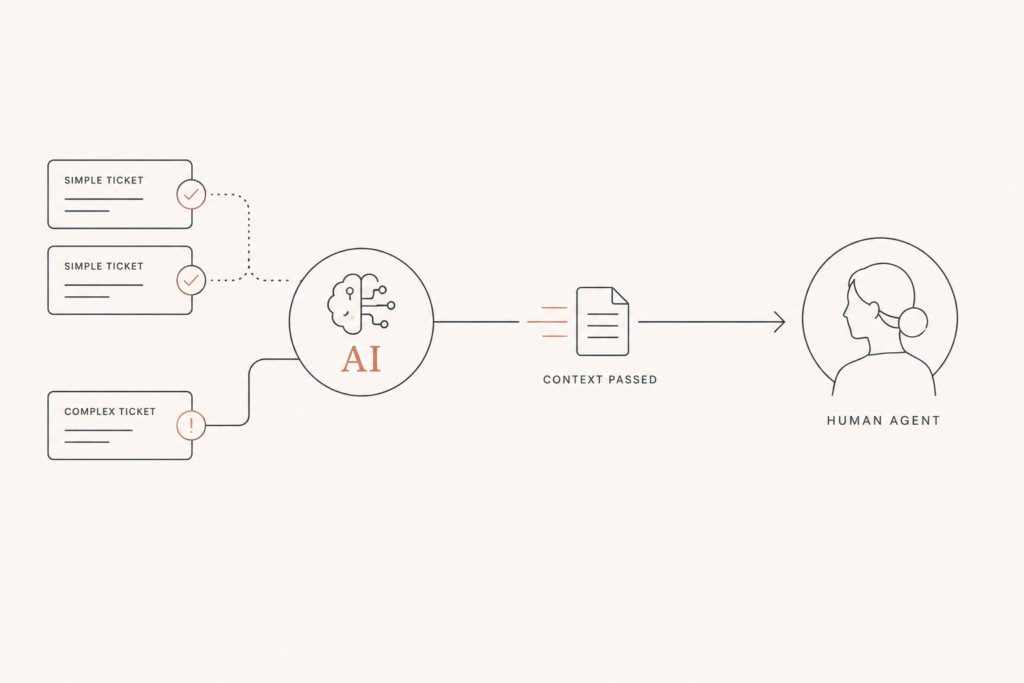
The rule is simple. When a customer asks for a human, escalate immediately. No loops. No “let me try one more thing.” No retry gauntlet designed to protect your deflection metric. The moment someone requests a person, the system should hand off with no friction.
And the handoff has to carry context. Nothing burns goodwill faster than a customer explaining their whole problem to a bot, getting escalated, and then explaining it all again to a human who sees a blank screen. Pass the full conversation, the order details, and the customer record to the agent who picks it up. Continuity is the difference between “the AI helped” and “the AI wasted my time.”
Think of it as a triage nurse, not a gatekeeper. The AI handles the routine, recognizes what it can’t solve, and routes the rest to the right person with the chart already filled in. That’s not overhead. It’s a faster path to resolution for everyone.
What it costs, and what it saves
Now the part everyone wants and few sites give straight. The economics are real, but they depend on volume and on getting resolution right.
Per-contact cost is where the math lives. An AI-handled resolution runs somewhere around $0.50 to $2.00, against roughly $6 to $13 for a human-handled ticket, based on cost benchmarks across support programs. Multiply that by a queue where three-quarters of tickets are automatable and the savings compound quickly. One widely cited figure has cost per interaction dropping from $4.60 to $1.45 after AI rollout, in a large employer survey. At the macro scale, Gartner has projected conversational AI will save around $80 billion in contact-center labor costs globally by the end of 2026.
But cost per ticket is only half the picture. The other half is what you stop paying for. Many stores are running three, four, five overlapping support and helpdesk apps, each with its own monthly fee, and a single well-built agent can replace the tangle. That’s the same logic behind auditing and cutting bloated app spend: fewer moving parts, lower recurring cost, less to maintain. And the routine automation that keeps order updates flowing can often run through a lightweight workflow layer like n8n rather than another subscription.
A word of caution on the ROI headlines. You will see figures like $3.50 returned per dollar and 340% first-year returns quoted widely, including in vendor benchmark reports. Treat those as ceilings, not promises. They assume a clean knowledge base, real data integration, and a resolution rate that took months to tune. The stores that hit those numbers did the boring setup work first. The stores that didn’t got a chatbot and a support ticket about the chatbot.
One of the most common conversations at Javaid Ahmad starts here, with a store owner who wants a support agent that closes tickets and quietly retires two or three paid apps. Javaid Ahmad builds on-site AI chatbots and quote engines wired into real store data, the kind of conversational interface that takes action instead of just chatting. Not a wrapper around a generic model. A system that reads your orders, respects your policies, and hands off cleanly.
The bottom line on AI customer service for ecommerce
AI customer service isn’t a personality you bolt onto your store. It’s a resolution system you wire into your data. The bots that fail talk. The agents that work take action.
If your setup is simple, a store with clean policies, straightforward shipping, and a queue that’s mostly WISMO, start narrow and you’ll see resolution fast. Point an agent at order status, connect it to live tracking, disclose it, and measure closed tickets. If your setup is complex, high-AOV products, custom orders, multi-warehouse fulfillment, intricate return rules, then the knowledge base and data-integration work matters more, and rushing it is how you get wrong answers at scale. Do the unglamorous part first either way.
The pattern holds across every category on this site. The tool is never the hard part. The plumbing is. Get the data and the policies right, keep the handoff frictionless, and the agent earns its place.
If you’re weighing whether an AI support agent fits your store, you can reach out to Javaid Ahmad for a straightforward conversation about what to automate first and what to leave with your team. No lengthy discovery calls, no vague proposals, just a clear answer on next steps. Book a call or start a free store audit at javaid.dev/contact.
FAQ
Q: What is AI customer service for ecommerce? A: It’s a support agent, usually a chat or messaging interface, connected to your store’s order data and knowledge base so it can answer customer questions and take actions like looking up tracking, starting returns, or updating details. The good ones resolve tickets end to end rather than just deflecting customers to a help page.
Q: What’s a realistic resolution rate for an AI support agent? A: Industry benchmarks put well-built agentic deployments at roughly 75% to 80% of inbound contacts, and ecommerce brands often land in the 70% to 84% range because order-status and shipping questions are so data-rich. Expect 40% to 60% on initial deployment and improvement over several months of tuning, not day-one perfection.
Q: Which ecommerce tickets should AI handle first? A: WISMO and order-status questions. They’re the highest-volume, most predictable, most automatable category, often a third or more of your queue, and 70% to 90% can be handled without a human. Prove resolution there before expanding to returns, FAQs, and shipping edge cases.
Q: Will AI customer service replace my support team? A: No, it changes what your team spends time on. The agent absorbs the repetitive lookups so your people handle the exceptions that need judgment, like lost packages, disputes, and custom orders. The handoff has to be immediate and context-rich, which means humans stay essential for the hard cases.
Q: How much does AI customer service cost per ticket? A: An AI-handled resolution typically runs around $0.50 to $2.00 versus roughly $6 to $13 for a human-handled ticket, though your real number depends on volume and how much of your queue is automatable. The larger saving often comes from retiring overlapping support apps rather than the per-ticket cost alone.
Q: What’s the most common reason AI support deployments fail? A: Two things: a messy knowledge base and a broken handoff. If the content the agent reads is stale or contradictory, it gives wrong answers at scale. And if it won’t escalate cleanly when a customer asks for a human, it turns a solvable ticket into a lost customer. Fix both before you widen the rollout.
Support agents are the most immediately useful AI build for most stores, but they are not the only one. More of these teardowns sit in AI in ecommerce.

Comments are reviewed before they appear, so yours will not show up straight away. Your email is never published.