
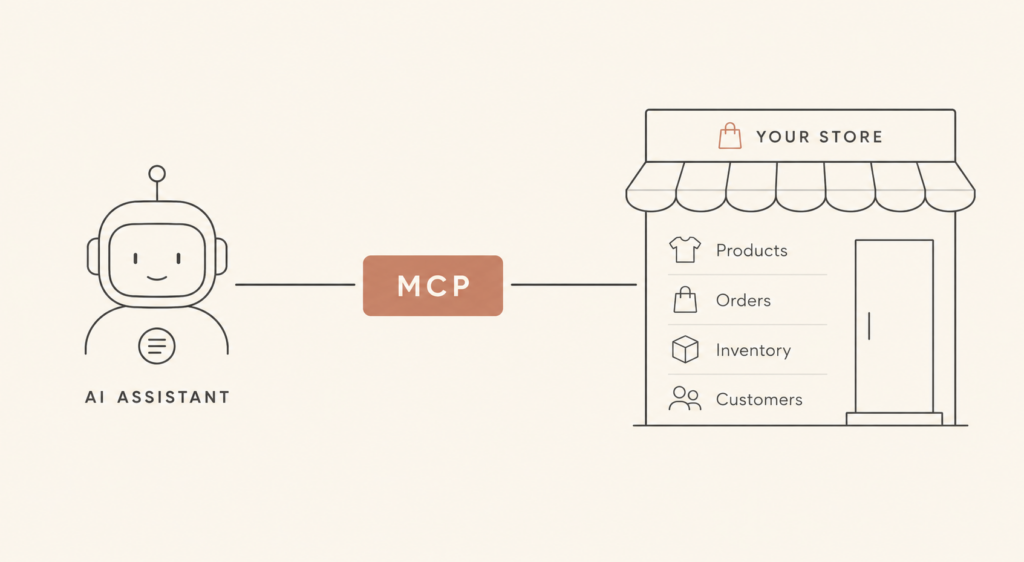
Your AI assistant can write a product description in seconds. Ask it where order #48392 is, and it goes quiet.
That gap is the whole story of AI in ecommerce right now. The model is smart. It just cannot see your store.
A year ago, merchants wanted AI to write copy. Today they want it to answer customer questions, build discounts, fix inventory, pull reports, and move work between five systems at once. None of that happens if the model has no live connection to your data.
That connection is what a Shopify MCP server gives you. And in 2026, Shopify went all in on it.
On January 11, 2026, Shopify and Google announced the Universal Commerce Protocol at NRF. On April 9, Shopify open-sourced its AI Toolkit under MIT license. The plumbing for agent-driven commerce is now official, not experimental.
In this post I’ll explain what an MCP server is, why it matters if you run Shopify or Shopify Plus, how I’d build one for a real store, and the security and performance traps to avoid.
What Is a Shopify MCP Server?
Think about what APIs did for software. Apps stopped scraping web pages and started talking through clean, defined interfaces. MCP is doing the same thing for AI.
MCP stands for Model Context Protocol. Instead of every AI vendor inventing its own way to plug into your systems, MCP gives them one shared standard. The model can discover the tools you expose, read what each one does, and call it only when it needs to.
For a Shopify store, those tools might include:
- Look up products and collections
- Read inventory and stock levels
- Pull customer history
- Create draft orders
- Check fulfillment and shipping status
- Update product metadata
- Generate reports
Instead of hardcoding hundreds of prompts and raw API calls, the agent understands which tools exist and reaches for the right one. That makes the whole thing far more reliable.
Shopify ships a few flavors. The Storefront MCP handles product discovery and cart actions for shoppers. The Customer Account MCP handles logged-in customer data. And if you run Hydrogen 2026.1.4 or later, your /api/mcp route already forwards to Shopify’s hosted Storefront MCP with no server code from you.
Why This Matters for Your Store
Most stores already sit on a pile of valuable data. The problem is that it lives in different places that do not talk to each other.
You probably have some mix of Shopify, Klaviyo, Google Analytics, an ERP, inventory software, a help desk, a shipping platform, and a few spreadsheets nobody wants to open.
An MCP server becomes the layer that ties them together for an agent. Picture asking:
“Which products lost inventory this week but never got an email campaign?”
Instead of opening five dashboards, your agent gathers the data, reasons over it, and hands you an answer you can act on. That is a real productivity jump, not a demo trick.
How MCP Differs From a Traditional Shopify App
A lot of developers assume MCP replaces Shopify apps. It does not.
Apps still own the user-facing side: embedded admin screens, checkout customizations, webhooks, and the APIs themselves. An MCP server sits beside them.
In most cases you already run a Laravel, Node, or Python service that talks to Shopify’s Admin API. Adding an MCP layer exposes that same business logic to AI assistants without a rewrite. You are making your existing code agent-accessible, not rebuilding it.
If you already maintain custom integrations for enterprise merchants, this is the cheapest high-value upgrade on the board.
Real Workflows I’d Build
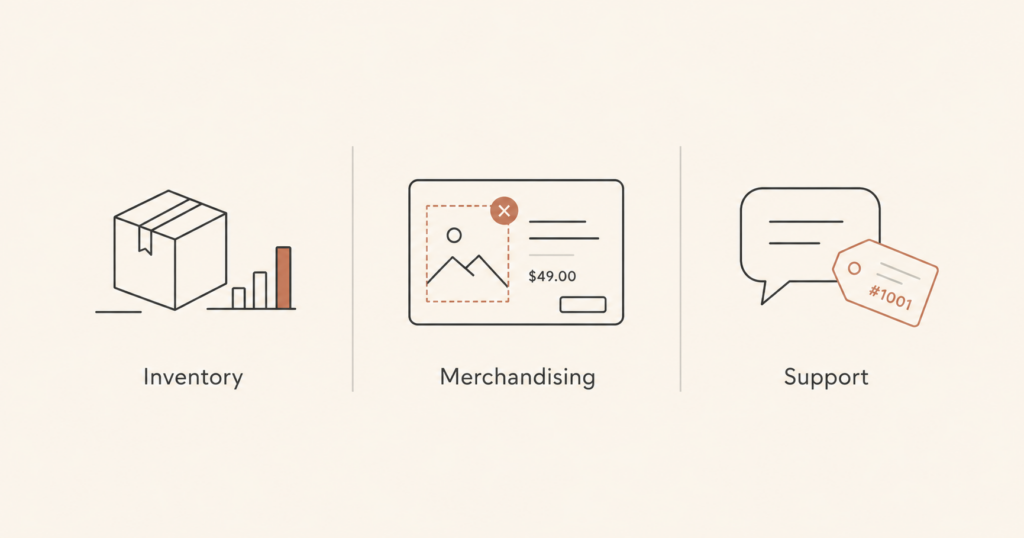
Working with brands, I can already name a dozen practical uses. Here are three I’d ship first.
Inventory analysis. Skip the CSV export and ask:
“Show products that sold fewer than five units in sixty days but still have more than fifty in stock.”
The agent pulls inventory, sales history, and product data, then recommends what to discount or pull.
Merchandising cleanup. Ask:
“Find products missing lifestyle photos, short descriptions, or meta titles.”
It flags the gaps and can even draft suggested copy for review.
Smarter support. Instead of digging through the admin, a rep asks:
“Where is order #48392, and has this customer contacted us before?”
Shipping status, order history, and past conversations come back in one answer.
Notice the pattern. The AI is not replacing Shopify. It becomes a smart interface sitting on top of your stack.
The Architecture I Recommend
When I build custom ecommerce systems, I keep responsibilities separated. A practical layout looks like this:
- Shopify Admin API provides the store data.
- Laravel (or your app) acts as the business logic layer.
- Authentication verifies who the agent is acting for and what it may do.
- The MCP server exposes only approved tools.
- Claude, ChatGPT, or another compatible client consumes those tools.
- Logging records every action for auditing.
Most stores already have steps one through three. Adding the MCP layer is an incremental improvement, not a teardown. It also keeps sensitive operations under your control instead of inside the model.
Security and Permission Models
This is the part people skip, and it’s the part that gets them burned.
The MCP spec revision from June 2025 made it formal: an MCP server is an OAuth Resource Server. The job of deciding who gets in belongs to a separate authorization server, not the MCP server itself. Treat those as two different responsibilities.
A few rules I hold to on every build:
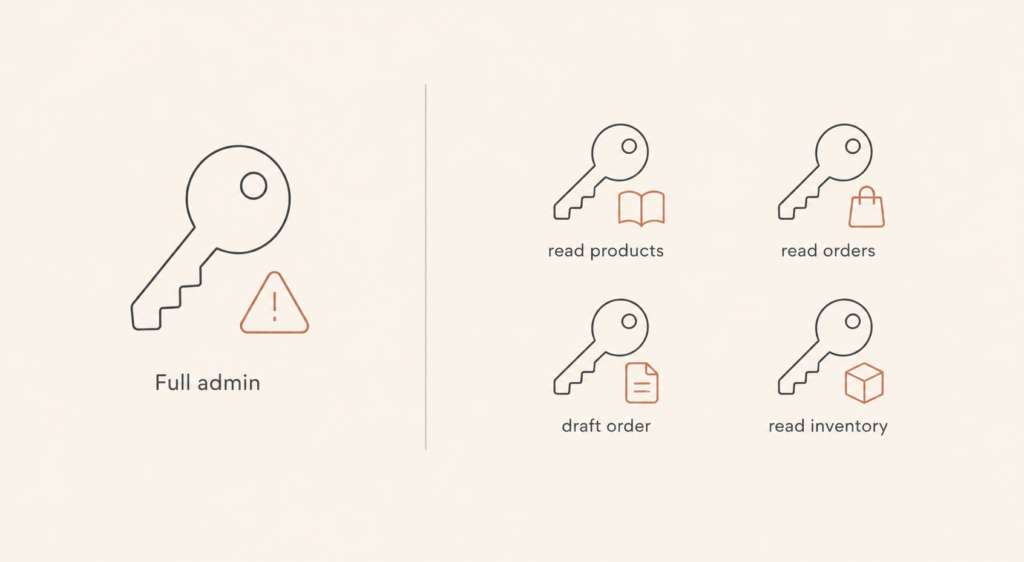
- Least privilege everywhere. Each tool gets the minimum Shopify scope it needs. A read-only reporting tool should never hold write access.
- Role-based access at the tool level. Define which users and agents can call which tools, and deny everything else by default.
- Isolate each server. Run the MCP server in its own container with tight permissions. If one server is compromised, the blast radius stays small.
- Retire credentials. When an agent finishes its task, its token should be revoked, not left lying around. OWASP calls this non-human identity governance, and it matters more as agents multiply.
Shopify’s own guidance is blunt: request only the scopes your app needs, so a leaked token does less damage. That single habit prevents most worst-case scenarios.
Authentication Best Practices
Shopify splits this cleanly, and it helps to know which door you’re walking through.
Storefront MCP needs no authentication for basic product and cart operations. It’s meant to be public-facing.
Customer Account MCP does require auth. You get a token through the OAuth 2.0 authorization code grant with PKCE, and the scopes attached to that token decide exactly what data it can touch.
For Admin-level work, use custom app access tokens and scope them narrowly. My short checklist:
- Use PKCE on the authorization code grant for any customer-facing flow.
- Store tokens in a secret manager, never in code or a committed .env.
- Rotate tokens on a schedule and after any staff offboarding.
- Log the actor, the tool, and the scope on every call so you can answer who did what later.
Shopify Plus Use Cases
Plus is where this gets interesting, because Plus merchants already run the custom integrations MCP loves to sit on top of.
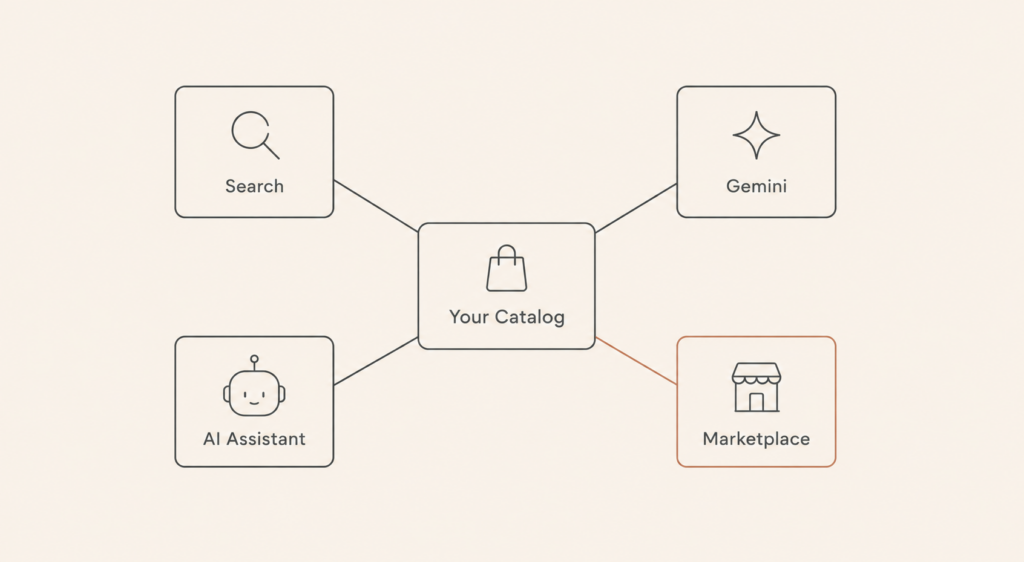
In 2026, Shopify pushed Plus stores toward agentic storefronts. Turn the setting on, and Shopify Catalog automatically structures, enriches, and syndicates your product data to every connected AI channel in real time. When a new AI platform adopts the Universal Commerce Protocol, your store shows up there with zero extra integration work.
Practical Plus plays I’d set up:
- Syndicate the catalog to agent channels through UCP so buyers can find you inside Gemini, Search, and other assistants.
- Wire B2B workflows, like wholesale reorders and net-terms checks, into agent tools backed by your ERP.
- Give support and ops teams an internal agent that reads across Shopify, the help desk, and shipping in one query.
The Catalog API now supports semantic search and vector embeddings, plus per-product inference attributes built for models to read. So when a shopper’s agent asks for something breathable for a humid climate, it can match on material and reviews, not just tags.
Performance Considerations
An agent that takes nine seconds to answer feels broken, even when it’s right. Speed is part of the product.
Where I focus:
- Cache read-heavy data. Product and collection lookups don’t need a live API hit every time. A short cache cuts latency and protects you from Shopify rate limits.
- Batch and paginate. Pull what the task needs in keyset pages instead of dragging the whole catalog into context.
- Keep tool responses lean. Return the fields the model actually uses. Huge JSON blobs slow inference and waste tokens.
- Respect rate limits. The Admin API has cost limits. Queue and retry with backoff instead of hammering it.
A good target: most tool calls answer in under a second so the full agent reply lands in two to three. Anything slower and users stop trusting it.
Common Implementation Mistakes
The same handful of mistakes show up again and again. Save yourself the rework.
- Over-scoping tokens. Handing every tool admin-wide access is the number one risk. Scope down.
- No audit log. If you can’t replay what an agent did, you can’t debug it or defend it. Log from day one.
- Exposing raw write actions with no guardrails. Let agents draft changes for human approval before anything touches a live order or price.
- Dumping entire records into the model. It’s slow, costly, and leaks data you didn’t mean to share.
- Skipping rate-limit handling. Works fine in testing, falls over on a busy day.
- Treating MCP as a replacement for your app. It’s a layer on top, not a rebuild.
The Future of Agentic Commerce
The direction is clear, and it moved fast in 2026.
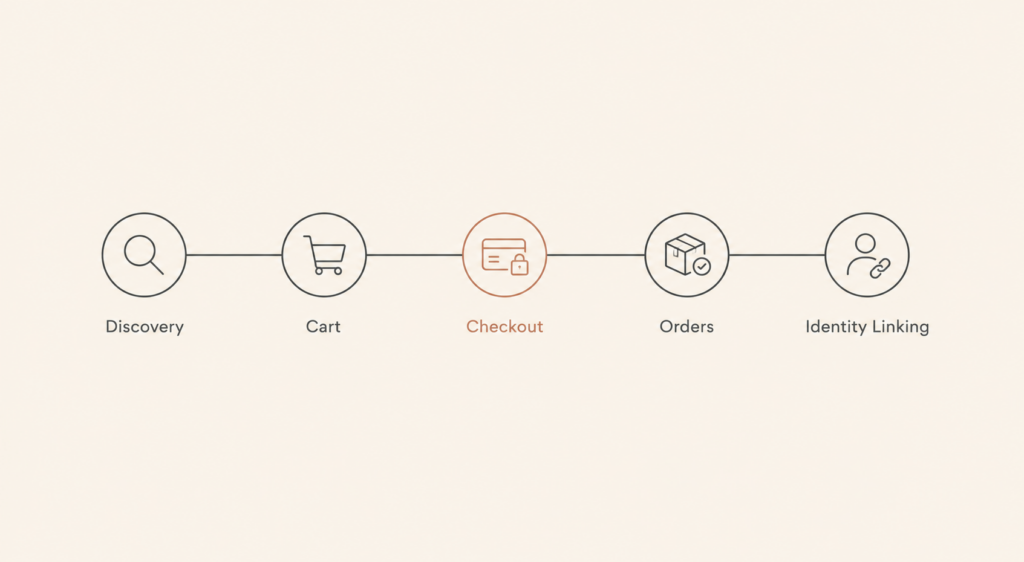
Shopify and Google launched the Universal Commerce Protocol at NRF in January. By Google I/O in May, Google’s Universal Cart let shoppers add items across Search, Gemini, YouTube, and Gmail and carry one persistent cart between them. The store stopped being the only place a sale happens.
Shopify now frames itself less as a storefront provider and more as infrastructure for the agentic web. An MCP server is the on-ramp. UCP is the highway.
My read: in the next year or two, “is your catalog agent-readable” becomes as basic a question as “is your site mobile-friendly” was a decade ago. The stores that wire this up early get discovered inside assistants while everyone else waits to be told they’re missing.
FAQ
Do I need to code an MCP server from scratch? Not always. If you run Hydrogen 2026.1.4 or later, your storefront already forwards to Shopify’s hosted Storefront MCP. Custom logic still needs your own server.
Is the Shopify AI Toolkit free? Yes. Shopify open-sourced it under the MIT license on April 9, 2026. It bundles the MCP server stack, agent skills, and a Claude Code plugin.
Will this replace my Shopify apps? No. Apps handle the user interface and platform extensions. MCP exposes your business logic to AI agents. They work side by side.
Is it safe to give an AI agent access to my store? It is, if you scope tokens tightly, gate write actions behind human approval, and log everything. The risk comes from skipping those steps, not from MCP itself.
Do I need Shopify Plus? No. Storefront and Customer Account MCP work on standard Shopify. Plus adds agentic storefronts and deeper UCP syndication.
Internal Link Recommendations
If you’re publishing this on the dev daily, link these in as you go:
- Anchor “Shopify Admin API” to your Shopify API integration guide.
- Anchor “Laravel” to your Laravel and Shopify backend post.
- Anchor “OAuth 2.0 authorization code grant with PKCE” to an auth deep-dive article.
- Anchor “Universal Commerce Protocol” to a dedicated UCP explainer (worth its own post).
- Anchor “agentic storefronts” to a Shopify Plus capabilities roundup.
- Add a closing CTA linking to your “work with me on Shopify and AI” services page.
The Takeaway
The model is already smart enough. What’s missing is a safe, fast connection to your store data, and that’s exactly what a Shopify MCP server gives you.
Start small. Expose two or three read-only tools, scope them tight, log every call, and let an agent answer real questions about your store. Once you trust it, add the write actions behind human approval.
Agentic commerce is no longer a maybe. The standards shipped in 2026. The earlier you make your catalog agent-readable, the more often you get found when the buying happens inside an assistant instead of on your homepage.
MCP is one way stores are getting wired into AI agents. I cover the others, including what is worth building now and what is still theatre, in AI in ecommerce.

1 comment
Great content! Keep up the good work!
Comments are reviewed before they appear, so yours will not show up straight away. Your email is never published.