
Key Takeaways
- Cloudflare launched cloudflare.pay and Cloudflare Wallets on August 4, 2026, giving AI agents a stable identity and the ability to pay for APIs and content on their own.
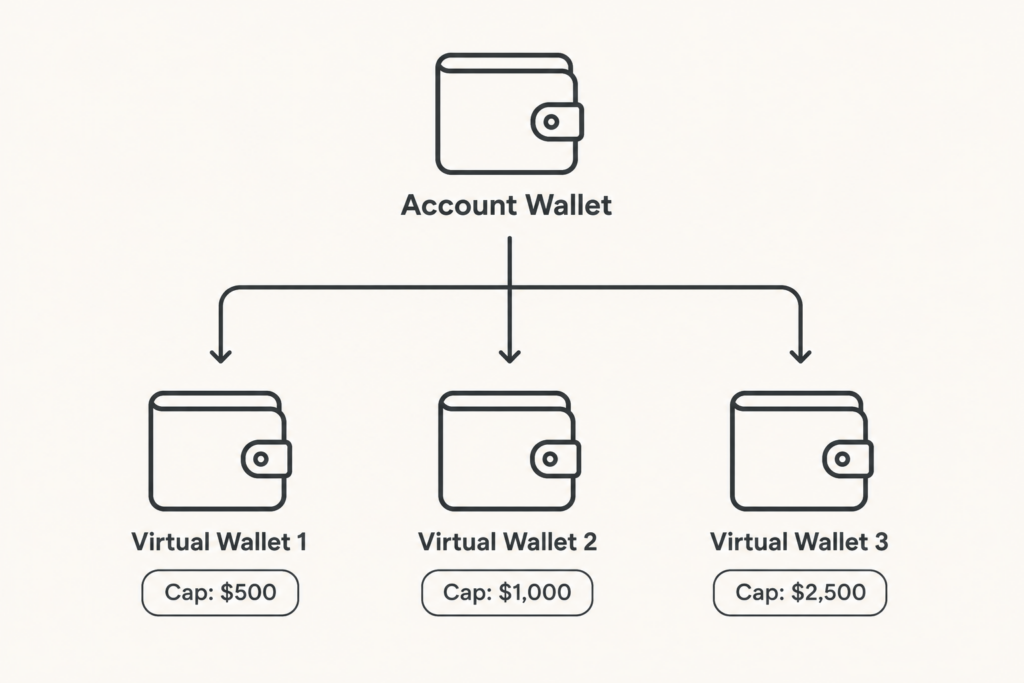
- The system splits into two tiers: Account Wallets that humans fund and control, and Virtual Wallets that agents spend from within hard caps you set.
- Payments run on x402, an open protocol that attaches stablecoin micropayments to standard HTTP requests, so agents pay per call instead of signing up for accounts.
- Guardrails are built in from day one: spending allowances, merchant allow lists, and maximum transaction sizes an agent cannot override on its own.
- Only handle reservation is live right now. Funding, withdrawals, and agent spending arrive in the coming months, but the identity namespace is first come, first served.
- Paired with Cloudflare’s Monetization Gateway, this creates a two-sided market where your site can charge agents per request instead of blocking them.
You’ve probably spent the last year figuring out how to block AI bots from your site.
Good. That was the right defensive move. Bots now drive a majority of web traffic according to Cloudflare Radar, and most of them were taking your content for free.
But here’s the harder question: what happens when those agents show up ready to pay?
That’s no longer hypothetical. On August 4, 2026, Cloudflare announced Cloudflare Wallets and cloudflare.pay, a system that gives AI agents a verifiable identity and a stablecoin wallet with human-set spending limits. This post breaks down how it works, what’s live today, and what it means for anyone who builds, sells, or buys on the web.

The Agent That Can’t Buy Anything
Picture an AI agent trying to use a paid API today.
It hits a signup page built for humans. It needs an email, a password, a credit card. It has none of these. So it stops, kicks the task back to you, and waits.
Cloudflare’s own announcement calls this out directly. Agents lack two things: a stable identifier to sign up with, and a native way to pay. Because of that, they give up on registration and payment entirely, which caps the growth of what Cloudflare calls agentic commerce.
Think about the cost of that friction. An agent that could compare 50 APIs in an afternoon instead tests one, the one you manually set up for it.
The agent isn’t dumb. The infrastructure is missing.
That’s the gap Cloudflare Pay fills.
Two Wallets, One Leash
The design is simple, and the simplicity is the point.
Account Wallets belong to humans. You fund them with stablecoins, set the rules, and can withdraw money anytime. This is the central balance tied to your Cloudflare account.
Virtual Wallets belong to agents. They operate via API keys and spend within limits you define. An agent with a Virtual Wallet can buy API calls, MCP tools, data, and content on its own, but only inside its cage.
The guardrails Cloudflare names are concrete:
- A spending allowance (the total budget)
- A merchant allow list (who the agent can pay)
- A maximum transaction size (the biggest single purchase allowed)
If an agent hits its cap, it has to ask a human for a manual override. Cloudflare gives a practical example: give every employee a $100 per week Virtual Wallet for AI inference, all funded from one Account Wallet.
Here’s the counterintuitive part. Cloudflare argues these limits create freedom, not restriction. An agent responsible for $10 can explore dozens of cheap services without supervision. An agent holding $1,000 needs a babysitter.
Small budgets buy big autonomy. That’s the design bet.
The Identity Problem Nobody Was Solving
Payments are only half the launch. The other half is cloudflare.pay itself, the identity layer.
Right now, when an agent visits your site, you know almost nothing about it. Is it acting for a Fortune 500 research team or a scraper farm? You can’t tell. And that breaks basic business models. You can give a human a free trial. You can’t give one to an anonymous agent when a single person can spin up dozens of them.
Cloudflare’s fix: every account gets a unique web address that works as a stable ID, and you can extend that identity to specific agents. A research agent could live at research.example.cloudflare.pay, so any merchant it contacts knows exactly which organization sent it.
Matthew Prince, Cloudflare’s CEO, framed it as giving agents “a face” so trust and real commerce can follow.
Two details matter here:
- Identity is optional. Agents choose whether to declare who they are. Merchants choose whether to treat identified agents better than anonymous ones. Cloudflare compares this to how sites treat VPN users: not untrustworthy, just required to prove more.
- It builds on existing standards. Web Bot Auth already lets agents register identity through a cryptographic keypair. The cloudflare.pay handle just makes that keypair human-readable, the same way DNS made IP addresses readable.
The takeaway: identity becomes a market signal, not a mandate.
The Rails Underneath: x402
None of this works without a payment protocol built for machines, and that protocol is x402.
x402 repurposes the HTTP 402 “Payment Required” status code so stablecoin micropayments attach directly to web requests. No account creation. No API key dance. An agent hits an endpoint, gets a price, pays, and receives the resource in one flow.
The backing here is serious. The x402 Foundation launched under the Linux Foundation in July 2026 with 40 members. Cloudflare and Stripe sit among 17 premier members alongside Visa, Mastercard, Google, AWS, and Circle. Cloudflare’s x402 documentation lists USDC as the settlement asset across chains including Base, Ethereum, Solana, and Polygon.
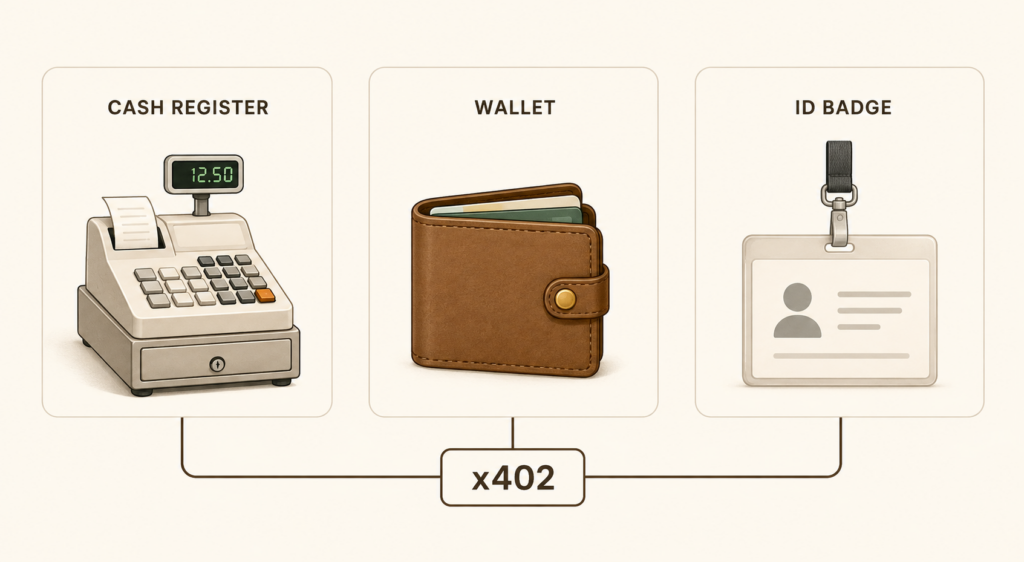
And this is where the two-sided market snaps together. Cloudflare’s Monetization Gateway, announced July 1, 2026, is the seller side: it lets sites and API owners charge agents per request. Cloudflare Wallets is the buyer side: the purse those agents pay from.
| Piece | Who it serves | What it does |
|---|---|---|
| Monetization Gateway | Sellers | Charges agents per HTTP request for content, APIs, MCP tools |
| Cloudflare Wallets | Buyers | Funds agents with capped stablecoin budgets |
| cloudflare.pay | Both | Gives agents a verifiable, human-readable identity |
Cash register, purse, and ID card. That’s the whole market.
What You Can Actually Do Today
Be clear-eyed about the rollout, because the headlines oversell it.
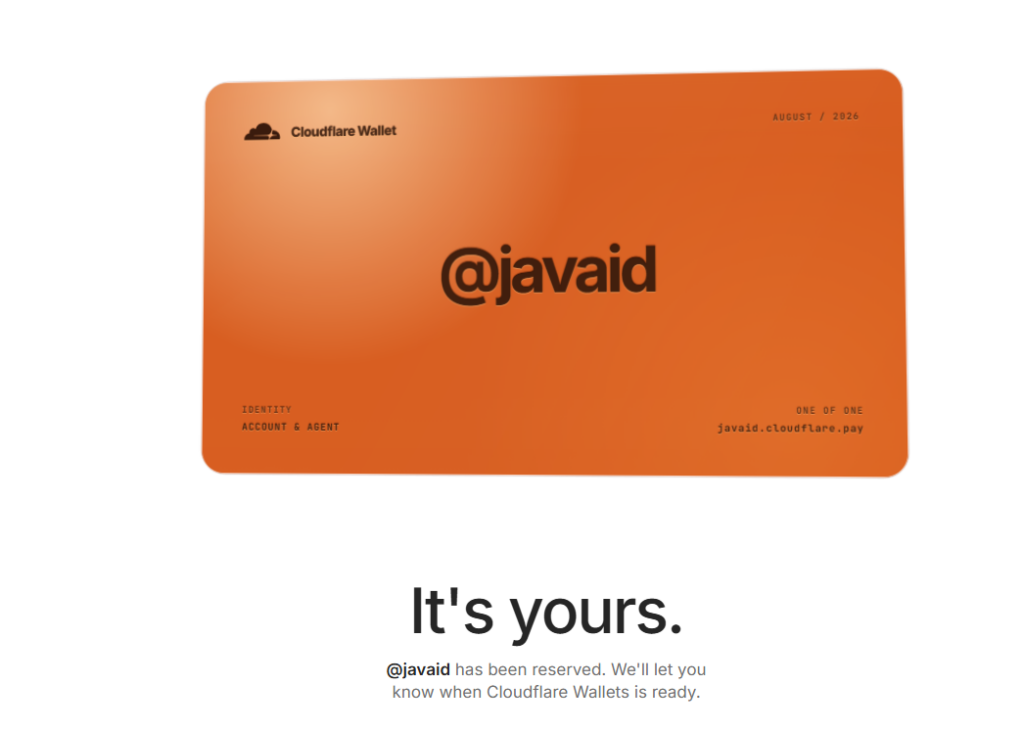
Live now: handle reservation only. Any Cloudflare account can claim a cloudflare.pay wallet handle, which locks in your name in the namespace.
Coming in the months ahead: funding wallets, onramping and offramping in supported regions, stablecoin self-funding for eligible users, issuing Virtual Wallets to agents, and actual payments. Cloudflare has published no exact date and named no launch merchants. The Monetization Gateway is also still in waitlist stage.
So the honest current state is this: you can claim an identity, not spend money.
That still matters. Handles work like usernames on any new platform. Early X users got @javaid. Late users got @javaid_123. If your brand or agency name has value, the reservation costs you five minutes.
Claim the name now. Judge the payments later.
Why This Matters Now
The timing here isn’t random. Look at the sequence Cloudflare has run:
- July 2025: Pay Per Crawl launches, charging AI crawlers for access.
- September 2025: Cloudflare co-announces the x402 Foundation with Coinbase.
- April 2026: The Linux Foundation agrees to host x402, with 22 organizations signaling support.
- July 1, 2026: Monetization Gateway announced, giving sellers a cash register for agent traffic.
- July 14, 2026: The x402 Foundation launches operationally with 40 members.
- August 4, 2026: Cloudflare Wallets and cloudflare.pay complete the buyer side.
That’s a 13-month build toward one thing: replacing the “block all bots” web with a “charge the bots” web.
And Cloudflare isn’t alone. Mastercard has announced a machine-payments program with comparable spending controls, which tells you identity, limits, and settlement for agents is now a competitive infrastructure race, not one company’s experiment.
Cloudflare’s chief strategy officer Stephanie Cohen put the stakes plainly in an interview with Fortune: the internet needs a different business model.
For anyone running an ecommerce store, a content site, or an API, the window to think through your agent strategy is open right now, while everything is still in preview and the norms haven’t hardened.
FAQs
What is Cloudflare Pay?
cloudflare.pay is the identity and handle system Cloudflare launched on August 4, 2026, alongside Cloudflare Wallets. It gives each Cloudflare account a unique web address that acts as a stable ID, which can extend to individual AI agents so merchants know who authorized a request.
Can I use Cloudflare Wallets to make payments right now?
No. Only handle reservation is live today. Funding, withdrawals, Virtual Wallet issuance for agents, and actual payments arrive in the coming months, and Cloudflare has not published an exact date.
How do the spending limits work?
You fund a human-controlled Account Wallet with stablecoins, then issue Virtual Wallets to agents with three guardrails: a total allowance, an approved merchant list, and a maximum single transaction size. An agent that hits a limit must request a human override.
What is x402?
x402 is an open protocol, developed by Coinbase and now governed under the Linux Foundation, that attaches stablecoin micropayments to standard HTTP requests using the 402 status code. It lets agents pay per API call or per piece of content without creating accounts, with USDC as the settlement asset.
The Question Worth Asking
For two years, the question every site owner asked was “how do I stop AI agents?”
Cloudflare just made that the wrong question.
The infrastructure now exists, or will within months, for agents to identify themselves and pay for what they consume, in amounts you cap and to merchants you approve. Blocking stays an option. But so does pricing.
Stop asking how to keep agents out. Start asking what you’d charge them to come in.
If you run a store or an API, claim your cloudflare.pay handle this week and get on the Monetization Gateway waitlist. The namespace won’t wait for you.

Comments are reviewed before they appear, so yours will not show up straight away. Your email is never published.